

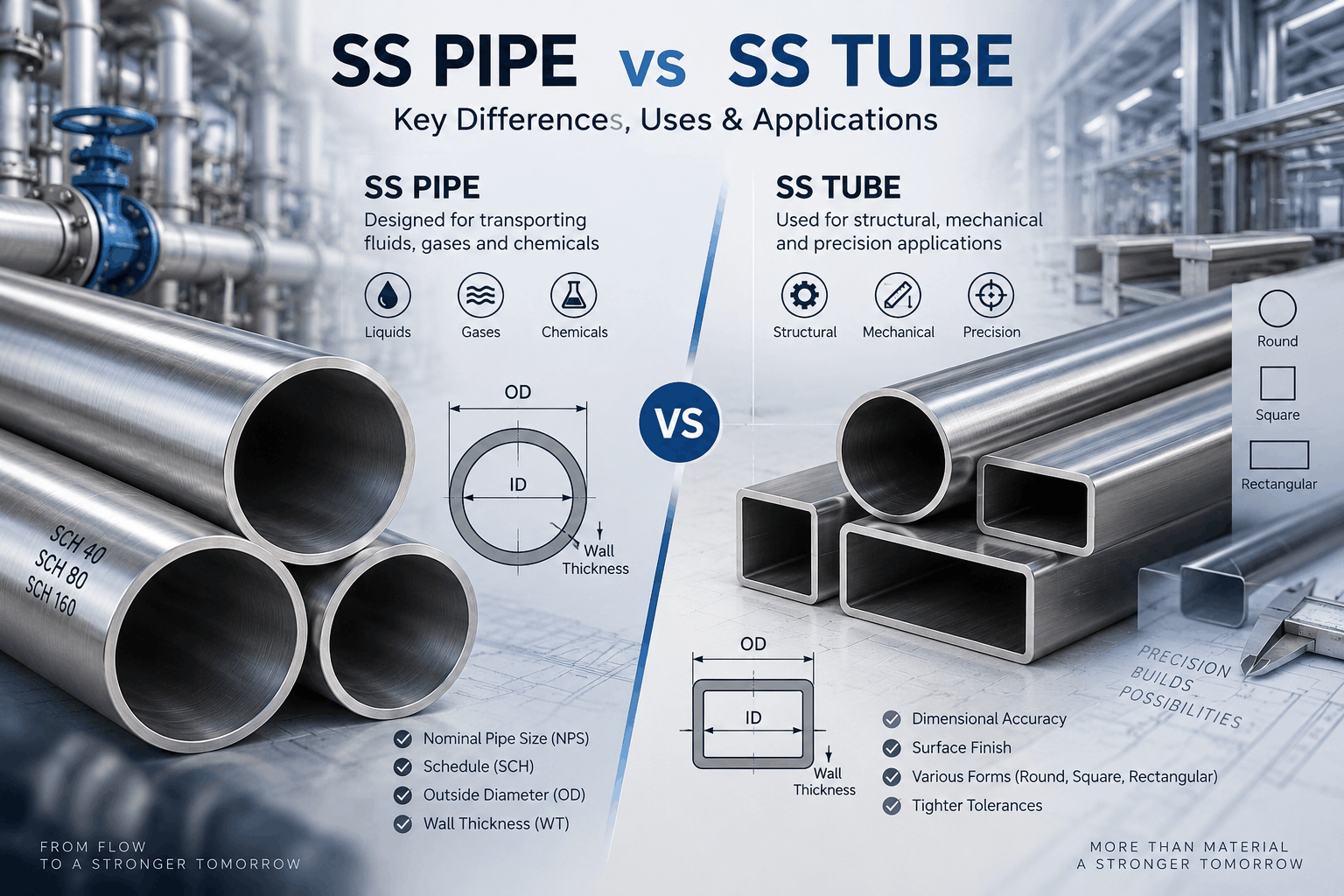
SS Pipe vs SS Tube Understanding the Key Differences
Stainless steel products are widely used in industries because of their excellent corrosion resistance, strength, and long service life. Among the most commonly used stainless steel products, SS pipes and SS tubes are often considered the same. However, both products have different characteristics, manufacturing methods, and applications.
Many people get confused when choosing between a stainless steel pipe and a stainless steel tube because both look similar and are made from the same material. The main difference depends on their purpose, dimensions, tolerance, and application requirements.
In this blog, we will explain the difference between SS pipe vs SS tube, their uses, advantages, and how to select the right option for your industrial needs.
What is an SS Pipe?
An SS pipe or stainless steel pipe is a hollow cylindrical product mainly used for transporting fluids, gases, and chemicals from one place to another. Stainless steel pipes are designed to handle high pressure, temperature changes, and harsh environments.
SS pipes are generally identified by their inside diameter (ID), outside diameter (OD), and wall thickness. The pressure handling capacity of a stainless steel pipe depends mainly on its wall thickness.
Stainless steel pipes are available in different grades, such as:
- SS 304 Pipe
- SS 316 Pipe
- SS 321 Pipe
- SS 904L Pipe
- Duplex Stainless Steel Pipe
These pipes are commonly used in industries where corrosion resistance and durability are important.
Common Applications of SS Pipes
Stainless steel pipes are widely used in:
- Oil and gas industries
- Chemical processing plants
- Pharmaceutical industries
- Food and beverage industries
- Power generation plants
- Water treatment systems
- Petrochemical industries
SS pipes are preferred for fluid transportation because they provide excellent strength and resistance against corrosion.
What is an SS Tube?
An SS tube or stainless steel tube is also a hollow stainless steel product, but it is mainly used for structural, mechanical, and precision applications.
Unlike pipes, stainless steel tubes are manufactured with stricter dimensional accuracy and better surface finishing. Tubes can be round, square, or rectangular depending on the application.
SS tubes are measured using:
- Outside diameter
- Wall thickness
- Length
- Shape and dimensional tolerance
Stainless steel tubes are available in different forms, including:
- Stainless steel round tubes
- Stainless steel square tubes
- Stainless steel rectangular tubes
Common Applications of SS Tubes
Stainless steel tubes are commonly used in:
- Heat exchangers
- Automotive components
- Furniture manufacturing
- Architectural structures
- Hydraulic systems
- Mechanical equipment
- Instrumentation systems
SS tubes are selected where accuracy, appearance, and structural strength are important.
Difference Between SS Pipe and SS Tube
Although SS pipes and SS tubes may look similar, several factors make them different.
1. Difference in Purpose
The biggest difference between stainless steel pipes and tubes is their application.
SS pipes are mainly used for transportation of liquids and gases. They are designed to handle pressure and flow requirements.
SS tubes are mainly used for structural and mechanical purposes. They provide strength, precision, and better dimensional accuracy.
For example, a chemical plant may use SS pipes for transferring chemicals, while a manufacturing machine may use SS tubes for mechanical support.
2. Difference in Measurement System
SS pipes and SS tubes are measured differently.
Stainless Steel Pipe Measurement
Pipes are generally measured using:
- Nominal Pipe Size (NPS)
- Schedule number
- Outside diameter
- Wall thickness
The schedule number indicates the thickness of the pipe wall. Common schedules include:
- SCH 10
- SCH 40
- SCH 80
- SCH 160
A higher schedule number means a thicker pipe wall.
Stainless Steel Tube Measurement
Tubes are measured using:
- Outside diameter
- Inside diameter
- Wall thickness
- Dimensional tolerance
Tubes require more precise measurements because they are often used in applications where accuracy is critical.
3. Difference in Shape
Another major difference is the available shapes.
SS pipes are mostly available in:
- Round shape
SS tubes are available in:
- Round shape
- Square shape
- Rectangular shape
Square and rectangular stainless steel tubes are commonly used in construction, fabrication, and architectural projects.
4. Difference in Manufacturing Process
Both stainless steel pipes and tubes can be manufactured using seamless and welded processes.
Seamless SS Pipe and Tube
Seamless products are manufactured from a solid stainless steel billet. The billet is heated and pierced to create a hollow section.
Advantages:
- Higher pressure resistance
- Better strength
- Suitable for critical applications
Welded SS Pipe and Tube
Welded products are manufactured by rolling stainless steel sheets or strips and welding the joint.
Advantages:
- Cost-effective
- Available in large sizes
- Suitable for general applications
The manufacturing process depends on the required strength, size, and application.
5. Difference in Tolerance and Accuracy
Stainless steel tubes usually have tighter dimensional tolerances compared to pipes.
This makes tubes suitable for:
- Precision engineering
- Heat exchangers
- Automotive applications
- Instrumentation systems
Pipes generally focus more on pressure handling capability rather than exact dimensions.
6. Difference in Surface Finish
SS tubes usually require a better surface finish because they are often visible in applications such as:
- Handrails
- Furniture
- Decorative structures
SS pipes generally focus on performance rather than appearance because they are mostly installed inside industrial systems.
However, both pipes and tubes can be supplied with different surface finishes depending on customer requirements.
SS Pipe vs SS Tube: Comparison Table
| Feature | SS Pipe | SS Tube |
|---|---|---|
| Main Purpose | Fluid and gas transportation | Structural and mechanical applications |
| Measurement | Nominal size and schedule | Outside diameter and thickness |
| Shape | Mainly round | Round, square, rectangular |
| Accuracy | Standard tolerance | Higher dimensional accuracy |
| Pressure Handling | Designed for pressure applications | Depends on design and usage |
| Surface Finish | Functional finish | Better aesthetic finish |
| Applications | Oil, chemical, water systems | Automotive, construction, machinery |
Advantages of Stainless Steel Pipes
Stainless steel pipes offer several benefits:
Excellent Corrosion Resistance
Stainless steel contains chromium, which creates a protective layer on the surface. This helps prevent rust and corrosion.
High Strength
SS pipes can withstand high pressure and extreme temperatures, making them suitable for demanding industries.
Long Service Life
Stainless steel pipes require less maintenance and provide long-term performance.
Hygienic Properties
Because stainless steel has a smooth surface, it is widely used in food, beverage, and pharmaceutical industries.
Advantages of Stainless Steel Tubes
Stainless steel tubes also provide many benefits:
High Dimensional Accuracy
SS tubes are manufactured with precise measurements, making them suitable for engineering applications.
Better Appearance
Their smooth finish makes them suitable for decorative and architectural purposes.
Lightweight Strength
Stainless steel tubes provide good strength while maintaining lower weight compared to some other materials.
Versatile Designs
The availability of round, square, and rectangular shapes makes tubes useful for various applications.
How to Choose Between SS Pipe and SS Tube?
Selecting the correct product depends on your application requirements.
Choose an SS pipe when:
- You need to transport liquids or gases
- Pressure resistance is important
- The application involves chemical or industrial processes
Choose an SS tube when:
- Structural support is required
- Dimensional accuracy is important
- The product will be used in mechanical or fabrication work
Before selecting the product, consider:
- Operating pressure
- Temperature conditions
- Material grade
- Required dimensions
- Industry standards
Popular Stainless Steel Grades Used for Pipes and Tubes
Different industries use different stainless steel grades depending on their requirements.
SS 304
SS 304 is one of the most commonly used stainless steel grades. It offers good corrosion resistance and is suitable for general industrial applications.
SS 316
SS 316 provides better corrosion resistance compared to SS 304 because of the addition of molybdenum. It is commonly used in marine, chemical, and pharmaceutical applications.
Duplex Stainless Steel
Duplex stainless steel provides high strength and excellent resistance against corrosion. It is used in demanding applications such as oil and gas industries.
Frequently Asked Questions About SS Pipe vs SS Tube
Are SS pipes and SS tubes the same?
No, SS pipes and SS tubes are different products. Pipes are mainly used for fluid transportation, while tubes are commonly used for structural and mechanical applications.
Which is stronger, SS pipe or SS tube?
The strength depends on the grade, thickness, and manufacturing method. Both can provide high strength when selected according to the application requirements.
Can SS tubes be used for liquid transportation?
Yes, stainless steel tubes can carry liquids in some applications, but pipes are generally preferred for systems designed specifically for fluid flow and pressure handling.
Which is more expensive, SS pipe or SS tube?
The cost depends on size, grade, manufacturing process, and specifications. SS tubes may cost more when higher accuracy and finishing are required.
Which stainless steel grade is best for pipes and tubes?
The suitable grade depends on the application. SS 304 is widely used for general purposes, while SS 316 is preferred for applications requiring higher corrosion resistance.