

When selecting stainless steel products for industrial applications, choosing the correct material is only one part of the process. The product form also matters. Engineers and procurement teams often need to decide whether their project requires 254 SMO tubes or 254 SMO pipes.
Both products are manufactured from the same high-alloy austenitic stainless steel grade, known as UNS S31254. They offer excellent resistance to pitting corrosion, crevice corrosion and chloride-related corrosion. This makes them suitable for demanding environments such as seawater systems, chemical processing plants, desalination facilities and offshore installations.
However, pipes and tubes are not exactly the same. Their dimensional conventions, manufacturing requirements, standards and typical applications can differ.
So, what is the actual difference between 254 SMO tubes and 254 SMO pipes? Which one should you choose for your industrial project?
Let’s understand their properties, specifications, applications and selection factors in detail.
What Is 254 SMO Stainless Steel?
254 SMO is a high-alloy austenitic stainless steel developed for applications exposed to seawater and aggressive chloride-containing environments.
It is also known as UNS S31254, EN 1.4547 and 6Mo stainless steel. The material contains high levels of chromium, nickel and molybdenum, along with nitrogen and copper.
Its chemical composition gives it excellent resistance to several forms of corrosion, particularly pitting and crevice corrosion.
The presence of approximately 6% molybdenum and controlled nitrogen content improves its resistance in chloride-rich environments. It also provides higher strength than conventional austenitic stainless steel grades such as 304 and 316L.
254 SMO is commonly used in:
- Seawater handling systems
- Desalination plants
- Chemical processing equipment
- Marine and offshore installations
- Heat exchangers
- Pulp and paper processing plants
- Oil and gas production facilities
- Flue gas cleaning systems
Because of its corrosion resistance and mechanical properties, 254 SMO is considered for industrial applications where standard stainless steel grades may not provide sufficient performance.
What Are 254 SMO Pipes?
254 SMO pipes are hollow stainless steel products primarily used to transport liquids, gases, chemicals and other process fluids from one location to another.
They are manufactured using seamless or welded production methods, depending on the required size, specification and application.
The most common specification for pressure piping is ASTM A312, which covers seamless, welded and heavily cold-worked austenitic stainless steel pipes.
254 SMO pipes are generally specified using nominal pipe size (NPS) and schedule numbers. The schedule identifies the wall thickness for a particular nominal pipe size.
For example, an engineer may specify a 254 SMO pipe by its NPS, schedule, material grade and required length.
These pipes are used in industrial piping networks where resistance to aggressive chemicals, seawater and chloride-containing fluids is important.
For industrial requirements, explore 254 SMO Pipes from Leoscor Alloy Pipes.
What Are 254 SMO Tubes?
254 SMO tubes are hollow stainless steel products used in applications where accurate dimensions, controlled wall thickness and reliable material performance are important.
Unlike pipes, tubes are generally specified by their actual outside diameter and wall thickness. Their dimensions are commonly expressed in millimetres or inches.
254 SMO tubes are used in heat exchangers, instrumentation systems, hydraulic lines, cooling equipment and specialised process applications.
Depending on the application, tubes can be supplied in seamless or welded construction.
ASTM A269 is one of the relevant specifications for seamless and welded austenitic stainless steel tubing intended for general corrosion-resistant service. ASTM A213 is also relevant for seamless ferritic and austenitic alloy-steel boiler, superheater and heat-exchanger tubes.
The correct specification depends on the intended service and product requirements.
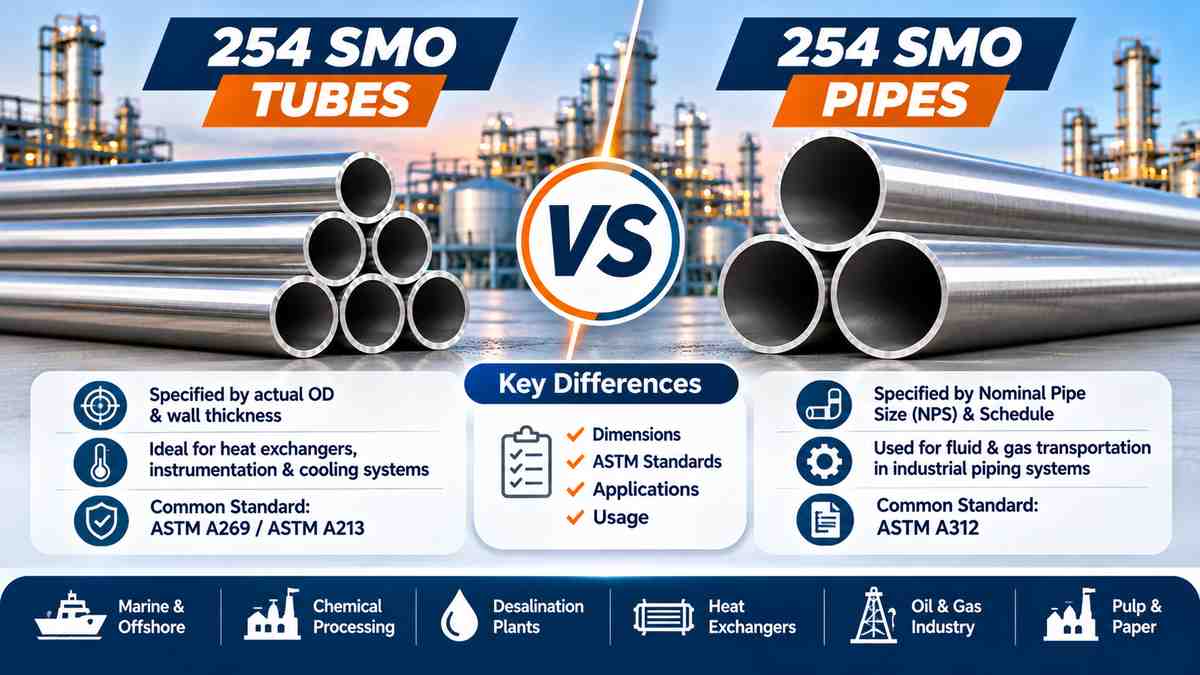
254 SMO Tubes vs 254 SMO Pipes: Key Differences
The most important point to understand is that 254 SMO tubes and pipes use the same alloy grade. Their primary differences are related to product dimensions, specifications and intended applications.
Here is a quick comparison:
| Comparison Parameter | 254 SMO Pipes | 254 SMO Tubes |
|---|---|---|
| Material Grade | UNS S31254 | UNS S31254 |
| Material Type | Austenitic stainless steel | Austenitic stainless steel |
| Common Specification | ASTM A312 | ASTM A269 / ASTM A213, depending on service |
| Dimensional Measurement | Nominal Pipe Size (NPS) and schedule | Actual outside diameter and wall thickness |
| Wall Thickness | Commonly defined by schedule | Specified directly |
| Main Purpose | Fluid and gas transportation | Heat transfer, instrumentation and specialised fluid handling |
| Common Applications | Industrial piping, seawater lines and chemical pipelines | Heat exchangers, cooling systems and instrumentation |
| Manufacturing | Seamless and welded | Seamless and welded |
| Corrosion Resistance | Depends on UNS S31254 material quality | Depends on UNS S31254 material quality |
Important: Both products can offer the same basic alloy corrosion resistance when manufactured from compliant material. The choice should be based on the required dimensions, product specification, design conditions and application.
1. Chemical Composition of 254 SMO Tubes and Pipes
There is no fundamental difference in the alloy chemistry simply because one product is called a pipe and the other a tube.
Both are made from 254 SMO stainless steel and are identified by UNS S31254.
The typical chemical composition includes:
| Element | Composition (%) |
|---|---|
| Carbon (C) | 0.020 max |
| Chromium (Cr) | 19.5–20.5 |
| Nickel (Ni) | 17.5–18.5 |
| Molybdenum (Mo) | 6.0–6.5 |
| Nitrogen (N) | 0.18–0.22 |
| Copper (Cu) | 0.50–1.00 |
| Manganese (Mn) | 1.00 max |
| Silicon (Si) | 0.80 max |
| Phosphorus (P) | 0.030 max |
| Sulphur (S) | 0.010 max |
The high chromium and molybdenum content improves corrosion resistance, while nitrogen contributes to strength and pitting resistance.
The actual chemical composition must be verified against the applicable product specification and material test certificate.
2. Corrosion Resistance and Performance
Corrosion resistance is one of the main reasons industries select 254 SMO instead of conventional stainless steel grades.
Both 254 SMO pipes and tubes can provide excellent resistance to:
- Pitting corrosion
- Crevice corrosion
- Chloride-induced stress corrosion cracking
- General corrosion in several aggressive environments
The high molybdenum and nitrogen content makes this grade particularly useful in chloride-rich environments.
254 SMO Pipes
Pipes are commonly used in seawater transportation, offshore piping networks, desalination plants and chemical process lines. Their corrosion resistance helps support reliable fluid transportation in demanding environments.
254 SMO Tubes
Tubes are used in heat exchangers, cooling systems, instrumentation lines and other applications where the material may come into contact with corrosive fluids.
The actual corrosion performance depends on temperature, chloride concentration, flow velocity, deposits, crevice conditions and fabrication quality. Neither pipes nor tubes should be considered automatically suitable for every chemical environment.
3. Dimensional Differences Between 254 SMO Tubes and Pipes
One of the most practical differences is how their dimensions are specified.
Pipe dimensions
254 SMO pipes are commonly ordered using:
- Nominal Pipe Size (NPS)
- Schedule number
- Outside diameter
- Wall thickness
- Pipe length
- End preparation
For example, a purchase order may specify an ASTM A312 UNS S31254 pipe with a particular NPS and schedule.
The nominal pipe size is not always equal to the actual outside diameter.
Tube dimensions
254 SMO tubes are generally specified using:
- Actual outside diameter
- Wall thickness
- Inside diameter, where required
- Length
- Dimensional tolerance
- Surface finish
For example, a tube may be ordered with a specified outside diameter and wall thickness in millimetres.
This dimensional approach is particularly useful in heat exchangers and instrumentation applications where accurate fitting and controlled dimensions are important.
4. Manufacturing Process: Seamless vs Welded
Both 254 SMO pipes and tubes can be manufactured through seamless or welded production routes, depending on the required product specification.
Seamless 254 SMO Pipes and Tubes
Seamless products are manufactured without a longitudinal weld seam. They are produced through processes involving billet preparation, piercing, hot working and further sizing or cold finishing.
They are commonly selected where the project specification requires seamless construction and specific dimensional or pressure requirements.
Welded 254 SMO Pipes and Tubes
Welded products are manufactured by forming stainless steel strip or plate into a tubular shape and joining the edges through a controlled welding process.
They can be suitable for different industrial requirements, including larger dimensions and applications where the specified welded product standard permits their use.
The selection between seamless and welded products should depend on the design code, operating pressure, dimensions, inspection requirements and project specification. Seamless construction is not automatically superior for every application.
5. Industrial Applications of 254 SMO Pipes
254 SMO pipes are widely used in industrial piping networks where corrosion resistance and mechanical strength are essential.
Some common applications include:
Seawater Handling Systems: Used in selected seawater cooling lines, firefighting systems and ballast water installations.
Desalination Plants: Used in suitable piping systems that handle saline water and concentrated brine.
Chemical Processing Plants: Applied in process lines exposed to aggressive chemicals and chloride-containing fluids.
Oil and Gas Industry: Used in selected offshore and onshore piping applications where the material meets the project requirements.
Pulp and Paper Industry: Used in equipment and piping exposed to corrosive bleaching chemicals.
Power Generation: Applied in selected cooling water and industrial process systems.
6. Industrial Applications of 254 SMO Tubes
254 SMO tubes are selected for applications where controlled dimensions and corrosion resistance are important.
Typical applications include:
Heat Exchangers: Used in selected heat exchanger systems where tubes come into contact with seawater or corrosive process fluids.
Cooling Systems: Applied in industrial cooling equipment and specialised water-handling systems.
Hydraulic and Instrumentation Tubing: Used where the required pressure rating, dimensions and material specification are satisfied.
Chemical Processing Equipment: Suitable for selected tubing systems exposed to aggressive chloride-containing environments.
Desalination Equipment: Used in selected heat transfer and fluid-handling components.
Marine Equipment: Applied in specialised systems where seawater corrosion resistance is important.
7. Which Is Better: 254 SMO Tube or 254 SMO Pipe?
There is no universal winner because both products are manufactured from the same material grade.
The right choice depends on the purpose of the installation.
Choose 254 SMO pipes when:
- You need to transport liquids, gases or process fluids.
- The project involves industrial piping networks.
- The system requires nominal pipe sizing and schedule-based wall thickness.
- You need a product specified to ASTM A312 for pressure piping.
- The application involves seawater, chemical processing or offshore fluid transportation.
Choose 254 SMO tubes when:
- The application requires accurate outside diameter and wall thickness.
- The project involves heat exchangers or cooling equipment.
- Instrumentation or hydraulic tubing is required.
- The purchase specification calls for ASTM A269 or ASTM A213, depending on the service.
- Dimensional tolerances and tube-specific requirements are important.
Before placing an order, engineers should confirm the material grade, product form, dimensions, pressure and temperature requirements, and applicable design code.
8. ASTM Standards for 254 SMO Tubes and Pipes
ASTM specifications define the requirements for material composition, manufacturing, mechanical properties, dimensions and testing.
Some relevant specifications for 254 SMO include:
| ASTM Standard | Product Type | Application / Scope |
|---|---|---|
| ASTM A312 | Seamless and welded pipe | Austenitic stainless steel pressure piping |
| ASTM A269 | Seamless and welded tubing | General corrosion-resistant service |
| ASTM A213 | Seamless tubing | Boiler, superheater and heat exchanger applications |
| ASTM A358 | Electric-fusion-welded pipe | Austenitic stainless steel pipe for higher-temperature and general corrosive service |
The correct standard must be selected according to the product form and application. Not every standard applies to every manufacturing method or service condition.
For 254 SMO pipes, ASTM A312 UNS S31254 is commonly specified for pressure piping requirements. For tubing, ASTM A269 and ASTM A213 are relevant depending on the intended service.
Buyers should confirm the applicable standard and grade on the purchase order and Material Test Certificate.
9. Factors to Consider Before Buying 254 SMO Pipes or Tubes
Selecting the right product requires a clear understanding of the project requirements.
Consider these factors before purchasing:
1. Material Grade: Confirm that the required material is UNS S31254 and that the supplied material meets the specified chemical composition.
2. Product Form: Decide whether your application requires a pipe or tube. Check the applicable product specification.
3. Dimensions: Verify the outside diameter, wall thickness, schedule, length and dimensional tolerances.
4. Operating Conditions: Review the working pressure, temperature and process fluid.
5. Corrosion Exposure: Check chloride concentration, chemical composition, flow conditions and potential crevice formation.
6. Manufacturing Method: Confirm whether seamless or welded construction is permitted by the project specification.
7. Testing and Certification: Ask for the required chemical analysis, mechanical testing, inspection documents and Material Test Certificate.
8. Supplier Experience: Work with a supplier who understands the technical requirements of stainless steel piping and tubing products.
These checks help avoid material mismatches and support reliable performance during operation.
Frequently Asked Questions
1. What is the main difference between 254 SMO tubes and 254 SMO pipes?
The main difference is their dimensional conventions and typical applications. Pipes are generally specified by nominal pipe size and schedule, while tubes are specified by actual outside diameter and wall thickness. Both can be manufactured from UNS S31254 and provide similar alloy-level corrosion resistance when they meet the required product specification.
2. Are 254 SMO pipes and tubes made from the same material?
Yes. Both products can be manufactured using 254 SMO stainless steel, identified by UNS S31254. The material contains high levels of chromium, nickel and molybdenum, along with nitrogen and copper. The chemical composition requirements depend on the applicable product standard and should be verified through the material test certificate.
3. Which ASTM standard is used for 254 SMO pipes?
ASTM A312 is a commonly used specification for seamless and welded austenitic stainless steel pressure pipes, including applicable UNS S31254 products. The exact requirements should be confirmed according to the project specification, manufacturing method, dimensions and intended service.
4. Which ASTM standard is used for 254 SMO tubes?
ASTM A269 is relevant for seamless and welded austenitic stainless steel tubing used in general corrosion-resistant service. ASTM A213 is also relevant for seamless tubes used in boiler, superheater and heat exchanger applications. The correct specification depends on the intended use and purchase requirements.
5. Is 254 SMO suitable for seawater applications?
Yes. 254 SMO is designed for seawater and other aggressive chloride-containing environments. Its high chromium, molybdenum and nitrogen content provides excellent resistance to pitting and crevice corrosion. It is used in selected seawater cooling systems, desalination equipment, marine installations and offshore applications.
6. What is the UNS number of 254 SMO stainless steel?
The UNS designation of 254 SMO is S31254. It is also known as EN 1.4547 and 6Mo stainless steel. Buyers should use the correct grade designation when requesting quotations, checking material certificates and preparing technical purchase orders.
7. Can 254 SMO pipes and tubes be supplied in seamless and welded forms?
Yes. Both pipes and tubes can be manufactured in seamless or welded forms, depending on the applicable product standard and available manufacturing route. The buyer should confirm the required manufacturing method, dimensions, inspection criteria and design requirements before placing an order.
8. Is 254 SMO better than 316L stainless steel?
254 SMO generally provides significantly better resistance to pitting and crevice corrosion in aggressive chloride environments because it contains considerably more molybdenum and nitrogen than 316L. However, it is also a higher-alloy and typically more expensive material. The correct choice depends on corrosion conditions, design requirements and overall project economics.
Conclusion
254 SMO tubes and 254 SMO pipes are both important products for industrial applications requiring high corrosion resistance and reliable mechanical performance.
The main difference is not the alloy itself but the way the products are dimensioned, specified and used. Pipes are generally selected for fluid transportation and industrial piping networks, while tubes are commonly used in heat exchangers, instrumentation systems and applications requiring controlled dimensions.
Both products can provide excellent resistance to chloride-related corrosion when manufactured and tested according to the applicable standards.
Before selecting a product, check the required dimensions, manufacturing method, ASTM specification, operating conditions and certification requirements.
At Leoscor Alloy Pipes, customers can explore 254 SMO stainless steel pipes for demanding industrial applications. The right product specification is an important step towards reliable piping performance.
Looking for 254 SMO Pipes for Your Industrial Project?
Connect with Leoscor Alloy Pipes to discuss your required material grade, dimensions, specifications and quantity.
Explore our product range:
254 SMO Pipes Supplier and Exporter – Leoscor Alloy Pipes
Contact Leoscor Alloy Pipes today for product enquiries and technical assistance.