

310 Stainless Steel Pipe vs 304 Stainless Steel Pipe: Key Differences, Properties and Uses
When selecting stainless steel pipes for an industrial project, the operating temperature is one of the first things to consider. A pipe used in a water distribution system may face very different conditions from a pipe installed in a furnace, heat-treatment unit or high-temperature processing plant.
This is where the difference between SS 310 and SS 304 becomes important.
Both grades belong to the austenitic stainless steel family, but their chemical compositions and intended applications are different. SS 304 is widely used for general industrial piping, food processing, fabrication and applications that require good corrosion resistance. SS 310, on the other hand, is designed for demanding heat-related applications where resistance to oxidation at elevated temperatures is important.
So, which grade should you choose? Is SS 310 always better than SS 304? And when does the additional material cost make sense?
The answer depends on the service conditions, temperature, mechanical loading, surrounding atmosphere and required material specification.
In this guide, we compare 310 stainless steel pipe vs 304 stainless steel pipe to help engineers, procurement managers and industrial buyers understand their properties, applications and selection criteria.
What Is SS 304 Stainless Steel Pipe?
SS 304 is one of the most widely used austenitic stainless steel grades. It contains chromium and nickel, which help provide corrosion resistance, toughness and good fabrication properties.
It is commonly identified by the UNS designation S30400 and is often called 18/8 stainless steel because its typical composition contains approximately 18% chromium and 8% nickel.
SS 304 is suitable for a broad range of industrial and commercial applications where general corrosion resistance is required. It can be welded, formed and fabricated using appropriate procedures.
Key Properties of SS 304 Pipes
- General corrosion resistance: Suitable for many atmospheric and industrial environments.
- Good fabrication properties: Can be formed and welded using suitable methods.
- Versatility: Widely used across different industrial sectors.
- Surface finish options: Available in different finishes depending on manufacturing and application requirements.
- Cost effectiveness: Often more economical than highly alloyed heat-resistant stainless steel grades.
Common Applications of SS 304 Pipes
SS 304 pipes are commonly used in food and beverage processing, water handling systems, general industrial piping, architectural fabrication, machinery and chemical processing applications where the grade is compatible with the process conditions.
However, SS 304 is not suitable for every corrosive environment or high-temperature application. Chloride exposure, elevated temperatures and long-term mechanical loading must be evaluated before selecting the material.
Explore the SS 304 Stainless Steel Pipes range from Leoscor Alloy Pipes for product details and available configurations.
What Is SS 310 Stainless Steel Pipe?
SS 310 is a high-chromium, high-nickel austenitic stainless steel grade developed for heat-resistant applications. It typically contains approximately 24–26% chromium and 19–22% nickel.
The higher chromium content supports oxidation resistance at elevated temperatures, while nickel helps maintain the austenitic structure and contributes to high-temperature performance.
SS 310 is commonly identified by UNS S31000. A related grade, SS 310S, is the low-carbon version, identified by UNS S31008.
The difference between these grades matters. Standard SS 310 permits a higher maximum carbon content than SS 310S, while 310S has a maximum carbon content of 0.08% under common specifications. The lower carbon content of 310S can help reduce carbide precipitation during welding.
For many industrial pipe applications, SS 310S is commonly specified where heat resistance and welding requirements must be considered together.
Key Properties of SS 310 Pipes
- High-temperature oxidation resistance: Suitable for selected applications exposed to elevated temperatures.
- High chromium and nickel content: Supports heat-resistant performance.
- Resistance to scaling: Helps protect against oxide formation under suitable high-temperature conditions.
- Thermal stability: Used in selected furnace and heat-treatment applications.
- Fabrication capability: Can be welded and fabricated using appropriate procedures.
The actual operating limit depends on temperature, atmosphere, exposure duration, mechanical loading and the applicable design requirements.
Common Applications of SS 310 Pipes
SS 310 and SS 310S are used in selected applications such as industrial furnaces, heat-treatment equipment, kilns, burner components, radiant tubes and high-temperature process equipment.
The grade may also be used in certain petrochemical and power-related applications where its heat-resistant properties meet the design requirements.
You can explore the SS 310 Stainless Steel Pipes range and SS 310S Stainless Steel Pipes range from Leoscor Alloy Pipes.
SS 310 vs SS 304 Stainless Steel Pipes: Key Differences
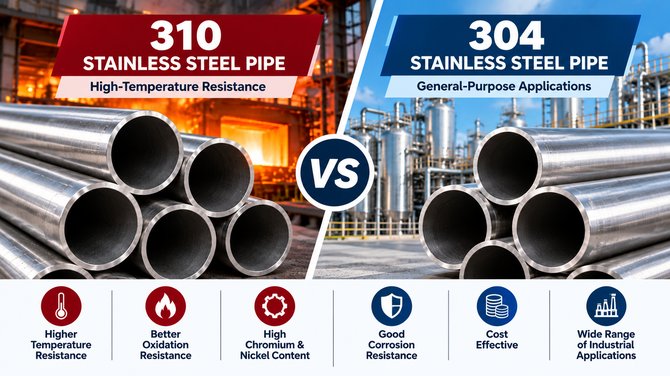
The main difference between these grades is their intended service. SS 304 is a general-purpose corrosion-resistant stainless steel, while SS 310 is primarily known for its performance in demanding high-temperature environments.
| Comparison factor | SS 304 pipe | SS 310 pipe |
|---|---|---|
| Common UNS designation | S30400 | S31000 |
| Material family | Austenitic stainless steel | Austenitic heat-resistant stainless steel |
| Chromium content | 18–20% | 24–26% |
| Nickel content | 8–10.5% | 19–22% |
| Carbon content | Maximum 0.08% | Maximum 0.25% for standard 310 |
| Main advantage | General corrosion resistance and fabrication versatility | High-temperature oxidation resistance |
| Typical service | General industrial and corrosive environments | Furnaces, heat-treatment equipment and selected hot-service systems |
| Relative cost | Generally lower | Generally higher |
| Related grade | 304L for lower-carbon requirements | 310S for lower-carbon requirements |
Composition ranges are common reference limits for the respective grades. Always verify the exact pipe specification and material test certificate. SS 310 and SS 310S should not be treated as identical grades.
1. Chemical Composition: Why Does It Matter?
Chemical composition has a major influence on how stainless steel performs during service.
SS 304 contains approximately 18–20% chromium and 8–10.5% nickel. This combination provides useful corrosion resistance and fabrication characteristics across many common applications.
SS 310 contains approximately 24–26% chromium and 19–22% nickel. The higher alloy content supports oxidation resistance and performance under demanding thermal conditions.
Chromium helps form a protective oxide layer on the surface of stainless steel. At elevated temperatures, the stability of this layer becomes particularly important because oxidation can gradually damage the material.
Nickel helps maintain the austenitic structure and contributes to the material’s overall properties.
This is why SS 310 is often selected for high-temperature equipment rather than simply as a more expensive alternative to SS 304.
2. Temperature Resistance: Which Grade Is Better?
Temperature resistance is the main factor that separates SS 310 from SS 304.
SS 304 Temperature Performance
SS 304 can be used in many applications involving moderate or elevated temperatures when its mechanical properties and oxidation resistance meet the design requirements.
However, prolonged exposure to high temperatures can affect mechanical properties and oxidation behaviour. The suitability of SS 304 depends on the temperature, atmosphere, duration of exposure and applied stress.
For continuous high-temperature service, engineers should check whether SS 304 meets the required performance limits.
SS 310 Temperature Performance
SS 310 is designed to provide improved oxidation resistance at elevated temperatures. Its higher chromium and nickel content makes it suitable for many furnace, kiln and heat-treatment applications.
However, SS 310 is not suitable for every hot environment. Sulphur-bearing atmospheres, carburising conditions, cyclic heating and mechanical stress can influence performance. Long exposure within particular temperature ranges can also affect the material’s microstructure.
Which is better for high-temperature applications? SS 310 is generally the stronger candidate when elevated-temperature oxidation resistance is the primary requirement. SS 304 may remain suitable where the operating conditions are less demanding.
The final selection should be based on verified material data and the engineering design, not a single temperature value.
3. Corrosion Resistance: SS 310 vs SS 304
SS 304 is widely recognised for its general corrosion resistance in many industrial and atmospheric environments.
SS 310 also offers corrosion resistance, and its higher chromium content contributes to oxidation resistance at elevated temperatures. However, this does not mean that SS 310 is automatically more corrosion-resistant than SS 304 in every aqueous environment.
For applications involving water, cleaning chemicals, chlorides or process fluids, the chemical composition of the fluid and the operating conditions must be evaluated.
In some applications, SS 304 may be the suitable and more economical choice. Other environments may require SS 316, duplex stainless steel or a different corrosion-resistant alloy.
When selecting a pipe, distinguish between resistance to high-temperature oxidation and resistance to corrosion caused by liquids or chemicals. They are related material considerations, but they are not the same property.
4. Strength and Mechanical Properties
Both SS 304 and SS 310 are austenitic stainless steels with useful mechanical properties. However, their strength at a particular temperature depends on the product grade, material condition and applicable specification.
SS 310’s higher alloy content does not mean it will automatically provide better performance under every type of mechanical loading.
For pressure-containing pipes, the selection must account for design temperature, pressure, wall thickness, material properties and the applicable piping code.
The 310 family also includes specialised variants such as 310H, which is intended for certain elevated-temperature applications where creep and stress-rupture properties are important.
For critical projects, the appropriate grade should be specified by the design engineer based on the actual service requirements.
5. Cost Difference Between SS 310 and SS 304 Pipes
SS 310 pipes generally cost more than SS 304 pipes because of their higher chromium and nickel content.
The final price depends on the grade, dimensions, wall thickness, pipe schedule, manufacturing method, testing requirements, quantity and current market conditions.
For general-purpose industrial piping, SS 304 is often a more economical choice when it meets the required conditions.
For high-temperature equipment, using SS 304 simply to reduce initial material cost may not be appropriate if the service conditions require a heat-resistant grade. Premature oxidation, maintenance work or replacement can increase the total project cost.
When comparing quotations, consider the material’s suitability, expected service life, inspection requirements, fabrication costs and potential downtime.
The right grade is the one that meets the technical requirements at a reasonable overall cost.
6. Industrial Applications of SS 310 and SS 304
Where SS 304 Pipes Are Commonly Used
SS 304 pipes are suitable for many applications where general corrosion resistance and fabrication versatility are important.
Common examples include:
- Food and beverage processing
- Water handling and utility systems
- General manufacturing
- Industrial equipment and fabrication
- Selected chemical processing systems
- Architectural and commercial installations
The specific fluid and operating conditions must still be checked before choosing SS 304.
Where SS 310 Pipes Are Commonly Used
SS 310 and SS 310S pipes are considered for applications that require improved oxidation resistance under high-temperature conditions.
Typical examples include:
- Industrial furnaces and kilns
- Heat-treatment equipment
- Radiant tubes and furnace components
- Burner assemblies
- High-temperature process equipment
- Selected petrochemical and thermal processing systems
For applications involving sustained high temperatures and mechanical stress, a specialised grade such as 310H may be appropriate, subject to the governing material specification and design requirements.
How to Choose Between SS 310 and SS 304 Pipes
Before ordering stainless steel pipes, review the following points.
1. Confirm the operating temperature. Identify the normal and maximum metal temperatures, exposure duration and whether the system experiences repeated heating and cooling.
2. Understand the environment. Check whether the pipe is exposed to air, combustion gases, sulphur-bearing atmospheres, chemicals, water or chloride-containing fluids.
3. Specify the exact grade. Clarify whether the requirement is SS 304, SS 310, SS 310S or SS 310H. These designations have different composition limits and intended uses.
4. Verify pipe dimensions. Provide the nominal size, outside diameter, schedule or wall thickness, length and end preparation.
5. Check the applicable standard. ASTM A312/ASME SA312 is a commonly used specification for seamless and welded austenitic stainless steel pipes, including applicable grades. The precise grade and product standard must match the application.
6. Review documentation. Confirm the material test certificate, chemical composition, mechanical properties and any required inspection reports.
7. Consider long-term costs. Compare material cost with the performance required, maintenance needs and expected service life.
For pressure systems and critical high-temperature equipment, the final selection should be reviewed by a qualified piping or materials engineer.
Why Source Stainless Steel Pipes from Leoscor Alloy Pipes?
Leoscor Alloy Pipes supplies industrial stainless steel pipes in multiple grades and configurations.
Its published product range includes SS 304, SS 310, SS 310S and SS 310H pipes. Depending on the grade and required specification, products are available in seamless, welded, ERW and other configurations.
When requesting a quotation, provide complete technical details so the required product can be evaluated correctly.
Include the following information:
- Required grade and material specification
- Nominal pipe size and schedule
- Required length and quantity
- Seamless or welded construction
- Operating temperature and service environment
- Inspection and certification requirements
- Delivery location and expected schedule
You can review the SS 304 Stainless Steel Pipes product range, SS 310 Stainless Steel Pipes and SS 310S Stainless Steel Pipes for product information.
Request a Quote for SS 310 or SS 304 Pipes
Are you sourcing stainless steel pipes for a furnace, heat-treatment plant, refinery, food processing facility or other industrial project?
Contact Leoscor Alloy Pipes with your grade, dimensions, quantity and operating conditions. This will help the team review your requirement and discuss suitable supply options based on the specified product and availability.
Contact Leoscor Alloy Pipes to submit your requirements and request a quotation.
Conclusion
The key difference between SS 310 and SS 304 stainless steel pipes is their intended application and performance under elevated temperatures.
SS 304 is widely used for general-purpose industrial applications because it offers useful corrosion resistance, fabrication versatility and a comparatively economical material cost.
SS 310 contains higher levels of chromium and nickel, making it a better candidate for applications where high-temperature oxidation resistance is important.
However, the choice is not simply about which grade is better. The appropriate material depends on temperature, atmosphere, mechanical stress, corrosion exposure and the applicable engineering specification.
Before purchasing, confirm the exact grade, dimensions, product standard and service conditions. This helps avoid material mismatches and supports reliable operation over the intended service life.
For your stainless steel pipe requirements, contact Leoscor Alloy Pipes with your technical specifications to discuss suitable products.
Frequently Asked Questions
1. What is the main difference between SS 310 and SS 304 pipes?
SS 310 contains higher chromium and nickel levels and is primarily designed for improved high-temperature oxidation resistance. SS 304 is widely used for general-purpose corrosion-resistant applications.
2. Is SS 310 better than SS 304?
SS 310 is generally more suitable for demanding high-temperature oxidation service. SS 304 may be the better option for general-purpose applications where its properties meet the requirements. The correct choice depends on the operating environment.
3. Which stainless steel pipe is better for high-temperature applications?
SS 310 and its variants are commonly considered for demanding high-temperature oxidation service. However, the exact grade depends on temperature, exposure duration, atmosphere, stress and the applicable engineering specification.
4. What is the chemical composition of SS 310?
SS 310 typically contains 24–26% chromium and 19–22% nickel. Standard SS 310 permits a maximum carbon content of approximately 0.25% under common specifications. Always check the specific grade and material standard.
5. What is the difference between SS 310 and SS 310S?
SS 310S is the low-carbon version of SS 310. It has a maximum carbon content of 0.08% under common specifications, compared with a higher permitted maximum for standard SS 310. The lower carbon content can help reduce carbide precipitation during welding.
6. Is SS 304 suitable for furnace applications?
SS 304 may be suitable for certain temperature conditions, but it should not be assumed appropriate for every furnace application. The metal temperature, exposure duration, atmosphere and mechanical loading must be evaluated.
7. Are SS 310 pipes more expensive than SS 304 pipes?
Generally, yes. SS 310 typically costs more because of its higher chromium and nickel content. Actual prices vary with dimensions, product form, quantity, testing and market conditions.
8. Which standard covers SS 310 and SS 304 stainless steel pipes?
ASTM A312/ASME SA312 covers seamless and welded austenitic stainless steel pipe, including applicable grades. Other standards may apply depending on the product form and intended service. Always confirm the full specification before ordering.
9. Where can I buy SS 310 and SS 304 stainless steel pipes?
You can explore the SS 310 and SS 304 product ranges from Leoscor Alloy Pipes and submit your requirements through its official contact page.