

Super Duplex Tubes vs Duplex Tubes: Key Differences, Properties and Applications
When choosing stainless steel tubes for an industrial project, material selection can make a significant difference to long-term performance. A tube may need to handle corrosive fluids, high pressure, changing temperatures or continuous exposure to seawater. In such situations, standard stainless steel grades may not always meet the required service conditions.
This is where duplex and super duplex stainless steel tubes become important.
Both material families combine high mechanical strength with good corrosion resistance. However, super duplex grades contain higher levels of certain alloying elements, which generally improve their resistance to pitting and crevice corrosion in aggressive environments.
So, what is the actual difference between super duplex tubes and duplex tubes? Is super duplex always the better option? And is the higher material cost worth it?
The answer depends on the environment in which the tubes will operate.
In this guide, we compare duplex and super duplex stainless steel tubes, including their chemical composition, strength, corrosion resistance, common grades, industrial applications and cost considerations. This will help engineers, project managers and procurement teams make a more informed material selection.
What Are Duplex Stainless Steel Tubes?
Duplex stainless steel tubes are made from stainless steel with a microstructure containing two main phases: ferrite and austenite. These phases are generally present in roughly equal proportions in a properly processed duplex grade.
This dual-phase structure provides a useful combination of strength, toughness and corrosion resistance. Duplex stainless steel also offers better resistance to chloride stress corrosion cracking than many conventional austenitic grades under suitable conditions.
One of the most widely used duplex grades is UNS S32205, commonly known as Duplex 2205. UNS S31803 is another designation associated with the 2205 family, although its specified composition limits are not identical to those of S32205.
Duplex tubes are commonly selected when standard grades such as 304 or 316L may not provide the required combination of strength and corrosion resistance.
Key Properties of Duplex Tubes
High mechanical strength: Duplex stainless steel generally has higher yield strength than common austenitic grades such as 304L and 316L.
Good corrosion resistance: Duplex 2205 offers good resistance to pitting, crevice corrosion and chloride-related stress corrosion cracking in appropriate environments.
Useful fabrication properties: Duplex tubes can be welded and fabricated using suitable procedures. Heat input and cooling conditions require proper control.
Practical cost balance: Duplex 2205 can provide the required performance without the additional alloy cost of super duplex in many applications.
Common Applications of Duplex Tubes
Duplex stainless steel tubes are commonly considered for:
- Heat exchangers and condensers
- Chemical and petrochemical processing
- Cooling-water systems
- Oil and gas facilities
- Desalination equipment
- Industrial process systems
- Fertiliser and power generation plants
The correct grade should always be selected according to the fluid composition, operating temperature, pressure and applicable material specification.
Explore the Duplex Steel Tubes range from Leoscor Alloy Pipes for information about duplex 2205 tubing and related grades.
What Are Super Duplex Stainless Steel Tubes?
Super duplex stainless steel tubes belong to a higher-alloy group within the duplex stainless steel family. They retain the ferritic-austenitic microstructure but generally contain higher amounts of chromium, molybdenum and nitrogen than standard duplex grades.
These alloying elements contribute to improved resistance to localised corrosion, particularly in chloride-rich environments. Super duplex grades also offer high mechanical strength, making them suitable for selected applications involving demanding pressure and corrosion conditions.
Two common examples are UNS S32750, often called Super Duplex 2507, and UNS S32760, associated with the Zeron 100 grade designation.
Although these grades belong to the same broad material family, their detailed compositions and properties differ. They should not be treated as interchangeable without confirming the required specification.
Key Properties of Super Duplex Tubes
Improved pitting resistance: Higher alloy content generally improves resistance to localised corrosion in chloride-containing environments.
High mechanical strength: Common super duplex grades have high specified yield strength, although the exact values depend on the product form and standard.
Resistance to chloride stress corrosion cracking: Super duplex grades are often chosen for applications where chloride exposure and mechanical stress create significant corrosion concerns.
Suitability for demanding service: They can be appropriate for selected offshore, marine, desalination and chemical processing applications.
Common Applications of Super Duplex Tubes
Super duplex tubes are often considered for:
- Offshore oil and gas facilities
- Seawater cooling systems
- Desalination plants
- Brine handling systems
- Marine heat exchangers
- Chemical processing equipment
- Subsea and other demanding industrial systems
Super duplex offers higher corrosion resistance than standard duplex in many chloride-rich environments, but it is not immune to corrosion. Material suitability still depends on temperature, fluid chemistry, flow conditions, deposits and fabrication quality.
You can explore the Super Duplex Steel Tubes range from Leoscor Alloy Pipes for product information covering grades such as UNS S32750 and UNS S32760.
Super Duplex Tubes vs Duplex Tubes: Key Differences
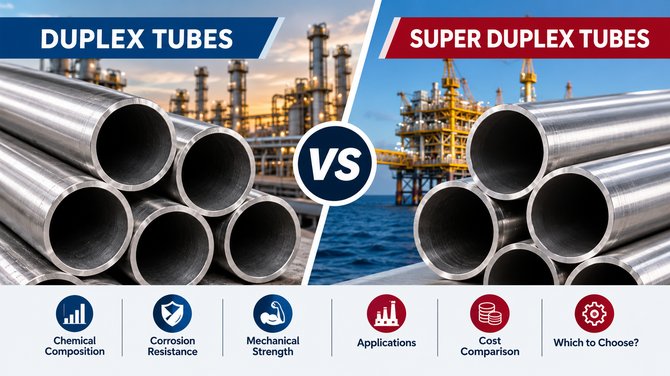
The primary differences relate to alloy composition, corrosion resistance, mechanical properties, suitable operating environments and material cost.
| Comparison factor | Duplex tubes | Super duplex tubes |
|---|---|---|
| Common example grade | UNS S32205 / Duplex 2205 | UNS S32750 / Super Duplex 2507 |
| Microstructure | Ferritic-austenitic | Ferritic-austenitic |
| Chromium content | Typically around 22% in Duplex 2205 | Typically around 24–26% in Super Duplex 2507 |
| Molybdenum content | Typically around 3% in Duplex 2205 | Typically around 3–5% in Super Duplex 2507 |
| Nitrogen content | Lower than common super duplex grades | Generally higher |
| Corrosion resistance | Good for many demanding industrial environments | Generally better resistance to pitting and crevice corrosion in aggressive chloride environments |
| Mechanical strength | High | High; common super duplex grades have higher specified minimum yield strength |
| Material cost | Generally lower | Generally higher |
| Common applications | Process systems, heat exchangers and industrial cooling systems | Offshore systems, seawater service and aggressive brine applications |
The figures are typical reference values for common grades, not universal limits for every duplex or super duplex alloy. Always check the exact material specification and product certificate.
1. Chemical Composition: Duplex vs Super Duplex
Chemical composition is one of the main factors that separates duplex from super duplex stainless steel.
Both material families contain chromium, nickel, molybdenum and nitrogen in controlled proportions. The actual quantities depend on the grade.
In Duplex 2205, chromium commonly falls within approximately 22–23%, with molybdenum around 3%. Nickel and nitrogen help maintain the desired duplex structure and mechanical properties.
Super Duplex 2507 typically contains approximately 24–26% chromium, 3–5% molybdenum and a higher nitrogen content. These alloying elements help improve pitting resistance and mechanical performance.
Molybdenum plays an important role in resistance to localised corrosion, while nitrogen contributes to strength and corrosion resistance.
The addition of these elements is one reason super duplex can be more suitable for applications involving warm seawater, concentrated chlorides and other demanding environments.
However, chemical composition alone does not guarantee reliable performance. Correct manufacturing, heat treatment, welding and inspection are also essential.
2. Corrosion Resistance: Which Is Better?
Corrosion resistance is often the deciding factor when comparing super duplex tubes vs duplex tubes.
Duplex Tube Corrosion Resistance
Duplex 2205 provides good resistance to pitting, crevice corrosion and chloride stress corrosion cracking in many industrial environments.
It may be a suitable choice for process piping, industrial cooling systems, heat exchangers and applications where the operating conditions are demanding but do not require super duplex’s higher corrosion resistance.
For many projects, duplex 2205 provides a practical balance of mechanical performance, corrosion resistance and material cost.
Super Duplex Tube Corrosion Resistance
Super duplex grades generally provide greater resistance to localised corrosion in environments with high chloride concentrations.
This makes them useful for selected marine systems, offshore installations, seawater equipment and aggressive brine applications.
A commonly used comparison indicator is the Pitting Resistance Equivalent Number, or PREN. Standard duplex 2205 often has a PREN in the mid-30s, while common super duplex grades typically exceed 40.
PREN is an alloy-based indicator, not a guarantee against corrosion. Actual performance depends on the operating environment, surface condition and fabrication quality.
Which should you choose? Duplex may be sufficient for moderate corrosion conditions, while super duplex is often considered when the risk of pitting or crevice corrosion is higher. The decision should be based on the actual process environment, not the grade name alone.
3. Strength and Mechanical Properties
Both duplex and super duplex stainless steel tubes offer high mechanical strength.
Duplex stainless steel generally has greater yield strength than conventional austenitic grades such as 304L and 316L. This can provide design advantages in applications where mechanical loading is important.
Common super duplex grades also have high specified yield strength. Depending on the design code and material specification, this may allow engineers to consider different wall-thickness or weight requirements.
However, higher strength does not automatically mean that a thinner tube can be used. Wall thickness must be calculated according to the applicable engineering code, pressure, temperature, dimensions, corrosion allowance and loading conditions.
For critical applications, engineering approval is required before changing the specified material grade or tube dimensions.
4. Cost Difference Between Duplex and Super Duplex Tubes
Super duplex tubes are generally more expensive than duplex 2205 tubes because of their higher alloy content and more demanding manufacturing and processing requirements.
However, comparing the purchase price alone may not give the full picture.
For example, duplex 2205 may provide adequate performance in a cooling-water system with relatively mild chloride exposure. In such a case, choosing super duplex may add unnecessary material cost.
On the other hand, in an aggressive seawater or brine application, using a grade with insufficient corrosion resistance can result in premature damage, maintenance work and unplanned downtime.
In those situations, the higher initial cost of super duplex may be justified by the required service performance.
Before making a purchasing decision, compare:
- Required corrosion resistance
- Material and fabrication costs
- Operating conditions
- Inspection and maintenance requirements
- Expected service life
- Cost of replacement and downtime
The best value comes from selecting the grade that meets the project’s requirements without over-specifying or under-specifying the material.
5. Applications: When Should You Use Duplex or Super Duplex Tubes?
When Duplex Tubes Are a Better Choice
Duplex 2205 may be suitable when the system requires higher strength and good corrosion resistance but does not need the additional resistance offered by super duplex.
Typical examples include industrial heat exchangers, cooling-water systems, selected chemical processing equipment and certain oil and gas applications.
The final choice depends on the chloride concentration, operating temperature, pressure and the other chemicals present in the fluid.
For grade information, visit the UNS S32205 Duplex Steel Tubes page.
When Super Duplex Tubes Are a Better Choice
Super duplex is often considered when the operating environment contains higher chloride concentrations or presents a greater risk of pitting and crevice corrosion.
Examples include offshore equipment, seawater systems, selected desalination applications and aggressive brine handling.
The exact grade should be selected according to the required corrosion performance and engineering specification.
For additional information, explore UNS S32750 Super Duplex Tubes or UNS S32760 Super Duplex Tubes.
6. Fabrication, Welding and Maintenance Considerations
Duplex and super duplex stainless steels require careful fabrication practices.
The balance between ferrite and austenite is important to their performance. Incorrect welding conditions, excessive heat input or unsuitable cooling conditions can affect the microstructure and corrosion resistance.
Super duplex can require particularly close control because its higher alloy content makes correct processing important for maintaining the required properties.
For both material families, consider the following:
- Use an appropriate, qualified welding procedure.
- Follow the specified heat-input and interpass-temperature limits.
- Use suitable filler material where required.
- Avoid contamination from other metals during fabrication.
- Follow the required cleaning, pickling or passivation procedures.
- Confirm inspection and material certification requirements.
Maintenance also matters. Deposits, stagnant conditions, crevices and unsuitable cleaning practices can contribute to localised corrosion even when a high-performance alloy is used.
Material selection should therefore be supported by proper design, fabrication and operating practices.
How to Choose the Right Duplex Tube for Your Project
Before ordering duplex or super duplex stainless steel tubes, review these important factors.
1. Identify the process fluid. Determine whether the tube will carry seawater, cooling water, chemicals, brine or another medium.
2. Check chloride exposure. Chloride concentration and operating temperature can strongly influence the risk of pitting and crevice corrosion.
3. Confirm the design conditions. Establish the required pressure, temperature, loading and wall thickness.
4. Select the material grade. Identify whether a duplex grade such as UNS S32205 or a super duplex grade such as UNS S32750 meets the requirement.
5. Check the applicable standard. Confirm the required product specification. ASTM A789/ASME SA789 is commonly used for seamless and welded duplex and super duplex stainless steel tubing. The exact specification must match the product and application.
6. Review documentation. Confirm chemical composition, mechanical properties, traceability and the required material test certificate.
7. Consider long-term cost. Compare the initial material price with the expected maintenance, replacement and operating costs.
For critical applications, material selection should be reviewed by a qualified materials or piping engineer.
Why Source Duplex and Super Duplex Tubes from Leoscor Alloy Pipes?
Leoscor Alloy Pipes supplies duplex and super duplex stainless steel tubes for industrial applications.
Its published duplex tube range includes UNS S31803 and UNS S32205 grades. Its super duplex range includes UNS S32750 and UNS S32760, along with other listed grades and designations.
Depending on the required product and specification, tube options include seamless and welded forms. Buyers should confirm the latest availability, dimensions and documentation for the particular grade before ordering.
To help evaluate your requirement, prepare the following details:
- Required grade and material specification
- Outside diameter and wall thickness
- Tube length and quantity
- Seamless or welded product requirement
- Inspection and certification requirements
- Delivery location and expected schedule
Explore the Duplex Steel Tubes product range and Super Duplex Steel Tubes product range to review the available product information.
Request a Quote for Duplex or Super Duplex Tubes
Looking for duplex 2205 or super duplex 2507 tubes for your next industrial project?
Contact Leoscor Alloy Pipes with your required grade, dimensions, quantity and service conditions. The team can review your enquiry and discuss suitable supply options based on the specification and availability.
Contact Leoscor Alloy Pipes to submit your requirement and request a quotation.
Conclusion
The main difference between duplex tubes and super duplex tubes lies in their alloy composition and the level of corrosion resistance they provide.
Duplex 2205 offers high strength and good resistance to corrosion in many industrial environments. Super duplex grades such as S32750 and S32760 generally provide improved resistance to pitting and crevice corrosion in more aggressive chloride-rich conditions.
Neither material is the right choice for every application. Duplex may be more economical when its performance meets the design requirements, while super duplex may be justified in more demanding environments.
Before making a final decision, review the process fluid, operating temperature, pressure, chloride concentration, required grade and applicable material standard.
Choosing the correct tube grade from the beginning can help support reliable operation, reduce the risk of premature corrosion and control long-term project costs.
For industrial tube requirements, contact Leoscor Alloy Pipes with your technical specifications to discuss a suitable option.
Frequently Asked Questions
1. What is the difference between duplex tubes and super duplex tubes?
Super duplex stainless steel generally contains higher levels of chromium, molybdenum and nitrogen than standard duplex grades. This improves its resistance to localised corrosion in aggressive chloride environments. Common super duplex grades also have high specified mechanical strength.
2. Is super duplex stronger than duplex?
Common super duplex grades have higher specified minimum yield strength than standard duplex 2205 under their respective material specifications. Exact properties depend on the grade, product form, manufacturing condition and applicable standard.
3. Which is more corrosion-resistant: duplex or super duplex?
Super duplex generally provides better resistance to pitting and crevice corrosion in high-chloride environments. However, actual performance depends on the fluid, temperature, surface condition, fabrication and other operating factors.
4. What are the common duplex stainless steel tube grades?
UNS S31803 and UNS S32205 are common duplex stainless steel grades. Duplex 2205, associated with the 2205 family, is widely used in industrial applications requiring strength and corrosion resistance.
5. What are the common super duplex tube grades?
UNS S32750, commonly known as Super Duplex 2507, and UNS S32760, associated with Zeron 100, are common examples. Their compositions and properties differ, so the correct designation must be specified during procurement.
6. Are duplex tubes suitable for seawater applications?
Duplex 2205 can be suitable for certain seawater-related services, depending on the water chemistry, temperature, flow and design conditions. More aggressive seawater environments may require super duplex or another suitable corrosion-resistant alloy.
7. Are super duplex tubes more expensive?
Generally, yes. Super duplex tubes usually cost more because of their alloy content and processing requirements. However, the additional cost may be justified when the operating environment requires greater corrosion resistance.
8. What is the difference between ASTM A789 and ASTM A790?
ASTM A789 covers seamless and welded ferritic/austenitic stainless steel tubing for general service, including duplex and super duplex tubing grades. ASTM A790 covers seamless and welded ferritic/austenitic stainless steel pipe. The correct standard depends on the product form and the project’s requirements.
9. Can duplex and super duplex tubes be welded?
Yes, both can be welded with suitable qualified procedures. Heat input, filler selection and cooling conditions must be controlled to preserve the required microstructure and properties.
10. How do I choose between duplex 2205 and super duplex 2507?
Review the chloride concentration, fluid chemistry, temperature, pressure, mechanical requirements and applicable design standards. Duplex 2205 may be sufficient for many industrial applications, while super duplex 2507 is often considered for more aggressive chloride-rich environments.