

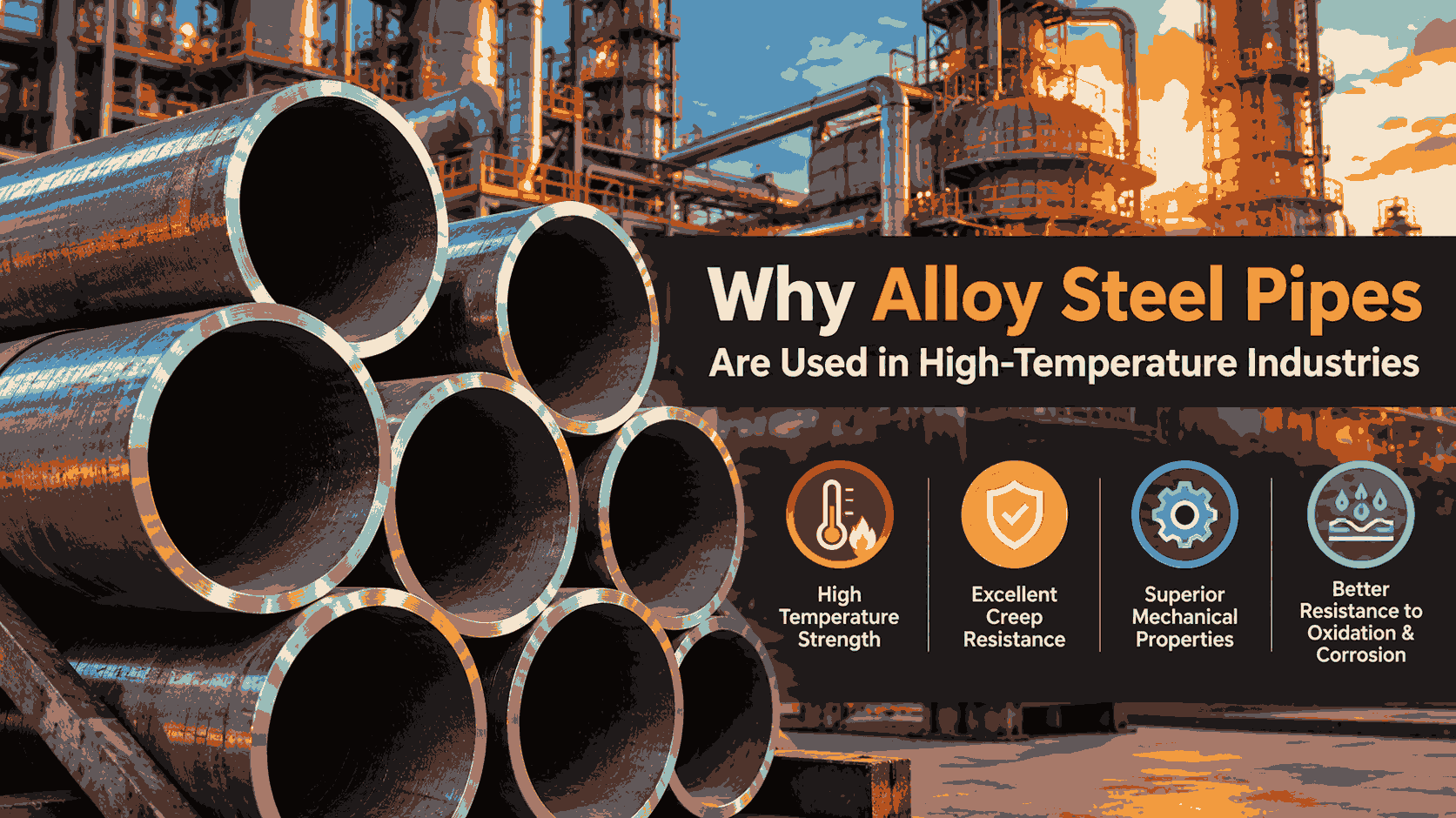
Why Alloy Steel Pipes Are Used in High-Temperature Industries
Think about a power plant running for long hours every day. Steam moves through pipelines under high pressure and at elevated temperatures. In a refinery, process fluids pass through heating systems where the pipe material must handle demanding operating conditions without losing its required properties.
In these situations, selecting the right pipe material is essential. A pipe that performs well under normal conditions may not be suitable for continuous high-temperature service.
This is one of the main reasons alloy steel pipes are used in high-temperature industries. They are designed with specific alloying elements that help improve mechanical properties, resistance to oxidation and performance under prolonged exposure to heat, depending on the selected grade.
Industries such as power generation, oil refining, petrochemicals and heavy engineering use alloy steel pipes in applications where both temperature and pressure must be considered carefully.
However, not every alloy steel pipe is suitable for every high-temperature application. The correct choice depends on the operating conditions, material grade, wall thickness and applicable engineering standards.
In this article, we will explain why alloy steel pipes are important, how they perform at elevated temperatures, which grades are commonly used and what buyers should consider before selecting them.
What Are Alloy Steel Pipes?
Alloy steel pipes are manufactured from steel containing specific alloying elements in addition to iron and carbon. These elements are added to achieve the properties required for a particular application.
Common alloying elements include chromium, molybdenum, nickel, vanadium and manganese. Each element contributes differently to the material’s behaviour.
For example, chromium can improve resistance to oxidation at elevated temperatures, while molybdenum contributes to strength and resistance to creep deformation under suitable conditions. Other alloying elements may help improve hardenability, toughness or overall mechanical performance.
The exact composition depends on the grade and the relevant material specification.
One important category is chromium-molybdenum, often called chrome-moly, alloy steel. Grades such as ASTM A335 P11 and P22 are used in suitable high-temperature piping applications.
For projects that require a specific pressure-piping material, the grade must be selected according to the approved design and operating conditions.
You can explore the alloy steel pipes range from Leoscor Alloy Pipes to review the available product categories and grades.
Why Alloy Steel Pipes Are Used in High-Temperature Industries
There is no single reason why these pipes are selected. Their value comes from the way their composition and specified mechanical properties meet the demands of industrial service.
1. They Help Maintain Strength at Elevated Temperatures
Steel properties change as temperature increases. Depending on the material and operating conditions, strength can decrease, and the pipe may become less capable of carrying the same load safely.
Alloy steel grades developed for elevated-temperature service are selected based on their mechanical properties at the intended operating conditions.
This is important in power plants, boilers and refineries, where pipelines may carry steam or process fluids for extended periods.
For example, ASTM A335 P11 and P22 pipes are used in suitable high-temperature piping systems. The correct grade depends on the design temperature, pressure, allowable stress and other engineering requirements.
Choosing a grade simply because it is described as high-temperature alloy steel is not enough. Engineers must verify that it meets the requirements of the actual installation.
2. They Offer Better Resistance to Creep Deformation
Creep is the gradual deformation of a material when it remains under stress for a long period, particularly at elevated temperatures.
This matters because many industrial pipelines operate continuously. A pipe may appear to perform normally during the early stages of operation but gradually deform if its material is unsuitable for the combination of heat and applied stress.
Certain alloy steel grades are designed to provide the creep strength needed for specific high-temperature applications.
Their suitability depends on alloy composition, heat treatment, material condition, operating temperature and stress. The design must account for these factors over the intended service life.
Creep resistance is therefore an important consideration when selecting pipes for boiler systems, steam lines and power generation equipment.
3. They Improve Resistance to Oxidation
At elevated temperatures, steel can react with oxygen and form oxide layers on its surface. Depending on the environment and the nature of the oxide layer, this can gradually affect the material.
Chromium helps improve oxidation resistance by supporting the formation of a protective oxide layer. This is one reason chromium-containing alloy steels are used in selected hot-service applications.
The required chromium content varies with the grade and operating environment. Some applications may require a higher-chromium grade, while others can be served by a lower-alloy material.
It is important to understand that oxidation resistance and general corrosion resistance are not the same thing. The material must be suitable for the actual process atmosphere, temperature and service conditions.
4. They Support Reliable Performance Under Pressure
High-temperature service often involves pressure as well as heat. The pipe must withstand the combined effect of internal pressure, temperature, mechanical loading and long-term exposure.
Alloy steel pipes specified for high-temperature service are selected using their permitted material properties and the applicable pressure design rules.
Wall thickness plays an important role here. A pipe with an unsuitable wall thickness may not meet the required design pressure even if the alloy grade itself is appropriate.
Engineers must consider the material grade, pipe size, schedule, design temperature, pressure, corrosion allowance and applicable code before approving a pipe for installation.
Material selection and pressure design must always be treated as connected decisions.
5. They Are Available in Different Grades for Different Conditions
Not all industrial systems operate at the same temperature or pressure. A refinery heating line may have different material requirements from a boiler system or a power plant steam line.
Alloy steel pipes are available in several grades, allowing engineers to select a material that meets the needs of a particular application.
For example, ASTM A335 P11, P22 and P91 have different compositions and high-temperature design characteristics. The appropriate grade depends on the operating conditions and the properties permitted by the relevant design code.
Using the correct grade helps ensure that the piping system meets its engineering requirements without choosing a more highly alloyed material unnecessarily.
Common Alloy Steel Pipe Grades Used for High-Temperature Service
Several grades are used in industrial piping. The following examples illustrate their typical applications, but they are not interchangeable.
| Grade | Typical characteristics | Common application areas |
|---|---|---|
| ASTM A335 P11 | Chromium-molybdenum alloy steel for suitable elevated-temperature service | Industrial process piping, boilers and power plants |
| ASTM A335 P22 | Chromium-molybdenum grade used in demanding elevated-temperature systems | Boiler piping, steam systems and power generation |
| ASTM A335 P5 | Higher-chromium alloy steel used where oxidation resistance is an important consideration | Selected refinery and petrochemical services |
| ASTM A335 P9 | Chromium-molybdenum grade used in specified elevated-temperature applications | Refineries and suitable high-temperature process systems |
| ASTM A335 P91 | Advanced chromium-molybdenum-vanadium alloy steel for demanding high-temperature service | Selected high-temperature power plant applications |
ASTM A335 covers seamless ferritic alloy steel pipes intended for high-temperature service. The specification establishes requirements for chemical composition, mechanical properties and other aspects of the product.
For the exact requirements, refer to the applicable edition of the ASTM A335/A335M specification.
Leoscor Alloy Pipes lists these grades within its alloy steel range. You can review the specifications for P11 alloy steel pipes, P22 alloy steel pipes and P91 alloy steel pipes.
The grades listed above are examples, not a ranking from lowest to highest quality. The correct selection should follow the project’s material specification and approved engineering calculations.
Industries That Use Alloy Steel Pipes at High Temperatures
Power Generation Plants
Power plants rely on extensive piping systems to transport steam, water and other process fluids. Certain lines operate under elevated temperatures and pressures for long periods.
Alloy steel pipes are used in suitable applications where their specified high-temperature properties meet the design requirements.
Material grade, wall thickness, pressure rating and inspection requirements must be established before installation.
Oil Refineries
Refineries use piping to move hydrocarbons and other process fluids through heating systems, processing units and associated equipment.
Some of these processes expose the pipework to elevated temperatures and demanding operating conditions. Alloy steel grades may be selected where they provide the required mechanical properties and oxidation resistance.
The material must also be compatible with the process fluid and any other relevant corrosion mechanisms.
Petrochemical Plants
Petrochemical facilities contain heating systems, process lines and equipment that may operate at elevated temperatures.
Alloy steel pipes are used in suitable services where the selected grade meets the pressure, temperature and material compatibility requirements.
The specific alloy should be chosen according to the process conditions rather than using one grade for every line.
Boiler and Steam Systems
Boilers and steam systems require materials that can withstand the specified pressure and temperature over their intended service life.
Alloy steel pipes may be used in selected steam lines and other pressure-containing applications where the design calls for their high-temperature characteristics.
Proper fabrication, welding, heat treatment and inspection are also important for reliable operation.
Heavy Engineering and Industrial Processing
Other industrial facilities may require alloy steel piping for hot process fluids, specialised equipment and demanding mechanical conditions.
In these cases, engineers must evaluate the operating environment and decide whether alloy steel, carbon steel, stainless steel or another material is appropriate.
The objective is to choose a material that meets the design requirements—not simply to select the most expensive or highly alloyed option.
Alloy Steel Pipes vs Carbon Steel Pipes for High-Temperature Service
Carbon steel pipes are suitable for many industrial applications, including some elevated-temperature services. However, carbon steel may not provide the required properties for every combination of temperature, stress and service life.
Alloy steel contains additional elements that are selected to improve particular properties, such as creep strength or resistance to oxidation.
Here is a simple comparison.
| Factor | Carbon steel pipes | Alloy steel pipes |
|---|---|---|
| Composition | Primarily iron and carbon, with other controlled elements | Includes specific alloying elements such as chromium and molybdenum |
| High-temperature performance | Depends on the grade and design conditions | Certain grades are specifically developed for demanding elevated-temperature service |
| Creep resistance | Depends on grade and operating conditions | Selected grades provide improved creep strength for specified conditions |
| Oxidation resistance | Depends on material and temperature | Chromium-containing grades can offer improved oxidation resistance |
| Typical selection | General industrial piping and other suitable services | Applications requiring particular high-temperature mechanical properties |
Alloy steel is not automatically the right choice for every hot-service line. Some systems can safely use carbon steel when the applicable code, grade and design conditions permit it.
The final choice should be made by reviewing the operating conditions, project specification and long-term performance requirements.
How to Select the Right Alloy Steel Pipe
Selecting the correct pipe is as important as selecting the material family. Before placing an order, engineers and procurement teams should confirm the following details.
1. Operating temperature and pressure: Establish the design conditions for the piping system, including any changes expected during operation.
2. Required material grade: Follow the approved piping material specification. Do not substitute P11, P22, P91 or another grade without the required engineering approval.
3. Pipe dimensions: Confirm nominal size, outside diameter, wall thickness or schedule, length and end preparation.
4. Applicable standards: Identify the required ASTM, ASME or other project specification. Confirm the product form covered by the standard.
5. Inspection and documentation: Check the required Mill Test Certificate, heat-number traceability, mechanical test results and any additional inspection or testing requirements.
6. Welding and heat treatment: Confirm the applicable welding procedure, preheating, interpass temperature control and post-weld heat treatment requirements. These can differ substantially between grades.
7. Supplier capability: Ensure the supplier can meet the required specification, dimensions, documentation and delivery schedule. Actual availability should be confirmed before procurement.
These checks help reduce the risk of material mismatch, documentation problems and delays during installation.
Why Choose Leoscor Alloy Pipes?
Leoscor Alloy Pipes supplies industrial piping products, including an alloy steel range covering ASTM A335 P5, P9, P11, P22 and P91 grades, as well as AISI 4130 pipes.
When sourcing alloy steel pipes for high-temperature applications, buyers should provide complete technical requirements so the correct product can be identified.
Leoscor’s alloy steel range includes different sizes, schedules and product requirements, subject to the applicable specification and availability. Buyers can request information about the required grade, dimensions, surface finish and certification.
Explore the alloy steel pipes product range or review the ASTM A335 P5 pipe range for additional product information.
Request a Quote for Alloy Steel Pipes
Looking for alloy steel pipes for a power plant, refinery, boiler system or other industrial project?
Contact Leoscor Alloy Pipes with your required grade, pipe size, schedule, quantity and material certification requirements.
Visit the Leoscor Alloy Pipes enquiry page to submit your requirements. Providing complete specifications will help the team review your enquiry and confirm suitable supply options.
Conclusion
Alloy steel pipes play an important role in high-temperature industries because selected grades provide the mechanical properties needed for demanding operating conditions.
Their resistance to creep deformation, performance at elevated temperatures and oxidation resistance can make them suitable for specific applications in power plants, refineries, petrochemical facilities and boiler systems.
However, these benefits depend on choosing the correct grade and following the applicable design requirements. P11, P22, P5, P9 and P91 differ in composition and performance, so they should not be treated as interchangeable products.
For engineers and procurement teams, the best approach is to confirm the operating temperature, pressure, required material grade, dimensions and certification before ordering.
Leoscor Alloy Pipes offers a range of alloy steel pipe products for industrial requirements. Share your technical specifications with the team to discuss the appropriate product for your project.
Frequently Asked Questions
1. Why are alloy steel pipes used in high-temperature industries?
They are used because certain alloy steel grades provide the mechanical properties, creep strength and oxidation resistance needed for specified high-temperature applications.
2. Which alloy steel pipe grades are used for high-temperature service?
Common examples include ASTM A335 P11, P22, P5, P9 and P91. The appropriate grade depends on the design temperature, pressure, service conditions and applicable engineering code.
3. What is the difference between P11 and P22 alloy steel pipes?
Both are chromium-molybdenum alloy steel grades, but they have different chemical compositions and permitted design properties. The correct choice depends on the project’s operating conditions and approved material specification.
4. Are alloy steel pipes suitable for boiler applications?
Selected alloy steel pipe grades are used in boiler and steam-related systems where their material properties meet the design requirements. The specific product must be approved for the intended service.
5. Are alloy steel pipes better than carbon steel pipes?
Not in every situation. Alloy steel may be preferred when improved high-temperature properties are required, while carbon steel can be suitable for many other applications. Selection depends on the operating conditions and applicable code.
6. What information is needed to purchase alloy steel pipes?
Buyers should provide the required grade, specification, pipe size, schedule or wall thickness, length, quantity, end finish, testing requirements and material certification details.
7. Where can I source alloy steel pipes in India?
You can contact Leoscor Alloy Pipes to review its alloy steel pipe range and submit an enquiry for your industrial requirements.