

Type 302 Stainless Steel Tube: Properties, Composition, Uses and Benefits
Type 302 stainless steel tube is an austenitic chromium-nickel stainless steel product known for its strength, ductility, formability and general corrosion resistance. Identified by the UNS designation S30200, this grade belongs to the 300 series of stainless steels and has traditionally been used in applications requiring a combination of mechanical performance and resistance to corrosion.
Type 302 is closely related to Type 304 stainless steel. Its higher maximum carbon content distinguishes it from Type 304 and can influence its mechanical properties and fabrication behaviour. However, many applications that historically used Type 302 now use Type 304 because modern steelmaking has made lower-carbon stainless steel products more widely available.
Understanding the properties, chemical composition and limitations of Type 302 stainless steel is important when selecting materials for industrial equipment, fabricated components and tubular applications.
In this guide, we explain Type 302 stainless steel tube properties, its applications, corrosion resistance and the key differences between Type 302 and Type 304.
What Is Type 302 Stainless Steel Tube?
Type 302 stainless steel is an austenitic stainless steel alloy primarily containing chromium, nickel and iron, along with controlled amounts of carbon and other elements.
Chromium helps form a protective passive layer on the steel surface, providing resistance to corrosion in many environments. Nickel supports the austenitic structure and contributes to the alloy’s toughness and formability.
Type 302 is commonly associated with the UNS designation S30200. It is sometimes described as a higher-carbon version of the familiar Type 304 stainless steel.
Although Type 302 has been used in various fabricated and tubular products, availability depends on the manufacturer, product form, dimensions and applicable material specification. Buyers should confirm that the specific grade is available as a tube and that the offered product complies with their project requirements.
Chemical Composition of Type 302 Stainless Steel
The chemical composition of stainless steel determines important properties such as corrosion resistance, strength, ductility and fabrication performance.
The following table provides general composition limits commonly associated with Type 302 under ASTM A240/ASME SA-240 composition requirements.
| Element | Typical specification limit by weight |
|---|---|
| Carbon (C) | 0.15% maximum |
| Chromium (Cr) | 17.0–19.0% |
| Nickel (Ni) | 8.0–10.0% |
| Manganese (Mn) | 2.00% maximum |
| Silicon (Si) | 0.75% maximum |
| Phosphorus (P) | 0.045% maximum |
| Sulfur (S) | 0.030% maximum |
| Nitrogen (N) | 0.10% maximum |
| Iron (Fe) | Balance |
These limits are reference values for the cited specification and may not apply unchanged to every tubular product standard. Always verify the specified grade against the applicable material standard and material test certificate.
Key Properties of Type 302 Stainless Steel Tube
1. Corrosion Resistance
Type 302 provides useful resistance to corrosion in many moderately aggressive environments. Its chromium content helps create a passive surface layer that slows further corrosion.
However, corrosion performance depends on the environment, chloride concentration, temperature, surface condition and exposure duration. Type 302 should not be assumed suitable for highly corrosive chemical or marine applications without a technical assessment.
2. Strength and Ductility
Type 302 offers a useful combination of strength and ductility. Its mechanical properties depend on the material condition, manufacturing process, dimensions and degree of cold working.
This makes it important to check the specified tensile strength, yield strength and elongation rather than relying on the grade designation alone.
3. Formability
Austenitic stainless steel is generally suitable for forming operations when the appropriate grade and processing conditions are selected. Type 302 has been used in applications involving stamping, spinning, wire forming and the production of springs, washers and similar components.
For tubular products, the appropriate forming procedure depends on tube dimensions, wall thickness and the material’s condition.
4. Weldability
Type 302 can be welded using suitable procedures, but the higher carbon content compared with low-carbon grades such as Type 304L or Type 316L can make sensitisation an important consideration under certain welding and service conditions.
For welded equipment or tubing, the required material specification, welding procedure and corrosion requirements should be reviewed before selecting the grade.
5. Magnetic Behaviour
Type 302 is generally non-magnetic in its fully annealed condition. However, cold working can introduce some magnetic response.
Magnetic behaviour alone should not be used to identify or verify a stainless steel grade. Chemical analysis and material certification provide a more reliable means of confirmation.
Applications of Type 302 Stainless Steel Tube
Type 302 stainless steel has historically been used in a range of engineering and manufacturing applications. Its suitability for any particular tubular application depends on the required dimensions, mechanical properties and product specification.
1. Industrial Engineering
Stainless steel tubular products are used in machinery, fabricated assemblies and industrial equipment. Type 302 may be considered where its mechanical properties and corrosion resistance meet the design requirements.
2. Springs and Formed Components
Type 302 is particularly associated with cold-worked products such as springs, wire products, washers and formed components. Its combination of ductility and work-hardening characteristics makes it useful in selected manufacturing processes.
3. Food and Processing Equipment
Stainless steel is widely used in food and beverage processing because of its cleanability and corrosion resistance. Type 302 may be suitable for certain applications, but the selected grade must meet the project’s hygiene, cleaning, corrosion and regulatory requirements.
Type 304 and other stainless steel grades may be more practical where availability and standardisation are important.
4. General Fabrication
Depending on the material condition and product form, Type 302 may be used for fabricated parts requiring a balance of strength, formability and corrosion resistance.
For industrial tubing, confirm the applicable tube standard rather than assuming that a specification for sheet, plate or strip automatically covers the tube product.
5. Specialised Mechanical Applications
Type 302 may be considered for components where the specified strength, ductility and manufacturing characteristics are appropriate. Final selection should be based on engineering requirements and documented material properties.
Type 302 Stainless Steel Tube vs Type 304 Stainless Steel Tube
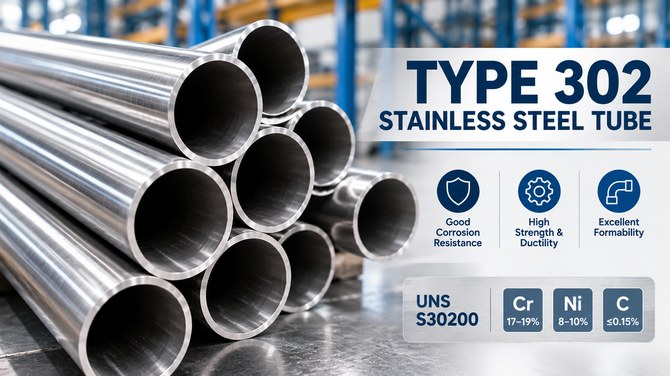
Type 302 and Type 304 are closely related austenitic stainless steel grades. Both contain chromium and nickel, but their composition limits and typical commercial uses differ.
| Comparison factor | Type 302 | Type 304 |
|---|---|---|
| UNS designation | S30200 | S30400 |
| Stainless steel family | Austenitic | Austenitic |
| Carbon content | 0.15% maximum under common specifications | 0.08% maximum under common specifications |
| Chromium content | Typically 17–19% | Typically 18–20% |
| Nickel content | Typically 8–10% | Typically 8–10.5% |
| General corrosion resistance | Good in suitable environments | Good in many general-purpose environments |
| Typical historical applications | Cold-worked products, springs and formed components | Broad industrial, fabricated and tubular applications |
| Commercial use | More specialised in many markets | Widely used as a general-purpose stainless steel grade |
The values shown are general reference limits, not a substitute for the applicable product specification.
Which Grade Should You Choose?
Type 302 may be suitable when a particular mechanical or fabrication requirement calls for its specified properties and the product is available in the required form.
Type 304 is commonly chosen for general-purpose stainless steel applications because it is widely available across many product forms, including tubes and pipes.
Neither grade should be selected solely because it has a higher carbon limit or a familiar name. Consider the application, manufacturing process, corrosion exposure, mechanical requirements and relevant material standard.
For a related product reference, see Leoscor Alloy Pipes’ SUS 304 stainless steel tubes.
Advantages of Type 302 Stainless Steel
The potential advantages of Type 302 stainless steel include:
- Useful corrosion resistance: Chromium helps protect the surface in suitable environments.
- Strength and ductility: The alloy can provide a useful balance of mechanical properties.
- Forming capability: It has been used in cold-working and forming applications.
- Versatility: The grade has a history of use in several manufacturing and engineering applications.
- Austenitic structure: Its microstructure supports useful toughness and fabrication characteristics.
These advantages depend on the product form, material condition, manufacturing quality and service environment.
Important Factors When Selecting Stainless Steel Tubes
Before purchasing a Type 302 stainless steel tube, evaluate the following points.
Material grade and standard: Confirm UNS S30200 and the applicable tubular product specification. Do not assume that a plate or sheet standard automatically covers tubes.
Dimensions: Specify the outside diameter, wall thickness, length and dimensional tolerances.
Operating conditions: Identify the working temperature, pressure, fluid and surrounding environment.
Corrosion requirements: Assess exposure to moisture, chlorides, chemicals and cleaning agents.
Fabrication requirements: Consider bending, forming, welding and any required post-fabrication treatment.
Inspection and documentation: Check the material test certificate, chemical composition, mechanical test results and traceability requirements.
Availability and delivery: Confirm stock availability, manufacturing lead time and the required quantity before placing an order.
For pressure-containing service, a qualified engineer should verify the material specification, design conditions and applicable piping code.
Stainless Steel Tubes from Leoscor Alloy Pipes
Leoscor Alloy Pipes offers stainless steel tube products, including SUS 304 and other grades listed in its product range. Buyers seeking Type 302 should confirm the availability of the exact grade and required tubular product specification before requesting a quotation.
When contacting a supplier, provide the grade, outside diameter, wall thickness, length, quantity, applicable standard and material certification requirements. This information helps determine whether the required product can be supplied and whether an alternative grade may meet the application requirements.
You can explore the SUS 304 stainless steel tubes product page for a related grade or visit the Leoscor Alloy Pipes website to discuss your requirements.
Conclusion
Type 302 stainless steel tube is associated with an austenitic chromium-nickel alloy that offers useful strength, ductility, formability and general corrosion resistance. The grade has been used in cold-worked products, formed components and selected engineering applications.
However, many applications have shifted towards Type 304 because of advances in steelmaking, availability and commercial considerations. The best choice depends on the exact material requirements, corrosion environment, product form and applicable standard.
Before purchasing Type 302 stainless steel tubing, verify the material grade, dimensional requirements, certification and suitability for the intended service. Where Type 302 is not readily available, a technically approved alternative may be worth evaluating.
Contact Leoscor Alloy Pipes with your grade, dimensions and project specifications to discuss suitable stainless steel tube options.
Frequently Asked Questions
1. What is Type 302 stainless steel?
Type 302 is an austenitic chromium-nickel stainless steel identified by UNS S30200. It is closely related to Type 304 and has a higher maximum carbon content under common specifications.
2. What is Type 302 stainless steel tube used for?
Type 302 has been used in formed components, springs, wire products and selected engineering applications. The suitability of a tube depends on the required product specification and operating conditions.
3. Is Type 302 stainless steel corrosion-resistant?
Yes, Type 302 provides useful corrosion resistance in many environments. However, its performance depends on the exposure conditions, and it should not be assumed suitable for every chemical or chloride-containing environment.
4. What is the difference between Type 302 and Type 304 stainless steel?
Type 302 permits a higher maximum carbon content under common specifications, while Type 304 is widely used for general-purpose stainless steel applications. Type 304 is also more commonly available in many tubular product forms.
5. Is Type 302 stainless steel magnetic?
Type 302 is generally non-magnetic when fully annealed, although cold working can produce some magnetic response.
6. Can Type 302 stainless steel be welded?
Type 302 can be welded using suitable procedures. Its higher carbon content makes the welding conditions and risk of sensitisation important considerations for certain applications.
7. What is the UNS number for Type 302 stainless steel?
The UNS designation for Type 302 stainless steel is S30200.
8. How do I purchase Type 302 stainless steel tubes?
Confirm the required grade, product specification, tube dimensions, quantity, certification and delivery schedule with the supplier before ordering.
9. Is Type 302 stainless steel better than Type 304?
Neither grade is universally better. Type 302 may be appropriate for specific mechanical or forming requirements, while Type 304 is commonly used for general-purpose corrosion-resistant applications. Selection should be based on the application and material specification.