

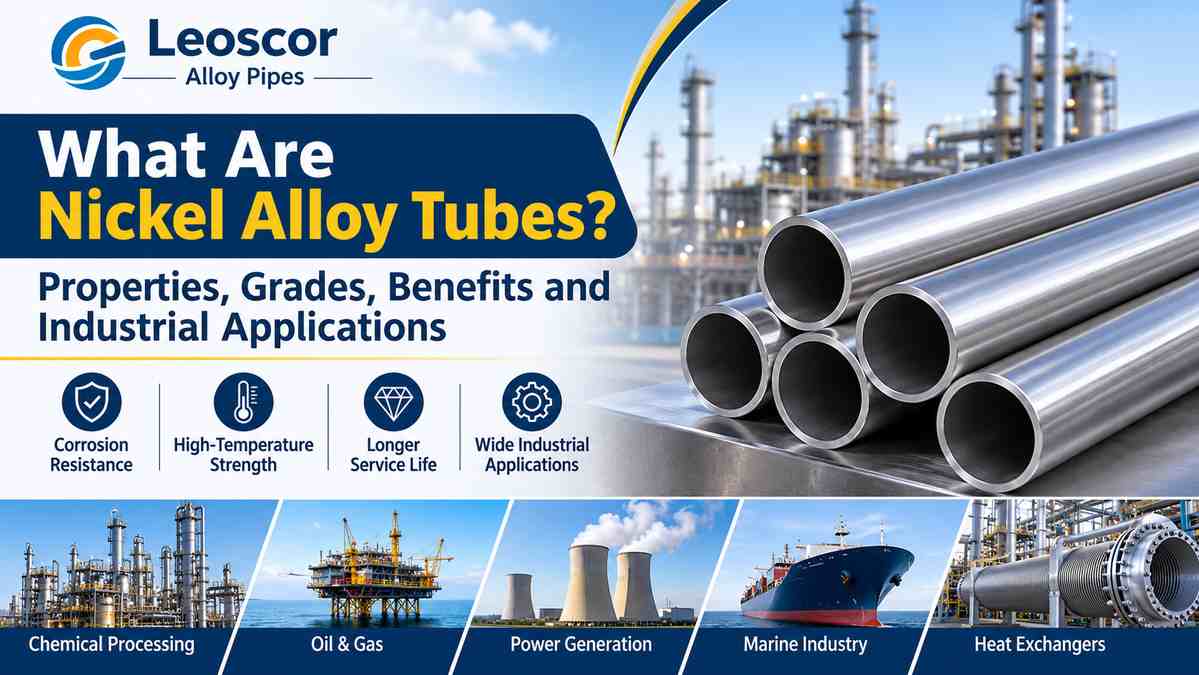
What Are Nickel Alloy Tubes? Properties, Grades, Benefits and Industrial Applications
In industries where equipment operates under high temperatures, pressure and corrosive conditions, selecting the right material is extremely important. A small material failure can affect production, damage equipment and increase maintenance costs. This is one of the main reasons why nickel alloy tubes are widely used in demanding industrial applications.
Nickel alloy tubes are known for their excellent corrosion resistance, strength and ability to perform in challenging operating environments. They are used in chemical processing plants, oil and gas facilities, power generation units, marine equipment and heat exchangers. Depending on the application, different nickel-based alloys offer specific properties that help industries handle heat, chemicals and mechanical stress.
But what exactly are nickel alloy tubes? Which grades are commonly available, and how do you choose the right one for your requirements?
Let’s understand their properties, grades, benefits and industrial applications in detail.
What Are Nickel Alloy Tubes?
Nickel alloy tubes are tubular products manufactured using nickel as the main or one of the major alloying elements, along with other metals such as chromium, iron, molybdenum and copper. The exact chemical composition depends on the grade and determines how the material performs under different operating conditions.
These tubes are designed for applications where ordinary carbon steel or standard stainless steel may not provide sufficient resistance to corrosion, oxidation or high temperatures.
For example, equipment used in chemical plants may come into contact with acids and other aggressive chemicals. Similarly, heat exchangers in power plants must withstand continuous temperature changes and demanding operating conditions. Nickel-based alloys are selected for such applications because certain grades can maintain their strength and corrosion resistance in environments where conventional materials may deteriorate.
Nickel alloy tubes are available in different dimensions, wall thicknesses, grades and manufacturing forms. They can be supplied as seamless or welded tubes, depending on the required specifications and application.
Important Properties of Nickel Alloy Tubes
The performance of nickel alloy tubes depends on their chemical composition, manufacturing process and operating conditions. Different grades offer different combinations of properties.
Here are some important characteristics that make these tubes suitable for industrial use.
1. Excellent Corrosion Resistance
Corrosion is a major concern in industries that handle chemicals, seawater, acids and other aggressive substances. Continuous exposure can damage equipment and reduce its service life.
Certain nickel alloy grades offer excellent resistance to specific corrosive environments. For example, Monel 400 is commonly selected for applications involving seawater and hydrofluoric acid under suitable conditions. Hastelloy C276 is used in demanding chemical processing environments because of its resistance to a broad range of corrosive media.
The correct grade must always be selected according to the chemical concentration, temperature and operating conditions.
2. High-Temperature Performance
Some industrial processes involve continuous exposure to elevated temperatures. Materials used in these conditions must retain suitable mechanical properties and resist oxidation.
Nickel-chromium-based alloys such as Inconel 600 and Inconel 601 are used in applications involving high temperatures. Incoloy 800H and 800HT are also selected for equipment operating under sustained heat exposure.
These properties make selected nickel alloy tubes suitable for furnace equipment, heat exchangers and thermal processing systems.
3. Good Mechanical Strength
Nickel alloys are used in applications where equipment is exposed to mechanical stress, pressure and temperature variations.
Depending on the grade and heat treatment, these materials can provide good tensile strength, toughness and structural stability.
This helps engineers select suitable tubing for demanding industrial systems where both material strength and corrosion resistance are important.
4. Resistance to Oxidation
Oxidation can become a serious issue when metal surfaces are exposed to high temperatures and oxygen. It can gradually affect the material surface and reduce its performance.
Certain nickel-chromium alloys develop protective oxide layers under suitable conditions. These layers help slow down further oxidation.
Inconel 601 is one example of a nickel alloy used in high-temperature applications where oxidation resistance is important.
5. Good Fabrication Properties
Many nickel alloy grades can be manufactured and fabricated using suitable industrial processes. Depending on the alloy, these processes may include cutting, forming, welding and machining.
However, nickel alloys do not all behave in the same way during fabrication. Some grades require special welding procedures, controlled heat input or particular machining practices.
Following the recommended fabrication guidelines is important to maintain the material’s performance.
Popular Grades of Nickel Alloy Tubes
Nickel alloy tubes are available in several grades, each developed for specific industrial requirements. Understanding the differences between these materials helps buyers and engineers select the right option.
1. Nickel 200 Tubes
Nickel 200 is a commercially pure nickel grade known for its good corrosion resistance in several environments, electrical and thermal conductivity, and useful mechanical properties.
It is commonly used in chemical processing equipment, food processing systems and applications involving caustic alkalis under suitable conditions.
Nickel 200 is covered by ASTM B163 for seamless heat exchanger and condenser tubes.
2. Nickel 201 Tubes
Nickel 201 is similar to Nickel 200 but has a lower carbon content. This makes it a preferred choice for certain applications involving elevated temperatures.
At temperatures above approximately 315°C, Nickel 200 may experience graphitisation under certain conditions. Nickel 201’s lower carbon content helps reduce this concern.
It is commonly considered for caustic evaporators, chemical processing equipment and other high-temperature applications where commercially pure nickel is suitable.
3. Inconel 600 Tubes
Inconel 600 is a nickel-chromium-iron alloy developed for applications requiring resistance to corrosion and oxidation at elevated temperatures.
Its combination of nickel and chromium makes it suitable for heat treatment equipment, chemical processing systems and selected nuclear industry applications.
These tubes are also used in heat exchangers and other equipment exposed to demanding thermal conditions.
4. Inconel 625 Tubes
Inconel 625 is a nickel-chromium-molybdenum alloy with niobium. It is known for its high strength and resistance to several corrosive environments.
The addition of molybdenum and niobium helps improve its mechanical properties and resistance to localised corrosion in suitable environments.
Inconel 625 tubes are commonly used in offshore equipment, marine systems, chemical processing plants and demanding heat exchanger applications.
5. Incoloy 800 and 800H Tubes
Incoloy 800 is a nickel-iron-chromium alloy used in applications requiring resistance to oxidation and carburisation at elevated temperatures.
Incoloy 800H and 800HT are modified grades developed to provide improved high-temperature creep and rupture properties.
These materials are commonly used in furnace equipment, petrochemical processing units, reformer systems and industrial heat exchangers.
6. Incoloy 825 Tubes
Incoloy 825 contains nickel, iron, chromium, molybdenum and copper. Its chemical composition provides resistance to several corrosive environments, including certain acidic conditions.
It is used in chemical processing equipment, pollution control systems, oil and gas applications and heat exchangers.
This grade is particularly useful where resistance to sulphuric acid and other aggressive process environments is required.
7. Monel 400 Tubes
Monel 400 is a nickel-copper alloy known for its resistance to seawater, marine environments and certain chemical solutions.
It offers good mechanical properties and is widely used in marine equipment, chemical processing systems, condensers and heat exchangers.
Its performance in hydrofluoric acid environments also makes it useful for certain specialised chemical applications.
8. Hastelloy C276 Tubes
Hastelloy C276 is a nickel-molybdenum-chromium alloy with excellent resistance to many aggressive chemical environments.
It is commonly selected for equipment exposed to mixed acids, chloride-containing solutions and other demanding process conditions.
Chemical processing plants, pollution control equipment and industrial heat exchangers are some of its important application areas.
Major Benefits of Nickel Alloy Tubes
Nickel alloy tubes offer several benefits that make them a preferred choice for specialised industrial applications.
Longer service life: Selecting a suitable nickel alloy can help reduce corrosion-related damage and extend equipment service life.
Reduced maintenance requirements: Materials with suitable corrosion and oxidation resistance may require fewer replacements and repairs under the intended operating conditions.
Reliable performance under heat: Certain grades retain useful mechanical properties at elevated temperatures, making them suitable for thermal processing equipment.
Suitable for aggressive environments: Different nickel alloy grades are developed to handle specific acids, alkalis, seawater and other corrosive substances.
Wide range of material options: Buyers can choose from commercially pure nickel, nickel-chromium, nickel-copper and nickel-molybdenum alloy families according to their requirements.
Versatile industrial applications: Nickel alloy tubes are available in different sizes, wall thicknesses and manufacturing forms for a wide range of equipment.
The important point is that not every nickel alloy offers all these benefits to the same extent. The right grade should always be selected after considering the actual service environment.
Industrial Applications of Nickel Alloy Tubes
Nickel alloy tubes are used across several industries because different grades can handle specialised operating conditions.
1. Chemical Processing Industry
Chemical processing plants use equipment that regularly comes into contact with acids, alkalis, solvents and other aggressive chemicals.
Nickel alloy tubes are used in heat exchangers, condensers, evaporators and process equipment where material corrosion resistance is important.
Grades such as Hastelloy C276, Incoloy 825 and Alloy 20 are considered for different chemical environments.
2. Oil and Gas Industry
Oil and gas operations often involve high pressure, corrosive fluids, elevated temperatures and demanding working conditions.
Certain nickel alloy grades are used in heat exchangers, process equipment and specialised tubing systems where resistance to corrosion and mechanical stress is required.
The material must be selected according to the fluid composition, temperature, pressure and applicable project specifications.
3. Power Generation Industry
Power plants depend on equipment that operates under continuous thermal and mechanical stress.
Nickel alloy tubes are used in selected heat exchangers, steam-related equipment and high-temperature processing systems.
Inconel 600, Inconel 625 and Incoloy 800H are examples of grades used in suitable power generation applications.
4. Marine Industry
Seawater can cause corrosion in conventional metals, particularly when equipment remains exposed for long periods.
Monel 400 and selected other nickel alloys are used in marine heat exchangers, condenser systems, seawater handling equipment and specialised marine components.
The grade selection depends on water chemistry, temperature, flow conditions and the possibility of deposits or biological growth.
5. Aerospace and High-Temperature Engineering
Certain nickel-based alloys are used in aerospace and specialised engineering applications because of their strength and performance at elevated temperatures.
They are used in selected engine-related components, thermal systems and equipment that must withstand demanding operating conditions.
The specific alloy and product form depend on the design requirements and applicable industry approvals.
6. Heat Exchanger Manufacturing
Heat exchangers transfer heat between two fluids without allowing them to mix. The tubes used in these systems must withstand the temperature, pressure and chemical conditions of the process fluids.
Nickel alloy tubes are selected when standard materials cannot provide the required performance.
Depending on the application, grades such as Nickel 201, Inconel 600, Inconel 625, Incoloy 825 and Monel 400 may be considered.
Nickel Alloy Seamless Tubes vs Welded Tubes
Nickel alloy tubes are available in both seamless and welded forms. The selection depends on the equipment design, operating pressure, dimensions and project specifications.
Seamless Nickel Alloy Tubes
Seamless tubes are manufactured without a longitudinal welded seam. They are produced through processes such as piercing and subsequent rolling or drawing.
They are commonly selected for applications requiring specific pressure capabilities, dimensional requirements and manufacturing standards.
Welded Nickel Alloy Tubes
Welded tubes are manufactured by forming metal strip or plate into a tubular shape and joining the edges through a controlled welding process.
They can be suitable for many industrial applications where the required specifications and inspection criteria are met.
Neither construction is automatically suitable for every application. Engineers should consider the applicable ASTM specification, manufacturing quality, inspection requirements and operating conditions before making a decision.
Important ASTM Standards for Nickel Alloy Tubes
ASTM standards define important requirements for material composition, manufacturing, dimensions, testing and inspection.
Some commonly used specifications for nickel alloy tubes include:
- ASTM B163 – Seamless nickel and nickel alloy condenser and heat exchanger tubes.
- ASTM B165 – Seamless Monel 400 tubes.
- ASTM B166 – Nickel-chromium-iron alloys, including Inconel 600, in relevant product forms.
- ASTM B167 – Seamless nickel-chromium-iron alloy tubes.
- ASTM B423 – Seamless nickel-iron-chromium-molybdenum-copper alloy tubes, including Incoloy 825.
- ASTM B444 – Nickel-chromium-molybdenum-columbium alloy tubes, including Inconel 625.
- ASTM B622 – Seamless nickel and nickel-cobalt alloy tubes for suitable grades.
The correct specification must match the alloy grade and product form. Buyers should always check the latest applicable standard and project requirements before placing an order.
How to Choose the Right Nickel Alloy Tube?
Choosing a nickel alloy tube is not simply about selecting a material with a high nickel content. The tube must be suitable for the actual operating conditions.
Here are some important points to consider:
1. Understand the operating environment: Identify the chemicals, fluids, temperature and pressure to which the tube will be exposed.
2. Select the appropriate grade: Compare the corrosion resistance, mechanical properties and temperature limitations of different alloy grades.
3. Check the ASTM specification: Make sure the selected product meets the required material and manufacturing standard.
4. Confirm dimensions: Specify the outside diameter, wall thickness and required length accurately.
5. Choose the manufacturing form: Decide whether seamless or welded tubes are suitable for the intended application.
6. Verify material documentation: Ask for the relevant inspection documents and material test certificates, such as EN 10204 3.1, when required by the project.
7. Work with a reliable supplier: Choose a supplier who understands industrial material requirements and can provide the correct grade, specifications and supporting documents.
Providing these details before requesting a quotation helps avoid material mismatches, ordering errors and unnecessary delays.
Why Choose Leoscor Alloy Pipes for Nickel Alloy Tubes?
Finding the correct nickel alloy tube is important for the safety, reliability and performance of industrial equipment. Buyers need a supplier who understands different alloy grades, material standards and application requirements.
Leoscor Alloy Pipes is an India-based supplier, stockist and exporter of nickel alloy tubes, serving industrial customers with a range of material grades and specifications.
The company’s product range includes Nickel 200, Nickel 201, Inconel 600, Inconel 601, Inconel 625, Incoloy 800, Incoloy 825, Monel 400 and Hastelloy grades.
Nickel alloy tubes are available in different specifications and forms, including seamless and welded construction, subject to grade and availability.
Leoscor Alloy Pipes focuses on reliable sourcing, quality control, technical requirements and delivery support for customers across different industries.
Whether you require tubes for chemical processing, heat exchangers, marine equipment or other industrial applications, discussing your project requirements with an experienced supplier can help you identify a suitable material.
To explore available grades, specifications and product details, visit the Nickel Alloy Tubes Supplier and Exporter page of Leoscor Alloy Pipes.
Conclusion
Nickel alloy tubes play an important role in industries where corrosion resistance, strength and high-temperature performance are essential. From chemical processing and oil and gas facilities to marine equipment and heat exchangers, these materials help engineers select suitable tubing solutions for demanding operating conditions.
Grades such as Nickel 200, Nickel 201, Inconel 600, Inconel 625, Incoloy 825, Monel 400 and Hastelloy C276 offer different properties for specific industrial requirements.
The right choice depends on the operating temperature, pressure, chemical exposure, tube dimensions and applicable ASTM specifications. Understanding these factors before purchasing helps ensure that the selected material is suitable for its intended application.
If you are looking for dependable nickel alloy tubes for your industrial requirements, Leoscor Alloy Pipes can assist you in exploring suitable grades and specifications.
Contact Leoscor Alloy Pipes today to discuss your nickel alloy tube requirements and request a quotation.