

Inconel 625 Tubes for Offshore Applications: Benefits, Uses and Selection Guide
Offshore oil and gas operations are carried out in some of the most demanding industrial environments. Equipment installed on offshore platforms, subsea systems and marine facilities is regularly exposed to seawater, chloride-rich fluids, high pressure, temperature changes and corrosive chemicals.
In these conditions, selecting the right material is essential. A small corrosion-related failure in an offshore system can lead to expensive repairs, production delays and safety concerns.
This is one reason why Inconel 625 tubes are widely considered for demanding offshore applications. Also known as Alloy 625 or UNS N06625, this nickel-based alloy offers a combination of high mechanical strength, corrosion resistance and reliable performance across a wide temperature range.
But where exactly are Inconel 625 tubes used in offshore projects? What makes this alloy suitable for marine and subsea environments? And what should buyers check before purchasing it?
Let’s explore its properties, applications and important selection considerations.
What Is Inconel 625?
Inconel 625 is a nickel-chromium-molybdenum-niobium alloy developed for applications requiring high strength and resistance to demanding corrosive environments.
It is identified by UNS N06625 and European material number 2.4856.
The alloy contains nickel, chromium, molybdenum and niobium as its major alloying elements. Molybdenum and niobium contribute to its strength, while chromium and the nickel-rich matrix help provide resistance to oxidation and corrosion.
Unlike some precipitation-hardened nickel alloys, Inconel 625 gains much of its strength through solid-solution strengthening. This allows it to maintain useful mechanical properties without relying on conventional precipitation-hardening treatments.
Some important characteristics include:
- Excellent resistance to many corrosive environments.
- High tensile and fatigue strength.
- Good resistance to pitting and crevice corrosion.
- Good resistance to chloride-induced stress corrosion cracking.
- Good oxidation resistance.
- Good weldability and fabricability.
- Useful mechanical performance at elevated and low temperatures.
These properties make Inconel 625 a suitable candidate for selected offshore, marine, chemical processing and oil and gas applications.
Why Are Inconel 625 Tubes Used in Offshore Applications?
Offshore facilities face several material-related challenges that are not always present in ordinary industrial installations.
Seawater contains chlorides that can cause localized corrosion. Offshore production systems may also handle fluids containing carbon dioxide, hydrogen sulphide, salts and other corrosive substances.
Equipment can experience continuous vibration, pressure fluctuations, temperature changes and mechanical loading.
Inconel 625 is considered for applications where a combination of corrosion resistance and mechanical strength is required.
1. Resistance to Seawater Corrosion
Seawater is one of the most challenging environments for metallic materials because of its chloride content.
Chloride ions can cause pitting and crevice corrosion in susceptible alloys, particularly when deposits, stagnant conditions or tight gaps are present.
Inconel 625 contains chromium and molybdenum, which help improve its resistance to localized corrosion.
This makes the alloy useful for selected offshore seawater systems, marine equipment, heat exchangers and subsea components.
However, actual performance depends on seawater temperature, velocity, oxygen content, deposits, crevice geometry and operating conditions. Material selection should always consider the complete service environment.
2. High Mechanical Strength
Offshore equipment must withstand pressure, vibration, mechanical loads and changing operating conditions.
Inconel 625 offers high tensile strength and good fatigue properties, making it suitable for selected components where mechanical performance is important.
Its strength also allows engineers to evaluate it for specialised tubing, hydraulic systems and instrumentation applications.
The required dimensions, material condition and design calculations must still be verified before the product is selected.
3. Resistance to Pitting and Crevice Corrosion
Pitting corrosion creates small, localised holes in a metal surface, while crevice corrosion can develop in narrow gaps where fluid movement is restricted.
Both are important concerns in offshore installations.
The molybdenum and chromium content of Inconel 625 helps improve its resistance to these corrosion mechanisms.
This is particularly useful in selected components exposed to seawater and chloride-containing fluids.
4. Performance in Demanding Chemical Environments
Offshore production equipment may come into contact with produced water, process chemicals, injection fluids and other corrosive media.
Inconel 625 provides resistance to many chemical environments, including several chloride-bearing and mixed chemical conditions.
Its suitability must nevertheless be evaluated against the actual fluid composition, concentration, temperature and exposure time.
Top Offshore Applications of Inconel 625 Tubes
Inconel 625 tubes are considered for several offshore and marine applications where corrosion resistance and mechanical properties are important.
1. Subsea Control and Hydraulic Tubing
Subsea production systems use hydraulic and control lines to operate valves, control equipment and support remote operations.
These systems may be exposed to seawater, pressure and demanding operating conditions.
Inconel 625 tubing can be considered for selected hydraulic and control-line applications where its corrosion resistance and strength meet the project requirements.
For subsea systems, buyers should pay attention to dimensional tolerances, pressure ratings, fatigue requirements, material condition and inspection documentation.
2. Chemical Injection Lines
Offshore platforms use chemical injection systems to introduce treatment chemicals into production and process streams.
These chemicals may be used for corrosion inhibition, scale control, hydrate prevention and other production requirements.
Inconel 625 tubes may be considered for selected chemical injection applications where the alloy is compatible with the injected chemical and operating environment.
Before selecting the material, engineers should check the chemical composition, concentration, pressure, temperature and flow conditions.
3. Seawater Handling Systems
Offshore platforms require seawater for cooling, firefighting, utility services and other operations.
Seawater exposure can create corrosion challenges for conventional materials, particularly in stagnant areas and crevices.
Inconel 625 may be used in selected seawater-exposed tubing, equipment and associated components where its corrosion properties meet the design requirements.
The final choice should consider the system’s flow velocity, temperature, deposits and maintenance conditions.
4. Offshore Heat Exchangers
Heat exchangers are used to transfer heat between process fluids, cooling water and other operating media.
Offshore heat exchangers may experience both thermal stress and corrosion due to the fluids passing through their tubes.
Inconel 625 tubes can be considered for selected heat transfer applications where corrosion resistance and mechanical performance are required.
Engineers should compare tube-side and shell-side fluid conditions, design temperature, pressure, heat transfer requirements and the applicable product standard.
5. Oil and Gas Production Equipment
Offshore oil and gas production systems handle hydrocarbons, produced water, gas and process chemicals.
Certain production environments contain carbon dioxide, hydrogen sulphide and chlorides, which can create challenging corrosion conditions.
Inconel 625 is used in selected oil and gas components and equipment, including specialised tubing and corrosion-resistant parts.
For applications involving hydrogen sulphide, the alloy grade alone does not establish sour-service compliance. The project must verify the applicable NACE MR0175 / ISO 15156 requirements, material condition, hardness limits and environmental conditions.
6. Offshore Risers and Associated Equipment
Risers connect subsea production systems with offshore platforms or floating facilities.
These systems may experience seawater exposure, pressure, mechanical loading, fatigue and movement.
Inconel 625 is used in selected offshore riser systems, components and corrosion-resistant applications.
The exact product form and design must be selected according to the riser configuration, loading conditions, applicable standards and engineering requirements.
7. Marine Instrumentation Systems
Offshore facilities depend on instrumentation to monitor pressure, temperature, flow and other process parameters.
Instrumentation tubing connects sensors, transmitters and control equipment to the main process system.
Inconel 625 tubing can be considered for selected instrumentation applications where corrosion resistance, mechanical strength and dimensional requirements are important.
Tube outside diameter, wall thickness, connection compatibility and pressure rating should be confirmed before ordering.
Inconel 625 Tube Specifications and Material Identification
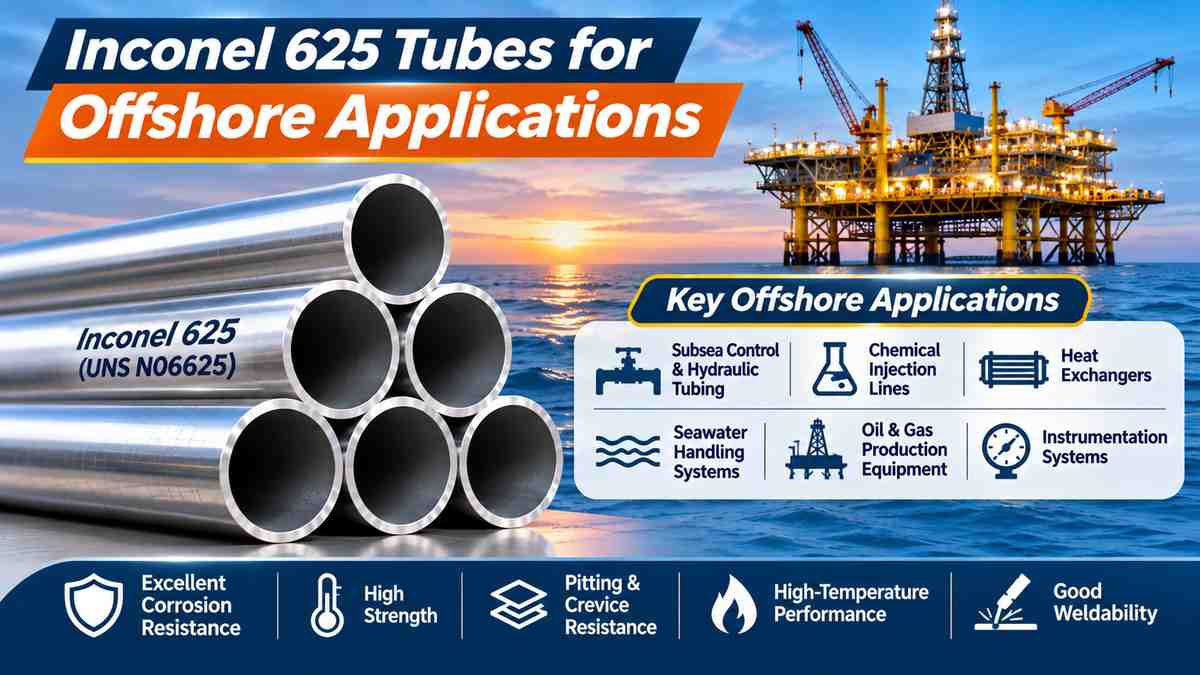
When purchasing Inconel 625 tubes, buyers should confirm the exact material designation and product specification.
Some common material identifiers include:
| Parameter | Specification |
|---|---|
| Alloy Name | Inconel 625 / Alloy 625 |
| UNS Number | N06625 |
| European Material Number | 2.4856 |
| Material Family | Nickel-Chromium-Molybdenum-Niobium Alloy |
| Seamless Tube Specification | ASTM B444 |
| ASME Equivalent Specification | ASME SB444 |
| Main Alloying Elements | Nickel, Chromium, Molybdenum and Niobium |
ASTM B444 covers seamless nickel-chromium-molybdenum-columbium alloy pipe and tube. Buyers should confirm the applicable edition, grade, product form and additional purchase requirements.
The required manufacturing route, dimensions, heat treatment and inspection scope should be clearly mentioned in the purchase order.
Seamless vs Welded Inconel 625 Tubes for Offshore Projects
Inconel 625 tubes may be available in different manufacturing forms, depending on the product specification and supplier’s manufacturing capabilities.
Seamless Inconel 625 Tubes
Seamless tubes are manufactured without a longitudinal weld seam. They are considered for applications where the project requires seamless construction and specific dimensional or mechanical requirements.
Welded Inconel 625 Tubes
Welded tubes are manufactured by forming alloy strip or sheet into a tubular shape and joining the edges through a controlled welding process.
They can be suitable for applications where the selected welded product standard, weld quality and inspection requirements meet the project specification.
Neither manufacturing method is automatically suitable for every offshore application. The correct choice depends on pressure, temperature, fatigue loading, dimensions, design code and required inspection.
Important Factors Before Buying Inconel 625 Tubes for Offshore Applications
Offshore procurement involves detailed technical requirements. Before placing an order, buyers should review the following points.
1. Material Grade: Confirm that the required alloy is Inconel 625, UNS N06625.
2. Product Specification: Check the applicable ASTM B444 or other approved product standard according to the required product form.
3. Tube Dimensions: Specify outside diameter, wall thickness, length and dimensional tolerances.
4. Operating Pressure: Confirm design pressure, working pressure and the required pressure rating.
5. Operating Temperature: Review normal, minimum and maximum operating temperatures.
6. Corrosion Environment: Provide details about seawater, chlorides, H2S, CO2, produced water and chemical exposure.
7. Sour-Service Requirements: Where hydrogen sulphide is present, confirm applicable NACE MR0175 / ISO 15156 requirements and project-specific restrictions.
8. Testing and Certification: Confirm chemical analysis, mechanical tests, nondestructive examination, PMI and material traceability requirements.
9. Material Test Certificate: Specify the required EN 10204 certificate type and inspection documentation.
10. Supplier Capability: Check the supplier’s product range, manufacturing options, quality procedures and ability to meet project requirements.
Providing these details helps suppliers understand the application and prepare a more accurate quotation.
Frequently Asked Questions
1. What is Inconel 625 tube used for in offshore applications?
Inconel 625 tubes are considered for selected offshore applications involving seawater, chloride-containing fluids, mechanical loading and demanding operating conditions. Typical uses include subsea control systems, hydraulic tubing, chemical injection lines, instrumentation systems and selected heat exchanger equipment. The final selection depends on the product specification and actual service environment.
2. Why is Inconel 625 suitable for seawater applications?
Inconel 625 contains chromium and molybdenum, which help improve resistance to pitting and crevice corrosion. These properties make it useful in selected seawater-exposed offshore and marine applications. However, performance depends on water temperature, flow velocity, deposits, oxygen content and crevice conditions. A complete corrosion review is necessary for critical systems.
3. What is the UNS number of Inconel 625?
The UNS designation of Inconel 625 is N06625. It is also known as Alloy 625 and has the European material number 2.4856. Buyers should confirm the UNS number and chemical composition on the material test certificate before accepting the supplied tubes.
4. Which ASTM standard is used for Inconel 625 seamless tubes?
ASTM B444 is the relevant specification for seamless nickel-chromium-molybdenum-columbium alloy pipe and tube, including UNS N06625. It defines requirements relating to chemical composition, mechanical properties and product quality. The required grade, dimensions, material condition and testing requirements should be clearly stated in the purchase order.
5. Is Inconel 625 suitable for sour-service offshore applications?
Inconel 625 is used in selected oil and gas environments containing hydrogen sulphide, but the alloy designation alone does not confirm sour-service suitability. The project must evaluate the H2S partial pressure, temperature, pH, chloride content, material condition and hardness. Applicable NACE MR0175 / ISO 15156 requirements must also be checked.
6. What is the difference between Inconel 625 and stainless steel 316L for offshore use?
Inconel 625 generally offers better resistance to many aggressive chloride-containing environments, especially localized pitting and crevice corrosion, than 316L. It also provides higher mechanical strength in relevant product conditions. However, 316L may be suitable for less aggressive environments at a lower material cost. Selection depends on the actual service conditions and project requirements.
7. Can Inconel 625 tubes be used in subsea systems?
Yes, Inconel 625 is used in selected subsea equipment and tubing applications where corrosion resistance and mechanical performance are required. The design must account for external seawater exposure, internal fluid chemistry, pressure, fatigue, temperature and installation conditions. The required product specification and project qualification should be verified before procurement.
8. What information is required when requesting an Inconel 625 tube quotation?
Buyers should provide the alloy designation, ASTM specification, seamless or welded requirement, outside diameter, wall thickness, length, quantity and required material condition. For offshore projects, also include operating pressure, temperature, process fluid, H2S exposure, applicable NACE/ISO requirements and inspection documentation.
Conclusion
Offshore installations require materials that can withstand corrosion, pressure, temperature changes and demanding operating conditions.
Inconel 625 is an important nickel-based alloy used in selected offshore and marine applications because it combines high mechanical strength with excellent resistance to many corrosive environments.
Its applications include subsea control tubing, chemical injection lines, seawater systems, heat exchangers, instrumentation and selected oil and gas production equipment.
However, choosing the correct product requires more than selecting the alloy grade. Buyers should verify the product specification, dimensions, manufacturing method, operating conditions, sour-service requirements and certification before placing an order.
At Leoscor Alloy Pipes, customers can explore ASTM B444 Inconel 625 tubes for different industrial and project requirements.
Looking for Inconel 625 Tubes for Your Offshore Project?
Connect with Leoscor Alloy Pipes to discuss your required UNS N06625 tube dimensions, manufacturing form, ASTM specification and project requirements.
Explore our product range:
ASTM B444 Inconel 625 Tubes Supplier and Exporter – Leoscor Alloy Pipes
Contact Leoscor Alloy Pipes today for product enquiries and technical assistance.