

Seamless Steel Tubes Manufacturer Grades, Manufacturing Process, Applications and Selection Guide
Seamless steel tubes are essential components in industries where strength, dimensional accuracy and reliable performance are important. They are widely used in oil and gas, petrochemical, refining, marine, instrumentation, pharmaceutical, medical and process industries.
Unlike welded tubes, seamless steel tubes are manufactured without a longitudinal welded joint. This makes them suitable for many applications involving pressure, temperature variations and demanding operating conditions.
Choosing the right seamless steel tube manufacturer is important for ensuring product quality, material suitability, dimensional accuracy and compliance with project specifications.
Leoscor Alloy Pipes offers a wide range of industrial tubes, including stainless steel, duplex stainless steel, super duplex stainless steel, nickel alloy, carbon steel and alloy steel tubes.
In this guide, we explain the manufacturing process, common grades, industrial applications, material specifications and important factors to consider when selecting a seamless steel tube manufacturer.
1. What Are Seamless Steel Tubes?
Seamless steel tubes are hollow cylindrical products manufactured without joining two edges through a longitudinal welding process.
They are produced using processes such as billet piercing, extrusion, hot rolling and cold drawing. These processes create a continuous tubular structure that can be finished to the required outside diameter, wall thickness and length.
Seamless steel tubes are used in applications where engineering requirements demand specific mechanical properties, dimensional tolerances and pressure-handling capabilities.
Important characteristics include:
- No longitudinal welded joint
- Availability in different material grades
- Different outside diameters and wall thicknesses
- Suitable for selected high-pressure applications
- Availability in hot-finished and cold-drawn forms
- Applications across multiple industrial sectors
The actual performance of a seamless tube depends on its material grade, manufacturing process, heat treatment, dimensions and applicable product standard.
2. How Are Seamless Steel Tubes Manufactured?
Seamless steel tubes are manufactured through a series of controlled operations to achieve the required dimensions and material properties.
Step 1: Raw Material Selection
The process starts with selecting a suitable solid steel billet according to the required material grade and chemical composition.
Step 2: Heating
The billet is heated to the required temperature to make it suitable for the piercing and forming operations.
Step 3: Piercing
A piercing operation creates a hollow section from the solid billet. This forms the initial tubular shape without a longitudinal weld seam.
Step 4: Rolling and Sizing
The hollow section passes through rolling and sizing operations to achieve the required outside diameter and wall thickness.
Step 5: Heat Treatment
Depending on the material grade and applicable specification, the tube may undergo heat treatment to achieve the required mechanical properties and material condition.
Step 6: Finishing
The tube is straightened, cut to the required length and finished according to the order requirements.
Step 7: Inspection and Testing
Final inspection may include dimensional checks, chemical analysis, mechanical testing and other examinations required by the applicable specification and purchase order.
3. Types of Seamless Steel Tubes
Seamless tubes are available in different material grades to meet the requirements of various industrial applications.
Stainless Steel Seamless Tubes
Stainless steel seamless tubes are commonly selected for applications requiring corrosion resistance, strength and durability.
Popular grades include:
- 304 Stainless Steel Tubes
- 304L Stainless Steel Tubes
- 304H Stainless Steel Tubes
- 310 Stainless Steel Tubes
- 310S Stainless Steel Tubes
- 316 Stainless Steel Tubes
- 316L Stainless Steel Tubes
- 316Ti Stainless Steel Tubes
- 317L Stainless Steel Tubes
- 321 Stainless Steel Tubes
- 347 Stainless Steel Tubes
- 904L Stainless Steel Tubes
These grades are used in chemical processing, food processing, pharmaceutical equipment, heat exchangers and industrial systems.
Duplex Stainless Steel Tubes
Duplex stainless steel tubes have a mixed austenitic-ferritic microstructure. They offer a combination of mechanical strength and corrosion resistance.
Common grades include:
They are used in chemical plants, marine systems, offshore installations and other applications requiring resistance to chloride-related corrosion.
Super Duplex Stainless Steel Tubes
Super duplex stainless steel tubes are developed for demanding corrosive environments where high strength and resistance to pitting and crevice corrosion are important.
Common grades include:
These tubes are considered for offshore oil and gas facilities, seawater systems, desalination plants and chemical processing equipment.
Nickel Alloy Seamless Tubes
Nickel alloy seamless tubes are used in applications involving demanding corrosion, oxidation and temperature conditions.
Leoscor alloy pipes listed nickel alloy seamless tube range includes:
- ASTM B163 Nickel 200 Tube
- ASTM B163 Nickel 201 Tube
- ASTM B166 Inconel 600 Tube
- ASTM B167 Inconel 601 Tube
- ASTM B444 Inconel 625 Tube
- ASTM B163 Incoloy 800 Tube
- ASTM B163 Incoloy 800H Tube
- ASTM B163 Incoloy 800HT Tube
- ASTM B423 Incoloy 825 Tube
- ASTM B165 Monel 400 Tube
- ASTM B622 Hastelloy C276 Tube
- ASTM B622 Hastelloy C22 Tube
- ASTM B622 Hastelloy B2 Tube
- ASTM B729 Alloy 20 Tube
- ASTM B338 Titanium Grade 2 Tubes
These materials are used in chemical processing, petrochemical plants, marine engineering, heat exchangers and specialised industrial equipment.
Carbon Steel and Alloy Steel Tubes
Carbon steel and alloy steel tubes are used in applications requiring specific mechanical properties and pressure or temperature performance.
Examples listed in Leoscor’s range include:
- ASTM A179 / ASME SA179 Tubes
- ASTM A192 / ASME SA192 Tubes
- ASTM A210 Grade A1 / ASME SA210 Grade A1 Tubes
- ASTM A210 Grade C / ASME SA210 Grade C Tubes
- ASTM A519 AISI 4130 Tubes
- ASTM A519 AISI 4140 Tubes
These materials are commonly considered for boiler, mechanical and industrial engineering applications, subject to the relevant product specification.
4. Seamless Steel Tubes vs Welded Steel Tubes
Seamless and welded tubes are both used across industrial applications. Their manufacturing methods and product specifications differ.
| Parameter | Seamless Steel Tubes | Welded Steel Tubes |
|---|---|---|
| Manufacturing | Produced through piercing and forming | Produced by forming and welding |
| Longitudinal weld | No longitudinal weld seam | Contains a longitudinal weld seam |
| Production route | Hot working, cold drawing or related processes | Strip or plate forming and welding |
| Inspection | Material and dimensional testing as specified | Material, weld and dimensional inspection as specified |
| Applications | Selected pressure, heat exchanger and industrial services | Industrial, process and equipment applications |
| Selection | Based on material, pressure, dimensions and design code | Based on material, weld quality, dimensions and design code |
Seamless tubes are not automatically better for every application. The correct choice depends on operating conditions, project requirements, applicable standards, dimensions and inspection criteria.
5. Industrial Applications of Seamless Steel Tubes
Seamless steel tubes are used across a wide range of industries because different material grades can meet different engineering requirements.
Oil and Gas Industry
Oil and gas facilities require tubes that can withstand demanding operating environments involving pressure, temperature and corrosive fluids.
Applications include:
- Process equipment
- Instrumentation systems
- Heat exchanger equipment
- Offshore installations
- Specialised fluid handling systems
The selected grade must be suitable for the actual process conditions.
Petrochemical and Refining Industry
Petrochemical plants and refineries use tubular products in process systems, heat exchangers and other equipment exposed to hydrocarbons, chemicals and elevated temperatures.
Nickel alloy, stainless steel and alloy steel tubes may be selected according to the application.
Marine Industry
Marine environments expose equipment to seawater and chloride-containing conditions. Duplex, super duplex and selected nickel alloy tubes are considered for suitable marine applications.
Pharmaceutical and Medical Industries
Pharmaceutical and medical manufacturing facilities require suitable materials for equipment used in controlled processing environments. Material selection depends on hygiene, cleaning, corrosion and regulatory requirements.
Process Technology and Biotechnology
Process technology and biotechnology facilities use tubular products in specialised equipment and process systems. The required material depends on the fluid, cleaning process, temperature and operating conditions.
Heat Exchanger Applications
Heat exchanger tubes are used to transfer heat between fluids in industrial equipment.
Depending on the service conditions, manufacturers and suppliers provide different options, including condenser and heater tubes, heat exchanger tubes and heat exchanger U-tubes.
6. Different Types of Tubing Available
Apart from conventional seamless and welded tubes, industrial buyers may require specialised tubing forms for particular applications.
Leoscor’s product page lists the following product categories:
- Seamless Tubing
- Welded Tubes
- Condenser and Heater Tubes
- EFW (Electric Fusion Welded) Tubes
- Instrumentation Tubes
- Heat Exchanger Tubes
- Heat Exchanger U-Tubes
- Coiled Tubing
- Capillary Tubes
- Hot-Finished Seamless Tubing
- Cold-Drawn Tubing
- ERW Tubing
Each product form has different manufacturing and application requirements. Buyers should confirm the required construction and specification before ordering.
7. Important Standards for Seamless Steel Tubes
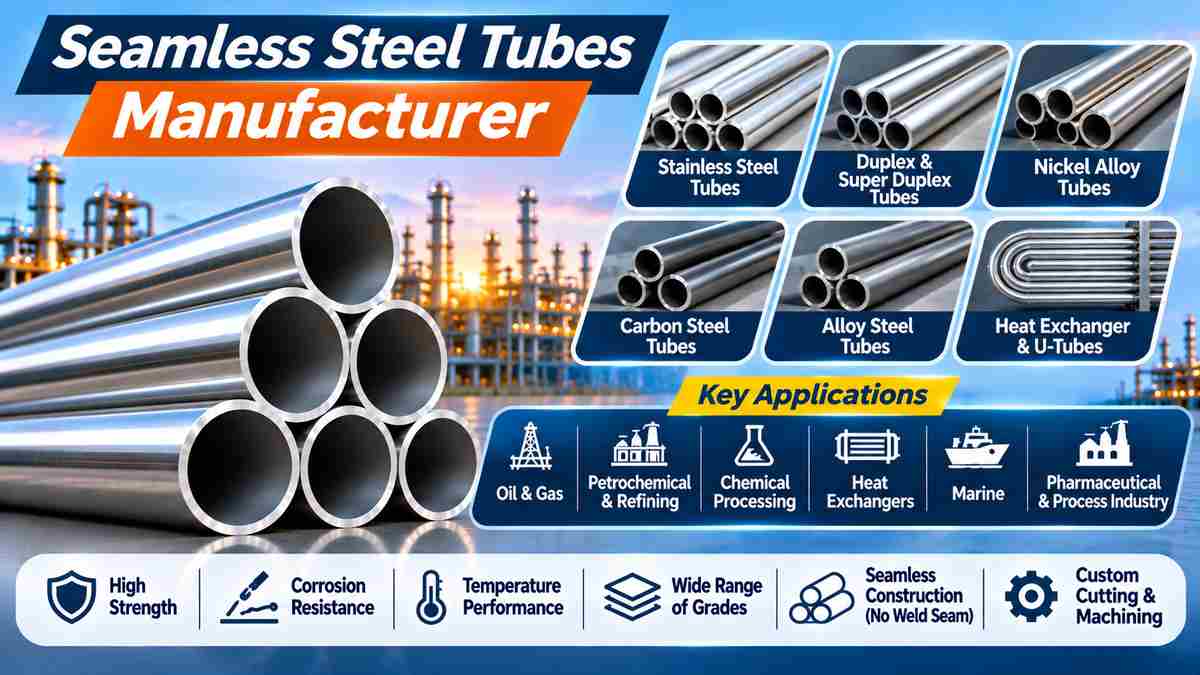
Seamless steel tubes are supplied according to material-specific standards. The correct specification depends on the grade, intended application and product form.
Some examples from the product range include:
| Standard | Product category |
|---|---|
| ASTM A179 / ASME SA179 | Heat exchanger and condenser tubes |
| ASTM A192 / ASME SA192 | Seamless carbon steel boiler tubes |
| ASTM A210 / ASME SA210 | Seamless medium-carbon steel boiler and superheater tubes |
| ASTM A519 | Carbon and alloy steel mechanical tubing |
| ASTM B163 | Nickel alloy seamless condenser and heat exchanger tubes |
| ASTM B167 | Nickel-chromium-iron alloy pipe and tube |
| ASTM B444 | Nickel-chromium-molybdenum-columbium alloy pipe and tube |
| ASTM B423 | Nickel-iron-chromium-molybdenum-copper alloy pipe and tube |
The table provides examples, not a complete list of all applicable standards. Always confirm the exact grade coverage and product requirements in the relevant standard edition.
8. How to Choose the Right Seamless Steel Tubes Manufacturer?
Selecting a suitable manufacturer or supplier is an important part of industrial procurement. Buyers should evaluate the following factors before placing an order.
Material Grade Availability
Check whether the supplier offers the required stainless steel, duplex, super duplex, nickel alloy, carbon steel or alloy steel grade.
Product Range
Review whether the supplier can provide the required tube form, such as seamless tubing, welded tubes, heat exchanger tubes, U-tubes or instrumentation tubes.
Dimensional Requirements
Confirm the outside diameter, wall thickness, length and dimensional tolerances required for the project.
Applicable Standards
Check that the offered material and product form comply with the applicable ASTM, ASME, EN or other project specification.
Quality Inspection and Documentation
Ask for the required chemical analysis, mechanical test results, material test certificates, inspection reports and traceability documentation.
Manufacturing and Finishing Capabilities
For specialised requirements, confirm the availability of cutting, machining and other finishing services.
Technical Support and Enquiry Handling
A reliable supplier should be able to understand the technical requirements and provide product information relevant to the application.
9. Why Choose Leoscor Alloy Pipes as Your Tube Supplier?
Leoscor Alloy Pipes supplies and manufactures a wide range of industrial tubes for customers across India and international markets.
According to its product information, the company offers corrosion-resistant tubular products in round, square and rectangular forms, with different widths, thicknesses and material grades.
Its listed product range includes:
- Stainless Steel Tubes
- Duplex Stainless Steel Tubes
- Super Duplex Stainless Steel Tubes
- Zeron 100 Tubes
- 253MA Tubes
- 254 SMO Tubes
- Ferralium 255 Tubes
- Carbon Steel Tubes
- Alloy Steel Tubes
- Nickel Alloy Tubes
The company also lists different tubing forms, including seamless, welded, condenser and heater tubes, EFW tubes, instrumentation tubes, heat exchanger tubes, U-tubes, coiled tubing and capillary tubes.
Its product page also mentions tube laser handling, saw cutting and machining services to meet customer specifications.
Customers can discuss requirements for:
- Different material grades
- Seamless and welded tube options
- Round, square and rectangular forms
- Required widths and thicknesses
- Cutting and machining requirements
- Industrial and project-specific applications
Explore the complete Tubes Manufacturer and Exporter product range at Leoscor Alloy Pipes to view available categories and submit an enquiry.
Contact Leoscor Alloy Pipes with your required material grade, dimensions, quantity and applicable specification to request product details and a quotation.
Frequently Asked Questions
1. What are seamless steel tubes?
Seamless steel tubes are hollow tubular products manufactured without a longitudinal welded joint. They are used in industrial applications requiring specific mechanical properties, dimensions and material performance.
2. How are seamless steel tubes manufactured?
They are generally manufactured through billet heating, piercing, rolling, sizing, heat treatment and finishing. The exact production route depends on the material and required product specifications.
3. Which materials are available in seamless steel tubes?
Common material categories include stainless steel, duplex stainless steel, super duplex stainless steel, nickel alloys, carbon steel and alloy steel.
4. What is the difference between seamless and welded tubes?
Seamless tubes are manufactured without a longitudinal weld seam, while welded tubes are produced by forming and joining metal through welding. Their suitability depends on the applicable specification and service requirements.
5. Where are seamless steel tubes used?
They are used in oil and gas, petrochemical, refining, marine, pharmaceutical, medical, biotechnology, process technology and heat exchanger applications.
6. What is the difference between hot-finished and cold-drawn seamless tubes?
Hot-finished tubes undergo forming at elevated temperatures. Cold-drawn tubes undergo additional forming at lower temperatures to achieve specific dimensional tolerances and surface finish requirements.
7. Which standards are used for seamless steel tubes?
Common standards depend on the material category. Examples include ASTM A179, ASTM A192, ASTM A210, ASTM A519, ASTM B163, ASTM B167 and ASTM B444.
8. What information should I provide when requesting a seamless tube quotation?
Provide the material grade, applicable standard, outside diameter, wall thickness, length, quantity, required product form and inspection or certification requirements.
Seamless steel tubes are important industrial products used in applications requiring reliable material performance, dimensional accuracy and specific mechanical properties. From stainless steel and duplex grades to super duplex, nickel alloy, carbon steel and alloy steel, the available material options serve different engineering requirements.
Choosing the right seamless steel tubes manufacturer involves checking material availability, manufacturing capabilities, product specifications, dimensional requirements and quality documentation.
Leoscor Alloy Pipes offers a wide range of industrial tubular products for different applications. Visit its tube product category to explore the available range and submit your technical enquiry.