

Nickel Alloy Seamless Pipes: Grades, Properties, Applications and Selection Guide
Nickel alloy seamless pipes are widely used in industries where high corrosion resistance, mechanical strength and reliable performance under demanding operating conditions are essential. These pipes are manufactured without a longitudinal welded joint, making them suitable for specialised applications involving high pressure, temperature variations and corrosive environments.
Industries such as oil and gas, chemical processing, petrochemicals, marine engineering, power generation and aerospace use nickel alloy materials for equipment that must perform reliably under challenging conditions.
Unlike conventional carbon steel and stainless steel pipes, nickel alloy seamless pipes are available in different grades designed to handle specific operating environments. Selecting the correct grade depends on factors such as temperature, pressure, chemical exposure and the required mechanical properties.
In this article, we explain the important grades, properties, manufacturing process and industrial applications of nickel alloy seamless pipes.
1. What Are Nickel Alloy Seamless Pipes?
Nickel alloy seamless pipes are tubular products manufactured from nickel-based alloys without using a welding process to join the pipe edges. They are produced through processes such as extrusion, piercing and subsequent hot or cold working.
Nickel is combined with elements such as chromium, molybdenum, iron, copper and other alloying additions to develop specific material properties.
These pipes are selected for applications requiring:
- High resistance to corrosion
- Resistance to pitting and crevice corrosion
- Good mechanical strength
- Performance in elevated-temperature environments
- Resistance to oxidation
- Reliable performance in demanding industrial conditions
The exact performance depends on the selected alloy grade, manufacturing condition and operating environment.
2. How Are Nickel Alloy Seamless Pipes Manufactured?
The seamless manufacturing process creates a hollow pipe without a longitudinal weld seam. Different manufacturing stages are used to achieve the required dimensions, mechanical properties and surface finish.
Step 1: Raw Material Selection
The manufacturing process begins with the selection of nickel alloy billets or suitable solid material. The chemical composition is controlled according to the required alloy grade and specification.
Step 2: Heating
The billet is heated to the required temperature to make it suitable for the piercing or forming operation. Temperature control is important for maintaining material quality.
Step 3: Piercing
The heated billet is pierced to create a hollow section. This forms the initial tubular shape without a welded joint.
Step 4: Hot Working or Cold Working
The hollow section is processed through suitable rolling, extrusion, drawing or other forming operations to achieve the required outside diameter and wall thickness.
Step 5: Heat Treatment
Depending on the alloy and applicable specification, the pipe undergoes the required heat treatment to achieve the specified material condition and properties.
Step 6: Finishing and Inspection
The pipes are straightened, cut to the required length and inspected. Dimensional checks, mechanical testing, chemical analysis and other examinations are performed according to the applicable specification and purchase requirements.
3. Common Grades of Nickel Alloy Seamless Pipes
Different nickel alloy grades are developed for different industrial requirements. Some commonly used grades include:
Inconel 600
Inconel 600 is a nickel-chromium alloy known for its resistance to oxidation and corrosion at elevated temperatures. It is used in heat treatment equipment, chemical processing and furnace-related applications.
- UNS designation: N06600
- DIN material number: 2.4816
- Typical applications: Heat treatment equipment, furnace components and chemical processing systems.
Inconel 625
Inconel 625 is a nickel-chromium-molybdenum-niobium alloy that provides high mechanical strength and excellent resistance to many corrosive environments.
- UNS designation: N06625
- DIN material number: 2.4856
- Typical applications: Offshore equipment, marine systems, chemical processing and heat exchangers.
Inconel 718
Inconel 718 is a precipitation-hardenable nickel-based alloy known for its high strength and good mechanical performance at elevated temperatures.
- UNS designation: N07718
- DIN material number: 2.4668
- Typical applications: Aerospace components, gas turbines and specialised high-strength equipment.
Incoloy 800
Incoloy 800 is a nickel-iron-chromium alloy developed for applications involving elevated temperatures and resistance to oxidation and carburisation.
- UNS designation: N08800
- DIN material number: 1.4876
- Typical applications: Heat exchangers, furnace equipment and industrial heating systems.
Incoloy 825
Incoloy 825 is a nickel-iron-chromium alloy containing molybdenum and copper. It is designed to provide resistance to a range of corrosive environments.
- UNS designation: N08825
- DIN material number: 2.4858
- Typical applications: Chemical processing, pollution control equipment and oil and gas installations.
Monel 400
Monel 400 is a nickel-copper alloy offering good resistance to seawater and several corrosive environments.
- UNS designation: N04400
- DIN material number: 2.4360
- Typical applications: Marine equipment, chemical processing and seawater handling systems.
Hastelloy C276
Hastelloy C276 is a nickel-molybdenum-chromium alloy designed for demanding corrosive environments. It is commonly considered for applications involving aggressive chemicals.
- UNS designation: N10276
- DIN material number: 2.4819
- Typical applications: Chemical processing equipment, pollution control systems and specialised industrial equipment.
Note: These grades belong to different nickel alloy families. Their chemical composition, product standards and mechanical properties are not interchangeable.
4. Important Properties of Nickel Alloy Seamless Pipes
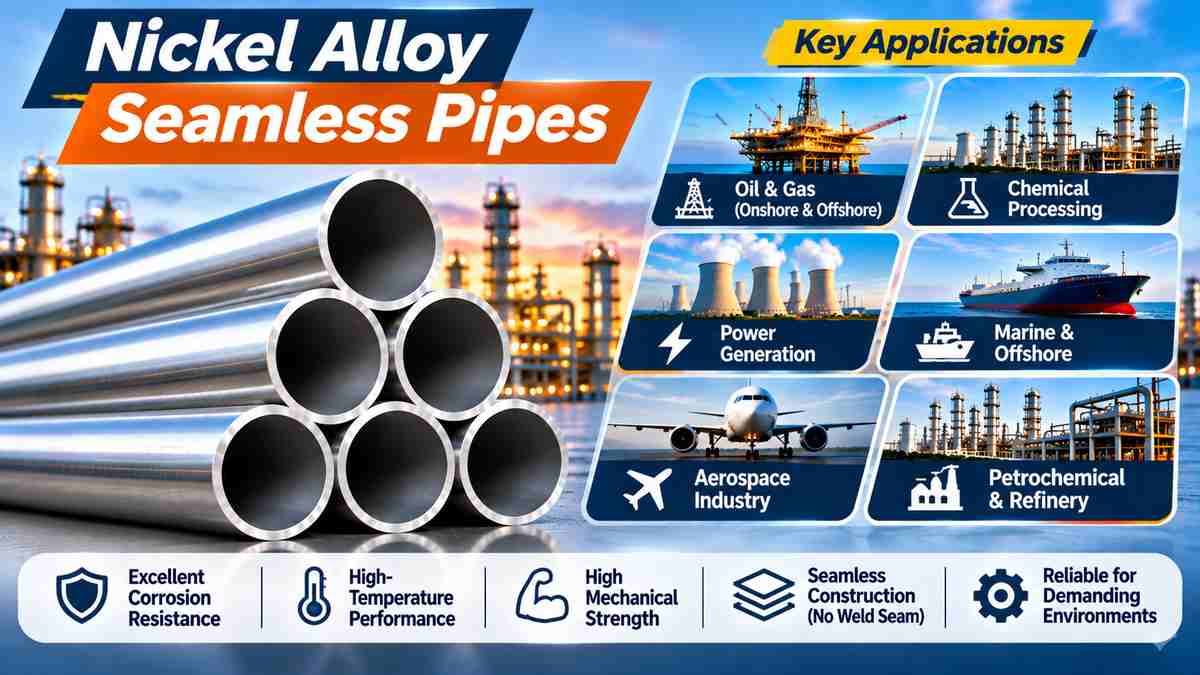
Nickel alloy seamless pipes are selected for their combination of mechanical and corrosion-resistant properties.
Excellent Corrosion Resistance
Different nickel alloy grades provide resistance to specific corrosive environments. Depending on the grade, they can withstand exposure to acids, chlorides, seawater and other industrial chemicals.
High-Temperature Performance
Certain nickel-based alloys maintain useful mechanical properties at elevated temperatures. This makes them suitable for selected furnace, heat exchanger and power generation applications.
Mechanical Strength
Nickel alloy pipes are available in grades designed to provide high tensile strength and resistance to mechanical loading. The actual properties depend on the alloy and heat treatment condition.
Resistance to Oxidation
Chromium-containing nickel alloys can develop protective oxide layers that improve resistance to oxidation in suitable high-temperature environments.
Pressure-Handling Capability
Seamless construction eliminates the longitudinal welded joint. However, pressure capability is determined by the pipe dimensions, material properties, manufacturing condition and applicable design code. Seamless construction alone does not guarantee higher allowable pressure.
5. Industrial Applications of Nickel Alloy Seamless Pipes
Nickel alloy seamless pipes are used in several industries where conventional materials may not meet the required operating conditions.
Oil and Gas Industry
Oil and gas facilities operate in environments involving pressure, temperature, moisture, chlorides and potentially corrosive production fluids.
Nickel alloy seamless pipes are considered for:
- Oil and gas processing equipment
- Offshore installations
- Corrosion-resistant process systems
- Selected heat exchanger applications
- Chemical injection and specialised tubing systems
The alloy grade must be selected according to the actual production fluid and service requirements.
Chemical Processing Industry
Chemical processing plants handle different acids, solvents and corrosive substances. Nickel alloy pipes are used in suitable process equipment where resistance to chemical attack is essential.
Applications include chemical transfer systems, reactors, heat exchangers and specialised process equipment.
Petrochemical and Refinery Industry
Refineries and petrochemical facilities use equipment exposed to hydrocarbons, chemicals and elevated temperatures.
Nickel alloy seamless pipes are considered for selected process lines, heat exchangers and corrosion-resistant equipment.
Marine and Offshore Industry
Marine environments contain high chloride concentrations that can cause corrosion in unsuitable materials.
Depending on the grade, nickel alloy seamless pipes are used in seawater systems, marine equipment, offshore installations and selected heat exchanger applications.
Power Generation Industry
Power plants use high-temperature and pressure-containing equipment. Selected nickel alloys are used in heat exchangers, turbine-related equipment and specialised thermal systems.
Aerospace Industry
The aerospace industry requires materials that offer high mechanical strength and temperature resistance. Certain nickel-based alloys are used in specialised engine systems, turbine components and other aerospace equipment.
6. Nickel Alloy Seamless Pipes vs Nickel Alloy Welded Pipes
Both seamless and welded nickel alloy pipes are used in industrial applications. The choice depends on the design requirements, product specification and operating environment.
| Parameter | Nickel Alloy Seamless Pipes | Nickel Alloy Welded Pipes |
|---|---|---|
| Manufacturing | Produced without a longitudinal weld seam | Produced by forming and welding a metal strip or plate |
| Weld seam | No longitudinal weld seam | Contains a longitudinal weld seam |
| Production route | Piercing, extrusion, rolling or drawing | Forming and welding |
| Dimensions | Available in specified size ranges | Available in a range of sizes and wall thicknesses |
| Inspection | Subject to applicable material and product testing | Weld quality and applicable weld inspection are important |
| Applications | Selected pressure, corrosion and high-temperature services | Suitable for applications meeting the relevant welded-pipe specification |
| Selection | Based on service conditions and project specifications | Based on service conditions, weld requirements and project specifications |
Neither manufacturing method is universally better. The correct option depends on the required specification, pipe dimensions, fabrication quality and design conditions.
7. Standards and Specifications for Nickel Alloy Seamless Pipes
Nickel alloy seamless pipes are manufactured according to grade-specific standards. The applicable specification must match the alloy composition and product form.
Some commonly encountered ASTM specifications include:
| ASTM Standard | Product Coverage |
|---|---|
| ASTM B444 | Seamless nickel-chromium-molybdenum-columbium alloy pipe and tube |
| ASTM B423 | Seamless nickel-iron-chromium-molybdenum-copper alloy pipe and tube |
| ASTM B407 | Nickel-iron-chromium alloy seamless pipe and tube |
| ASTM B729 | Seamless nickel-iron-chromium-molybdenum-copper alloy pipe and tube |
| ASTM B165 | Nickel-copper alloy seamless pipe and tube |
The exact grade coverage and requirements must be confirmed against the current edition of the relevant standard.
Before ordering, check:
- Required alloy grade and UNS designation
- Applicable ASTM or ASME specification
- Seamless manufacturing requirement
- Outside diameter and wall thickness
- Pipe length and dimensional tolerances
- Heat treatment condition
- Mechanical and chemical testing requirements
- Inspection and certification requirements
8. How to Select the Right Nickel Alloy Seamless Pipe?
Choosing the correct nickel alloy pipe is important for equipment reliability and long-term performance.
Consider these factors before procurement:
1. Operating temperature: Identify the minimum and maximum service temperatures.
2. Operating pressure: Confirm the design pressure and required wall thickness using the applicable design code.
3. Chemical environment: Review the process fluid, chemical concentration, chloride content and potential corrosion mechanisms.
4. Alloy grade: Select a grade that meets the required mechanical and corrosion performance.
5. Pipe dimensions: Confirm outside diameter, wall thickness, length and dimensional tolerances.
6. Applicable standard: Make sure the selected ASTM specification covers the required alloy and product form.
7. Material certification: Request the required material test certificate, inspection reports and traceability documentation.
A correct selection should always be based on engineering requirements and actual service conditions.
9. Why Choose Leoscor Alloy Pipes for Nickel Alloy Pipes?
Leoscor Alloy Pipes supplies nickel alloy pipes for industrial and engineering requirements. Its product range includes nickel-based alloy grades used in demanding industrial applications.
Customers can discuss requirements related to:
- Nickel alloy pipe grades
- Seamless pipe requirements
- Required outside diameter and wall thickness
- Customised lengths
- Applicable ASTM specifications
- Material certification and inspection requirements
- Project-specific technical requirements
Explore the Nickel Alloy Pipes product range at Leoscor Alloy Pipes for product details and enquiries.
Contact the team with your required grade, dimensions, quantity and technical specification to discuss availability and pricing.
Frequently Asked Questions
1. What are nickel alloy seamless pipes?
Nickel alloy seamless pipes are tubular products manufactured from nickel-based alloys without a longitudinal welded joint. They are used in applications requiring corrosion resistance, mechanical strength and performance under demanding operating conditions.
2. Which grades are commonly used for nickel alloy seamless pipes?
Commonly used grades include Inconel 600, Inconel 625, Inconel 718, Incoloy 800, Incoloy 825, Monel 400 and Hastelloy C276. The appropriate grade depends on the application.
3. What is the difference between nickel alloy seamless and welded pipes?
Seamless pipes are manufactured without a longitudinal weld seam, while welded pipes are produced by forming and welding metal strip or plate. Both can be suitable for industrial service when manufactured and tested according to the applicable specification.
4. Are nickel alloy seamless pipes suitable for high-temperature applications?
Certain nickel alloy grades are designed for elevated-temperature service. The suitability depends on the grade, temperature, mechanical loading and applicable design requirements.
5. Which ASTM standards are used for nickel alloy seamless pipes?
Common examples include ASTM B444, ASTM B423, ASTM B407, ASTM B729 and ASTM B165. The correct specification depends on the alloy grade and product form.
6. Are nickel alloy seamless pipes used in the oil and gas industry?
Yes. Selected nickel alloy grades are used in offshore installations, process equipment, chemical injection systems and corrosion-resistant applications in the oil and gas industry.
7. What information is required to order nickel alloy seamless pipes?
Buyers should provide the alloy grade, UNS designation, applicable standard, outside diameter, wall thickness, length, quantity, operating requirements and documentation needs.
Nickel alloy seamless pipes are important materials for industries that require reliable performance in corrosive, high-temperature and demanding operating environments. Different grades such as Inconel 600, Inconel 625, Incoloy 825, Monel 400 and Hastelloy C276 offer different combinations of mechanical strength and corrosion resistance.
Selecting the correct grade requires careful evaluation of operating conditions, chemical exposure, pressure, temperature and applicable material standards.
For nickel alloy seamless pipe requirements, explore the product range at Leoscor Alloy Pipes and discuss your technical specifications with the team.