

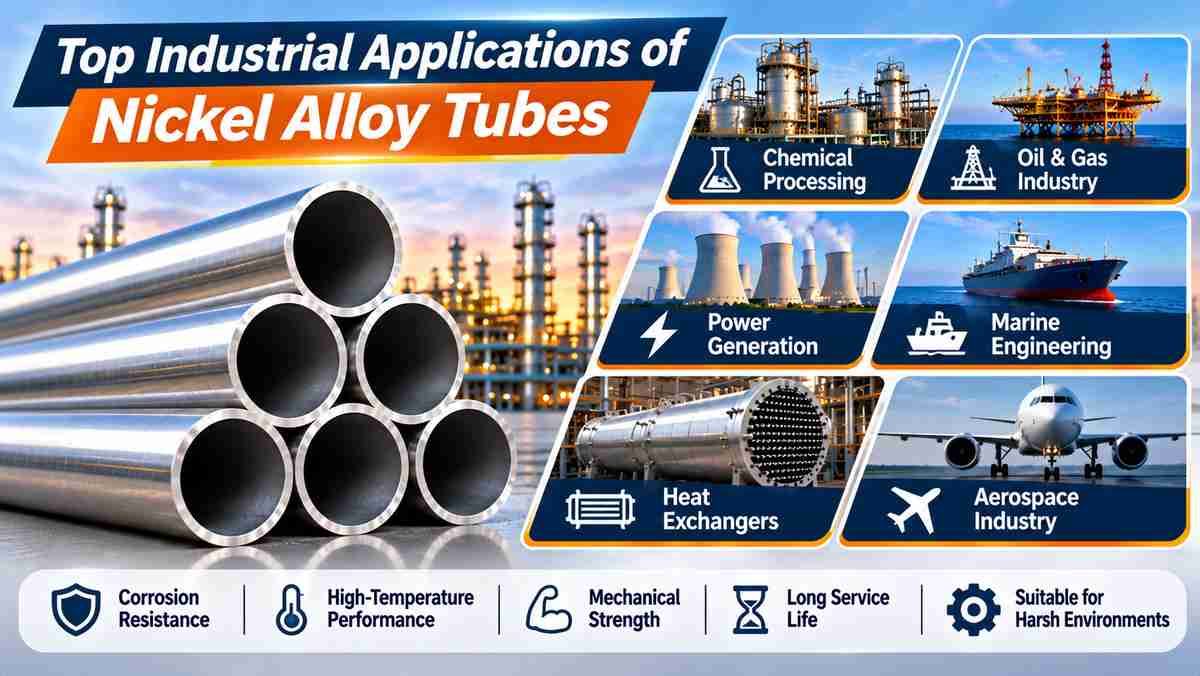
Top Industrial Applications of Nickel Alloy Tubes
Industrial equipment often works under conditions that can be difficult for ordinary metals to handle. High temperatures, aggressive chemicals, seawater, pressure and continuous operation can gradually damage conventional materials.
This is why nickel alloy tubes are widely used in industries that require reliable performance under demanding conditions.
Nickel alloys offer a combination of corrosion resistance, mechanical strength, oxidation resistance and thermal stability. Depending on the selected grade, they can perform in applications ranging from chemical processing and oil and gas production to marine engineering and power generation.
But where exactly are nickel alloy tubes used, and why do industries prefer them over conventional stainless steel tubes?
Let’s explore the top industrial applications of nickel alloy tubes, the commonly used grades and the factors that engineers should consider when selecting the right material.
What Are Nickel Alloy Tubes?
Nickel alloy tubes are hollow metal products manufactured using nickel-based alloys. They are designed for applications where corrosion resistance, high-temperature performance and mechanical strength are important.
Different alloying elements are added to nickel to improve specific properties. Chromium improves oxidation resistance, molybdenum helps resist pitting and crevice corrosion in suitable environments, while copper improves performance in certain reducing chemical conditions.
Some commonly used nickel alloy grades include:
-
- Inconel 600: Used in applications requiring oxidation resistance and high-temperature performance.
- Inconel 601: Known for improved resistance to high-temperature oxidation.
- Inconel 625: Offers high strength and excellent resistance to many corrosive environments.
- Incoloy 800 and 800H: Used in high-temperature equipment and furnace applications.
- Incoloy 825: Suitable for selected chemical processing and corrosive environments.
- Monel 400: Known for its resistance to seawater and certain reducing chemicals.
- Hastelloy C276: Used in demanding chemical processing environments.
- Nickel 200 and Nickel 201: Commercially pure nickel grades used in selected chemical and industrial applications.
The right grade depends on the operating temperature, process fluid, pressure, corrosion exposure and engineering requirements.
Industrial Applications of Nickel Alloy Tubes
1. Chemical Processing Industry
Chemical processing is one of the major applications of nickel alloy tubes. Chemical plants handle different acids, alkaline solutions, solvents and corrosive liquids. Many of these substances can damage ordinary metal tubing over time.
Nickel alloy tubes are used in equipment such as heat exchangers, condensers, reactors, evaporators and chemical transfer systems.
Different grades are selected according to the chemical environment.
For example:
- Hastelloy C276 is considered for demanding chemical environments involving several aggressive acids and chlorides.
- Incoloy 825 is used in selected applications involving sulfuric acid and other corrosive media.
- Inconel 625 is used where strength and resistance to chloride-related corrosion are important.
- Monel 400 is suitable for certain reducing chemical environments.
Using the correct nickel alloy helps reduce corrosion-related maintenance and supports reliable equipment operation.
2. Oil and Gas Industry
The oil and gas industry operates in demanding environments where equipment may be exposed to high pressure, elevated temperatures, seawater, corrosive fluids and sour-service conditions.
Nickel alloy tubes are used in selected process equipment, instrumentation systems, heat exchangers, offshore installations and specialised production equipment.
In offshore applications, corrosion resistance is particularly important because equipment may be exposed to seawater and chloride-containing environments.
Inconel 625 is widely considered for applications requiring high strength and resistance to many aggressive corrosive environments. Other nickel alloy grades are selected according to the specific process conditions.
For sour-service applications, engineers must also check the applicable material requirements, including the relevant NACE/ISO requirements where specified.
3. Power Generation Industry
Power generation facilities depend on equipment that can operate continuously under demanding temperature and pressure conditions.
Nickel alloy tubes are used in selected boilers, heat exchangers, steam generators, superheaters and other thermal equipment.
Some applications involve high-temperature steam, oxidation and thermal cycling. These conditions require materials that maintain suitable mechanical properties and resist degradation during service.
Commonly considered materials include:
- Inconel 600 for selected heat-resistant applications.
- Inconel 601 for high-temperature oxidation resistance.
- Incoloy 800H and 800HT for suitable high-temperature equipment.
- Inconel 625 for applications requiring a combination of strength and corrosion resistance.
The final grade must be selected according to the design temperature, pressure, steam chemistry and applicable equipment standards.
4. Marine Engineering and Offshore Applications
Marine environments are challenging because seawater contains chlorides that can cause pitting and crevice corrosion in susceptible materials.
Nickel alloy tubes are used in selected marine equipment, seawater cooling systems, offshore installations and shipboard heat exchangers.
Monel 400 is known for its resistance to seawater and is commonly considered for suitable marine applications.
Inconel 625 is another important option where high strength and resistance to localized corrosion are required.
These materials can be used in:
- Seawater cooling equipment.
- Marine heat exchangers.
- Offshore process systems.
- Selected fluid-handling equipment.
- Shipbuilding and marine engineering components.
The actual material selection should consider seawater temperature, velocity, deposits, aeration and crevice conditions.
5. Heat Exchangers and Condensers
Heat exchangers transfer heat between two fluids without allowing them to mix. They are widely used in chemical plants, refineries, power stations, marine systems and manufacturing facilities.
The tubes inside a heat exchanger are continuously exposed to heat and process fluids. If the fluid is corrosive, ordinary materials may experience corrosion, scaling or premature failure.
Nickel alloy tubes are used in selected heat exchanger and condenser applications because certain grades provide excellent corrosion resistance and thermal stability.
Some commonly considered grades include:
- Inconel 625 for demanding corrosive environments.
- Incoloy 800 and 800H for suitable high-temperature applications.
- Incoloy 825 for selected chemical processing environments.
- Monel 400 for suitable seawater and chemical applications.
The correct grade depends on both the tube-side and shell-side fluids, operating temperatures, pressure and heat transfer requirements.
6. Aerospace Industry
The aerospace industry requires materials that can withstand demanding mechanical and thermal conditions while maintaining reliable performance.
Nickel-based alloys are used in selected aircraft engine components, exhaust systems, combustion equipment and high-temperature structural parts.
Some specialised nickel alloys offer excellent strength at elevated temperatures, oxidation resistance and resistance to thermal fatigue.
Although many aerospace applications use specialised nickel superalloys rather than conventional industrial tubing grades, nickel alloy tubes and tubular components are important in selected aerospace systems.
Material selection is based on strict engineering specifications, testing requirements and applicable aerospace standards.
7. Petrochemical and Refinery Industry
Refineries and petrochemical plants process hydrocarbons and chemicals at different temperatures and pressures. Equipment may also be exposed to sulphur compounds, corrosive gases and process fluids.
Nickel alloy tubes are used in selected furnace equipment, heat exchangers, condensers, process heaters and other thermal processing systems.
Inconel and Incoloy grades are commonly considered for applications requiring resistance to oxidation, heat and selected corrosive environments.
For example, Inconel 601 is used in suitable high-temperature oxidation environments, while Incoloy 800H and 800HT are considered for high-temperature equipment where creep resistance and thermal stability are important.
Choosing the right grade helps equipment designers address material degradation and operating reliability.
8. Desalination and Water Treatment Plants
Desalination plants convert seawater into freshwater. During this process, equipment handles seawater, concentrated brine and other chloride-rich solutions.
These environments can create serious corrosion challenges for conventional materials.
Nickel alloy tubes are used in selected heat exchangers, condensers and process equipment where their corrosion resistance meets the operating requirements.
Inconel 625 and other high-alloy materials may be considered for specific aggressive chloride environments. However, the right choice depends on temperature, chloride concentration, flow velocity and design conditions.
Material selection should also consider alternatives such as super duplex stainless steel and titanium where technically and economically appropriate.
9. Pharmaceutical and Food Processing Industries
Pharmaceutical and food processing facilities require equipment that supports product quality, cleanliness and reliable operation.
Nickel alloy tubes may be used in specialised heat transfer, chemical handling and process equipment where their corrosion resistance is required.
Nickel 200 and Nickel 201 are commercially pure nickel grades used in certain applications where their chemical and physical properties are suitable.
However, not every nickel alloy is automatically suitable for direct food or pharmaceutical contact. Material selection must consider hygiene requirements, surface finish, cleaning procedures, product compatibility and applicable regulatory standards.
10. Pollution Control and Flue Gas Treatment Systems
Industrial pollution control systems handle exhaust gases, chemical condensates and other corrosive process streams.
Flue gas desulfurization systems, scrubbers and emission treatment equipment may experience acidic condensates and chloride-containing environments.
Nickel alloy tubes are considered for selected components where corrosion resistance is important.
Hastelloy C276, Hastelloy C22 and Inconel 625 are among the alloys that may be evaluated for demanding corrosion conditions.
The actual choice depends on the gas composition, condensate chemistry, operating temperature and cleaning process.
Why Are Nickel Alloy Tubes Preferred in Industrial Applications?
Nickel alloy tubes are selected because they offer several useful engineering properties.
1. Corrosion Resistance: Different nickel alloy grades provide resistance to acids, seawater, chlorides and other corrosive media.
2. High-Temperature Performance: Certain grades maintain useful mechanical properties and oxidation resistance at elevated temperatures.
3. Mechanical Strength: Many nickel alloys provide good tensile strength, toughness and durability.
4. Long-Term Reliability: Selecting the correct material can help reduce corrosion-related failures and maintenance requirements.
5. Grade Availability: Different alloy families allow engineers to match materials to specific industrial environments.
However, no single nickel alloy is suitable for every application. The material must always be selected according to the actual operating conditions.
How to Choose the Right Nickel Alloy Tube?
Before purchasing nickel alloy tubes, engineers and procurement teams should review the following points:
- Operating Temperature: Check the normal and maximum working temperatures.
- Process Fluid: Identify the chemical composition, concentration and corrosive characteristics of the fluid.
- Pressure Requirements: Confirm the working pressure, design pressure and required wall thickness.
- Material Grade: Select the appropriate grade, such as Inconel 600, Inconel 625, Monel 400 or Hastelloy C276.
- Tube Dimensions: Confirm outside diameter, wall thickness, length and dimensional tolerances.
- Manufacturing Type: Decide whether seamless or welded tubes are required.
- ASTM Specification: Verify the applicable product standard for the selected alloy and product form.
- Inspection and Certification: Confirm chemical analysis, mechanical testing, nondestructive examination and material test certificate requirements.
Providing these details when requesting a quotation helps suppliers identify the correct product for the project.
Frequently Asked Questions
1. What are nickel alloy tubes mainly used for?
Nickel alloy tubes are mainly used in industrial applications requiring corrosion resistance, high-temperature performance and mechanical strength. Common applications include chemical processing plants, oil and gas facilities, heat exchangers, power generation, marine engineering, desalination systems and petrochemical equipment. The selected alloy grade depends on the operating environment and engineering requirements.
2. Which nickel alloy is best for chemical processing?
There is no single best alloy for every chemical processing application. Hastelloy C276 is considered for several aggressive chemical environments, Incoloy 825 for selected acid applications, and Inconel 625 for demanding corrosion and strength requirements. The chemical concentration, temperature and process conditions must be reviewed before selecting a material.
3. Which nickel alloy tubes are suitable for seawater applications?
Monel 400 and Inconel 625 are among the nickel alloys considered for selected seawater applications. Monel 400 offers good resistance to seawater, while Inconel 625 provides excellent resistance to many chloride-related corrosion mechanisms. The final choice depends on seawater conditions, temperature, flow velocity and equipment design.
4. Are nickel alloy tubes suitable for high-temperature applications?
Yes. Several nickel alloy grades are developed for high-temperature service. Inconel 600 and 601 are used in suitable heat-resistant applications, while Incoloy 800H and 800HT are considered for high-temperature equipment. The maximum service temperature depends on the alloy grade, material condition, atmosphere, mechanical loading and design requirements.
5. What is the difference between Inconel, Monel and Hastelloy tubes?
Inconel, Monel and Hastelloy are different nickel alloy families. Inconel grades are commonly selected for heat resistance, oxidation resistance and demanding corrosion conditions. Monel 400 is known for seawater resistance and selected reducing chemical environments. Hastelloy grades are used in many aggressive chemical processing applications. The correct family depends on the process environment.
6. How do I select a reliable nickel alloy tube supplier?
Check the supplier’s available grades, dimensional range, manufacturing options, product specifications and material certification. Confirm that the supplied tubes meet the required ASTM standard and project requirements. It is also important to provide complete information about the operating conditions so the correct material can be identified.
Conclusion
Nickel alloy tubes play an important role in modern industrial operations. Their corrosion resistance, mechanical strength and high-temperature performance make them useful in chemical processing, oil and gas, power generation, marine engineering, heat exchangers and several other sectors.
However, selecting the right nickel alloy is just as important as selecting the correct tube dimensions. Inconel, Monel, Incoloy and Hastelloy grades have different properties and should be matched to the actual operating environment.
At Leoscor Alloy Pipes, customers can explore nickel alloy tube and pipe options for different industrial requirements.
Whether your project involves chemical processing, offshore equipment, heat exchangers or high-temperature systems, choosing the correct alloy and product specification is an important step towards reliable performance.
Looking for Nickel Alloy Tubes for Your Industrial Application?
Connect with Leoscor Alloy Pipes to discuss your required alloy grade, dimensions, manufacturing type and project specifications.
Explore our product categories:
Contact Leoscor Alloy Pipes today for product enquiries and technical assistance.