

Seamless vs Welded Nickel Alloy Tubes: Key Differences and Applications
Nickel alloy tubes are widely used in industries where ordinary stainless steel may not provide the required corrosion resistance, strength or high-temperature performance. Chemical processing plants, oil and gas facilities, power stations, marine equipment and heat exchangers often require materials that can perform reliably under demanding operating conditions.
When purchasing nickel alloy tubes, one important decision is whether to choose seamless or welded construction.
Both types are used in industrial applications, but their manufacturing processes, construction, dimensional availability and inspection requirements are different. Choosing the right type depends on the operating pressure, temperature, corrosion environment, tube dimensions and project specifications.
So, which is better: seamless or welded nickel alloy tubes?
Let’s understand how both types are manufactured, where they are used and what buyers should consider before selecting a product.
What Are Nickel Alloy Tubes?
Nickel alloy tubes are hollow metal products manufactured using nickel-based alloys. They are designed for applications that require resistance to corrosion, oxidation, heat and mechanical stress.
Depending on the alloy grade, these tubes can perform in aggressive chemical environments, seawater systems, high-temperature equipment and industrial heat exchangers.
Some commonly used nickel alloy grades include:
- Nickel 200 and Nickel 201: Commercially pure nickel grades used in suitable caustic, chemical and industrial applications.
- Inconel 600: A nickel-chromium-iron alloy known for oxidation resistance and high-temperature performance.
- Inconel 601: A nickel-chromium-aluminium alloy developed for improved high-temperature oxidation resistance.
- Inconel 625: A nickel-chromium-molybdenum-niobium alloy known for high strength and corrosion resistance.
- Incoloy 800, 800H and 800HT: Nickel-iron-chromium alloys used in furnace and high-temperature equipment.
- Incoloy 825: A nickel-iron-chromium alloy with molybdenum and copper, used in selected chemical and sour-service applications.
- Monel 400: A nickel-copper alloy known for its resistance to seawater and certain chemical environments.
- Hastelloy C276: A nickel-molybdenum-chromium alloy used in demanding chemical processing environments.
The correct grade depends on the actual operating conditions and the material requirements of the project.
Explore the available Nickel Alloy Tubes from Leoscor Alloy Pipes for different industrial applications.
What Are Seamless Nickel Alloy Tubes?
Seamless nickel alloy tubes are manufactured without a longitudinal weld seam. The production process generally starts with a solid alloy billet, which is heated and pierced to create a hollow section.
The hollow material then goes through different processes such as hot rolling, extrusion, cold drawing or sizing to achieve the required outside diameter and wall thickness.
Depending on the grade and manufacturing route, the tubes may also undergo heat treatment, pickling, finishing and inspection.
Because seamless tubes do not have a welded joint, they are often considered for applications where the project specification requires seamless construction.
Main Features of Seamless Nickel Alloy Tubes
- No longitudinal weld seam.
- Suitable for applications requiring seamless construction.
- Available in different nickel alloy grades.
- Can be manufactured with different wall thicknesses and dimensions.
- Used in heat exchangers, chemical processing and demanding industrial equipment.
- Subject to grade-specific dimensional, mechanical and inspection requirements.
Seamless construction does not automatically mean that a tube has a higher pressure rating. Its actual pressure capability depends on material grade, dimensions, manufacturing standard, temperature, design code and inspection requirements.
What Are Welded Nickel Alloy Tubes?
Welded nickel alloy tubes are manufactured by forming nickel alloy sheets or strips into a tubular shape and joining the edges through a controlled welding process.
The material is first prepared to the required width and thickness. It is then formed into a cylindrical section, and the edges are joined using a suitable welding process.
Depending on the product specification, welding may be followed by heat treatment, sizing, surface finishing and nondestructive examination.
Welded tubes are commonly selected for applications where the required dimensions, material properties and applicable specifications permit welded construction.
Main Features of Welded Nickel Alloy Tubes
- Manufactured by forming and joining alloy strip or sheet.
- Contains a longitudinal weld seam.
- Available in different grades and dimensions, depending on the manufacturing standard.
- Suitable for various heat exchanger and industrial applications.
- Can offer practical manufacturing and dimensional options.
- Requires appropriate weld quality control and inspection.
The quality of a welded nickel alloy tube depends on material preparation, welding procedure, heat treatment where required and inspection according to the applicable standard.
Seamless vs Welded Nickel Alloy Tubes: Key Differences
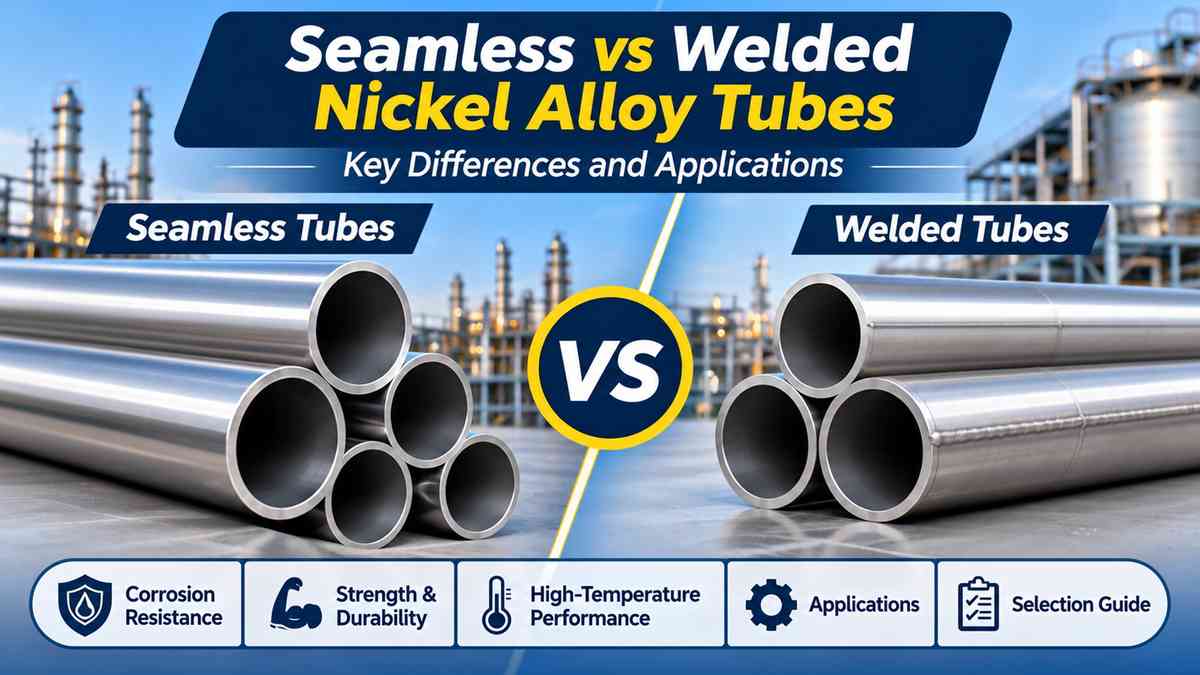
Although both products are manufactured from nickel-based alloys, their construction and production methods are different.
Here is a quick comparison:
| Comparison Parameter | Seamless Nickel Alloy Tubes | Welded Nickel Alloy Tubes |
|---|---|---|
| Manufacturing Process | Produced from a solid billet or hollow section | Formed from strip or sheet and welded |
| Weld Seam | No longitudinal weld seam | Contains a longitudinal weld seam |
| Construction | Seamless tubular structure | Welded tubular structure |
| Dimensional Availability | Depends on alloy, process and manufacturer | Depends on strip width, thickness and welding process |
| Wall Thickness | Available in different thicknesses | Available in different thicknesses |
| Inspection | Dimensional, mechanical and applicable NDT requirements | Includes weld-related inspection where required |
| Pressure Suitability | Depends on design and product specification | Depends on weld quality, design and product specification |
| Common Applications | Heat exchangers, chemical equipment and demanding process systems | Heat exchangers, process equipment and other permitted industrial applications |
| Applicable Standards | Grade-specific ASTM specifications | Grade-specific ASTM specifications |
The most important point is that both types can provide reliable performance when manufactured according to the correct specification and selected for suitable operating conditions.
1. Manufacturing Process: Seamless vs Welded Tubes
The manufacturing process is the main difference between seamless and welded nickel alloy tubes.
Seamless tube manufacturing
Seamless tubes generally start with a solid nickel alloy billet. The billet is heated and pierced to form a hollow section. It is then processed through hot working or cold drawing to achieve the required dimensions.
Additional operations may include:
- Heat treatment
- Cold drawing
- Tube sizing
- Straightening
- Pickling and surface finishing
- Dimensional inspection
- Mechanical and nondestructive testing
The exact process depends on the alloy grade and applicable ASTM specification.
Welded tube manufacturing
Welded tubes are produced using nickel alloy strips or sheets. The material is formed into a tubular shape, and the edges are joined through a suitable welding process.
The manufacturing process may include:
- Strip preparation
- Tube forming
- Controlled welding
- Weld inspection
- Heat treatment, where specified
- Sizing and straightening
- Surface finishing
- Dimensional and mechanical testing
Both manufacturing methods require suitable process controls to maintain material quality and dimensional accuracy.
2. Strength and Pressure Performance
Strength is an important consideration when selecting nickel alloy tubes for industrial equipment.
Seamless tubes are often preferred when a project specifically requires seamless construction. Their absence of a longitudinal weld seam can be an important design consideration in certain applications.
Welded tubes can also provide good mechanical performance when manufactured using approved welding procedures and tested according to the required product standard.
However, it would be incorrect to assume that every seamless tube is stronger than every welded tube.
Pressure performance depends on several factors:
- Nickel alloy grade.
- Outside diameter and wall thickness.
- Minimum specified mechanical properties.
- Operating temperature and pressure.
- Manufacturing standard.
- Weld quality and inspection requirements.
- Applicable design code.
Engineers should use the specified design calculations and product documentation rather than selecting a tube based only on its manufacturing method.
3. Corrosion Resistance
Corrosion resistance is one of the biggest reasons industries use nickel alloy tubes.
An important point is that corrosion resistance mainly depends on the alloy grade and the service environment, not simply whether the tube is seamless or welded.
For example:
Inconel 600: Offers resistance to oxidation and several corrosive environments, making it suitable for selected high-temperature and chemical processing applications.
Inconel 601: Provides improved resistance to high-temperature oxidation due to its chromium and aluminium content.
Inconel 625: Offers excellent resistance to many aggressive environments, including chloride-related pitting and crevice corrosion.
Monel 400: Provides good resistance to seawater, brine and certain reducing chemical environments.
Hastelloy C276: Is used in demanding chemical processing conditions where resistance to different corrosive media is required.
For welded products, the weld region and heat-affected zone must also meet the corrosion and inspection requirements of the applicable specification.
Proper material selection, welding procedure and surface treatment are important for long-term performance.
4. Dimensional Accuracy and Availability
Dimensional requirements can influence the choice between seamless and welded nickel alloy tubes.
Seamless tubes are manufactured through processes such as extrusion, hot working and cold drawing. Cold drawing can help achieve controlled dimensions and surface finish.
Welded tubes are manufactured from strip or sheet material. Their dimensions depend on the available starting material, forming process, welding procedure and final sizing operations.
Both types can be supplied with specified outside diameters, wall thicknesses and lengths, depending on the grade and manufacturer.
For heat exchanger and instrumentation applications, buyers should pay particular attention to:
- Outside diameter.
- Wall thickness.
- Inside diameter, where required.
- Length and dimensional tolerance.
- Surface finish.
- Straightness.
- Inspection and testing requirements.
Always confirm dimensions against the project drawing and purchase specification.
5. Industrial Applications of Seamless Nickel Alloy Tubes
Seamless nickel alloy tubes are used in applications where the project requires seamless construction and specific material performance.
Common applications include:
Heat Exchangers: Used in selected heat exchanger systems where corrosion resistance, thermal performance and dimensional requirements are important.
Chemical Processing Plants: Applied in equipment exposed to aggressive chemicals and demanding operating conditions.
Oil and Gas Industry: Used in selected process and offshore equipment where strength and corrosion resistance are required.
Power Generation: Applied in certain steam, heating and high-temperature systems, depending on the selected alloy.
Nuclear Industry: Certain nickel alloy tubes are used in specialised equipment where strict material and inspection requirements apply.
Marine Applications: Selected nickel alloy grades are used in seawater and offshore systems where their corrosion properties meet the service requirements.
6. Industrial Applications of Welded Nickel Alloy Tubes
Welded nickel alloy tubes are also used across several industries where the selected alloy, manufacturing process and product standard permit welded construction.
Typical applications include:
Heat Exchanger Equipment: Used in selected heat transfer systems where welded tubing meets the dimensional and service requirements.
Chemical Processing: Applied in suitable process equipment and fluid-handling systems.
Industrial Cooling Systems: Used in selected cooling and heat transfer applications.
Power Plants: Applied in certain industrial heating and auxiliary equipment.
Marine and Offshore Equipment: Used in selected systems exposed to seawater and other corrosive environments.
Fabricated Equipment: Suitable for applications where specific dimensions and welded construction are allowed by the project specification.
The actual suitability of a welded tube must be confirmed through its applicable material standard, welding quality requirements and inspection documentation.
7. ASTM Standards for Seamless and Welded Nickel Alloy Tubes
ASTM standards define requirements for chemical composition, manufacturing, mechanical properties, dimensions and testing.
Nickel alloy products use different ASTM specifications depending on the alloy grade and product form.
Some commonly used specifications include:
| ASTM Standard | Product / Alloy Application |
|---|---|
| ASTM B163 | Seamless nickel and nickel alloy condenser and heat exchanger tubes |
| ASTM B166 | Nickel-chromium-iron alloy rods, bars and wire; not a general seamless tube specification |
| ASTM B167 | Seamless nickel-chromium-iron alloy pipe and tube |
| ASTM B165 | Seamless nickel-copper alloy pipe and tube |
| ASTM B444 | Seamless nickel-chromium-molybdenum-niobium alloy pipe and tube |
| ASTM B622 | Seamless nickel and nickel-cobalt alloy pipe and tube |
| ASTM B515 | Welded nickel-iron-chromium alloy condenser and heat exchanger tubes |
| ASTM B626 | Welded nickel and nickel-cobalt alloy tubes |
| ASTM B705 | Welded nickel-chromium-molybdenum-cobalt alloy pipe |
| ASTM B730 | Welded nickel-copper alloy pipe and tube |
The correct standard depends on the specific alloy and product form. Not every ASTM specification applies to every nickel alloy grade.
For example, Inconel 625 seamless tubes are commonly supplied to ASTM B444, while welded Inconel 625 tubes may be supplied to the applicable welded product specification, such as ASTM B705 or B751 depending on the product form and requirements.
Buyers should confirm the UNS number, ASTM specification, manufacturing method, dimensions and testing requirements before placing an order.
8. How to Choose Between Seamless and Welded Nickel Alloy Tubes
The correct selection depends on the requirements of the application rather than simply choosing one manufacturing method over another.
Choose seamless nickel alloy tubes when:
- The project specification specifically requires seamless construction.
- The application has demanding pressure or mechanical requirements.
- The selected alloy and dimensions are available in seamless form.
- The design code and engineering documentation specify seamless products.
- The project requires a particular seamless product standard.
Choose welded nickel alloy tubes when:
- The project specification permits welded construction.
- The selected grade is available under the required welded product standard.
- The required dimensions and wall thickness can be achieved through welded manufacturing.
- The application meets the design and inspection requirements.
- The project benefits from the available welded product dimensions and manufacturing options.
Before making the final decision, review the process fluid, temperature, pressure, corrosion exposure, design code and material certification requirements.
9. Factors to Check Before Buying Nickel Alloy Tubes
Choosing a reliable supplier is important, but buyers should also provide accurate technical details when requesting quotations.
Consider the following factors:
1. Alloy Grade: Confirm whether the project requires Nickel 200, Nickel 201, Inconel 600, Inconel 601, Inconel 625, Monel 400, Incoloy 825 or another nickel alloy.
2. Manufacturing Type: Clearly mention whether seamless or welded tubes are required.
3. Dimensions: Specify outside diameter, wall thickness and required length.
4. ASTM Specification: Confirm the correct product standard for the alloy and manufacturing route.
5. Operating Conditions: Provide details about temperature, pressure and process fluid.
6. Testing Requirements: Mention the required mechanical tests, dimensional inspection and nondestructive examination.
7. Material Certification: Confirm the required Material Test Certificate, heat number traceability and inspection documentation.
8. Quantity and Delivery: Share the required quantity and delivery schedule to help the supplier check availability.
These details make the quotation process more accurate and reduce the possibility of receiving an unsuitable material.
Frequently Asked Questions
1. What is the main difference between seamless and welded nickel alloy tubes?
The main difference is their manufacturing process. Seamless nickel alloy tubes are produced from a solid billet or hollow section without a longitudinal weld seam. Welded tubes are made by forming alloy strip or sheet and joining the edges through welding. Both types can be suitable for industrial applications when manufactured according to the correct specification.
2. Are seamless nickel alloy tubes stronger than welded tubes?
Not always. Seamless construction removes the longitudinal weld seam, which can be an important consideration in certain applications. However, the actual strength and pressure capability depend on the alloy grade, dimensions, manufacturing process, material condition, inspection and design code. A properly manufactured welded tube can also meet demanding industrial requirements.
3. Which is better for high-pressure applications?
The correct choice depends on the design requirements and applicable product specification. Some high-pressure applications specify seamless tubes, while suitable welded products may also be permitted under certain design conditions. Engineers should evaluate pressure, temperature, wall thickness, weld quality, mechanical properties and design code requirements before selecting the product.
4. Which ASTM standard is used for seamless nickel alloy tubes?
The ASTM standard depends on the alloy and intended application. Common examples include ASTM B163, B167, B444, B165 and B622 for different nickel alloy product forms. Buyers should confirm the correct specification against the alloy grade, UNS designation and intended service.
5. Which ASTM standards are used for welded nickel alloy tubes?
Different standards apply to different alloy families and product forms. Examples include ASTM B515, B626, B705 and B730. The applicable standard should be checked against the alloy composition, manufacturing method and tube application. The purchase order should clearly mention the required ASTM specification.
6. Are welded nickel alloy tubes suitable for heat exchangers?
Yes. Welded nickel alloy tubes can be used in suitable heat exchanger applications when the material grade, manufacturing standard, weld quality, dimensional tolerances and testing requirements meet the design specification. The selection should consider the operating temperature, pressure and corrosion characteristics of the process fluid.
7. Which nickel alloy is best for corrosion resistance?
There is no single nickel alloy that is best for every corrosive environment. Inconel 625 offers excellent resistance to many chloride-containing environments, Monel 400 performs well in seawater and selected reducing chemical conditions, and Hastelloy C276 is used in demanding mixed chemical environments. The correct grade depends on the actual chemical composition, temperature and operating conditions.
8. What information should I provide when requesting a nickel alloy tube quotation?
Provide the alloy grade, UNS number, seamless or welded requirement, ASTM specification, outside diameter, wall thickness, length, quantity and delivery location. You should also mention operating temperature, pressure, process fluid and inspection requirements. Providing complete information helps the supplier identify a suitable product and prepare an accurate quotation.
Conclusion
Seamless and welded nickel alloy tubes both play an important role in modern industrial applications. The main difference lies in their manufacturing process and construction, while their corrosion resistance and mechanical properties depend largely on the selected alloy grade and applicable product requirements.
Seamless tubes are suitable when seamless construction is specified or required by the design. Welded tubes are a practical option for applications where welded manufacturing meets the required standards and service conditions.
Before selecting either type, carefully review the alloy grade, dimensions, ASTM specification, operating environment and inspection requirements.
At Leoscor Alloy Pipes, customers can explore a range of nickel alloy tubes and pipes in different grades, manufacturing forms and specifications for industrial requirements.
Looking for Seamless or Welded Nickel Alloy Tubes?
Connect with Leoscor Alloy Pipes to discuss your required alloy grade, outside diameter, wall thickness, manufacturing type and quantity.
Explore our product categories:
Contact Leoscor Alloy Pipes today for product enquiries and technical assistance.