

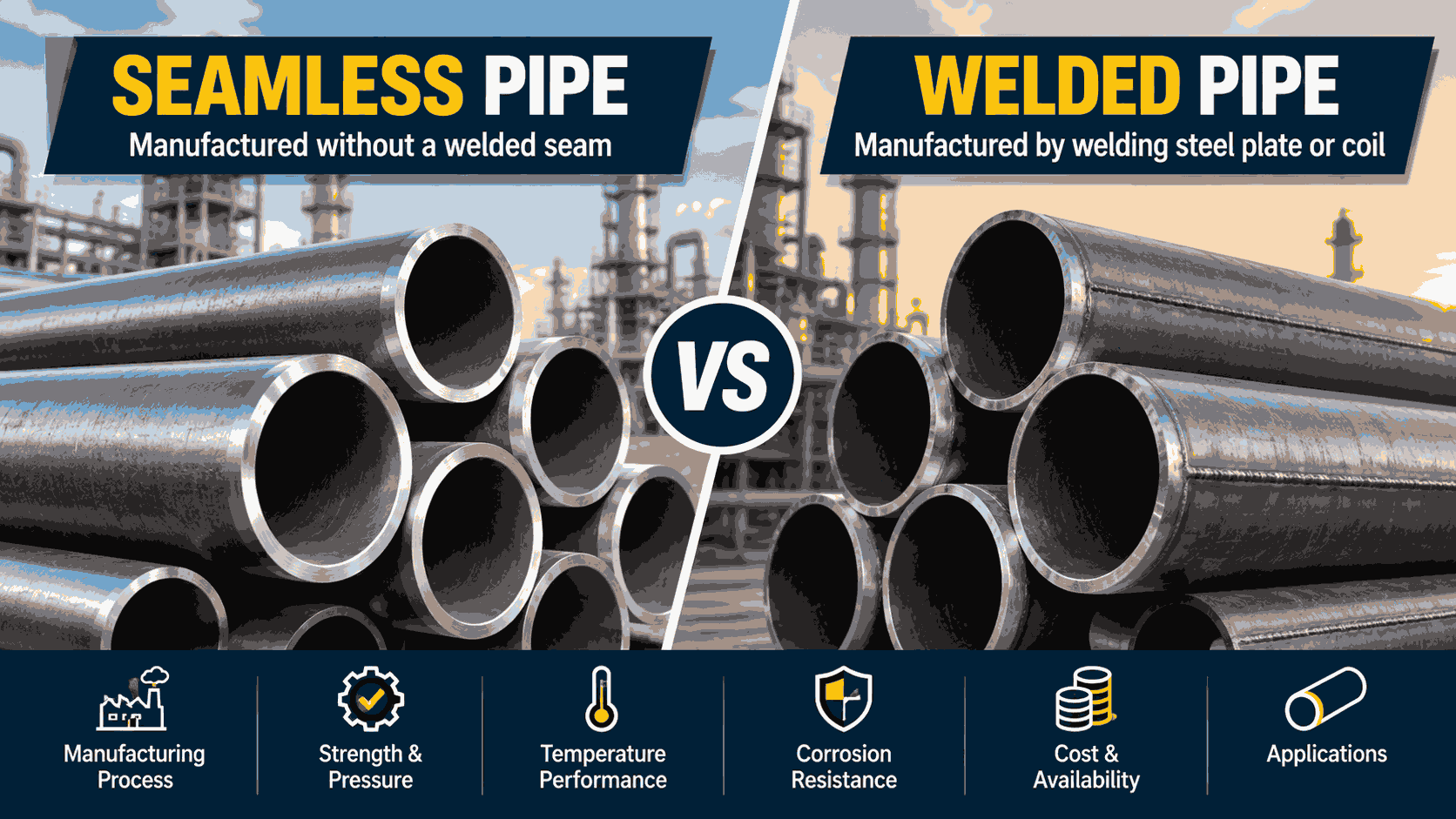
Seamless Pipe vs Welded Pipe: Key Differences, Applications and How to Choose
When selecting steel pipes for an industrial project, one of the first questions buyers ask is whether to choose seamless pipes or welded pipes. Both types are widely used in industrial piping systems, but they differ in how they are manufactured, inspected and selected for particular applications.
The right choice depends on several factors, including operating pressure, temperature, material grade, pipe dimensions, project specifications and budget. A seamless pipe does not automatically perform better in every application, and a welded pipe is not necessarily a weaker option.
Understanding the differences between seamless pipe vs welded pipe helps engineers, contractors and purchasing teams select a product that meets their technical requirements without unnecessary expense.
In this guide, we explain how both pipe types are manufactured, compare their features, discuss their industrial applications and explain what to check before placing an order.
What Is a Seamless Pipe?
A seamless pipe is manufactured without a longitudinal welded joint. During production, a solid steel billet is heated and pierced to create a hollow section. The hollow shell is then rolled, sized and finished to achieve the required dimensions.
Depending on the manufacturing process and material specification, additional operations such as heat treatment, straightening and inspection may also be required.
Since a seamless pipe does not have a longitudinal weld seam, it can be a suitable choice for applications where the specified design conditions and product standards call for seamless construction.
Seamless pipes are commonly used in refineries, power plants, boilers, petrochemical facilities and other industrial installations. Their suitability depends on the material grade, wall thickness, pressure, temperature and applicable design code.
For example, ASTM A106 specifies seamless carbon steel pipes for high-temperature service. However, not every seamless pipe is suitable for every high-pressure or high-temperature application. The complete specification must be checked before selection.
You can explore Leoscor Alloy Pipes’ carbon steel pipe range for information on available materials and product specifications.
What Is a Welded Pipe?
A welded pipe is manufactured by forming steel plate, strip or coil into a cylindrical shape and joining the edges through a welding process. The finished pipe is sized and inspected according to the applicable manufacturing specification.
Different welding methods are used depending on the pipe material, dimensions and application.
Electric Resistance Welded (ERW) Pipes
ERW pipes are manufactured by forming steel strip and joining its edges using electrical resistance heating and pressure. This process is widely used for producing pipes with controlled dimensions for suitable industrial and structural applications.
Electric Fusion Welded (EFW) Pipes
EFW pipes are manufactured using an electric fusion welding process. They are used in applications specified for the particular material, manufacturing method and required inspection.
Longitudinal Submerged Arc Welded (LSAW) Pipes
LSAW pipes are produced by forming steel plate into a pipe and welding the longitudinal seam using a submerged arc welding process. They are commonly considered for large-diameter applications where this manufacturing route suits the project requirements.
Spiral Submerged Arc Welded (SSAW) Pipes
SSAW pipes are manufactured by forming steel strip into a spiral shape and welding the seam. They are used in selected transmission and infrastructure applications according to the relevant product specification.
Welded pipes can provide accurate dimensions, efficient production and a practical solution for many industrial projects. Their suitability depends on weld quality, inspection, material properties and compliance with the required standard.
Leoscor Alloy Pipes offers API 5L welded pipes for relevant line-pipe requirements, subject to the required specification and availability.
Seamless Pipe vs Welded Pipe: Key Differences
The main difference between seamless and welded pipes is their manufacturing method. Other important factors include the presence of a longitudinal weld seam, production limitations, inspection requirements, cost and application suitability.
| Comparison factor | Seamless pipe | Welded pipe |
|---|---|---|
| Manufacturing | Produced by piercing and working a solid billet into a hollow section | Produced by forming steel and joining its edges |
| Longitudinal weld seam | No longitudinal weld seam | Contains a welded joint |
| Production method | Hot rolling, piercing and other specified finishing operations | ERW, EFW, LSAW, SSAW or another specified welding process |
| Dimensional options | Depends on the manufacturing route and available sizes | Depends on the welding process, equipment and specification |
| Pressure suitability | Depends on the grade, dimensions, design and applicable code | Depends on the grade, weld quality, inspection, dimensions and applicable code |
| Manufacturing cost | Can be higher for certain sizes and specifications | Can be more economical for many sizes and production volumes |
| Inspection | Tested according to the applicable pipe specification | Tested according to the applicable pipe specification, including relevant weld inspection |
| Common applications | Process piping, boilers and other specified pressure services | Transmission pipelines, industrial piping, structural and process applications |
| Selection basis | Choose when seamless construction is required or suitable for the design | Choose when the specified welded product meets the technical and commercial requirements |
Important: Neither type is automatically the better option. The project specification and engineering calculations should determine which pipe is suitable.
1. Difference in Manufacturing Process
The manufacturing process affects how a pipe is produced, inspected and supplied.
A seamless pipe starts as a solid billet. The billet is heated and pierced to create a hollow shell, which is then rolled or processed to achieve the required diameter and wall thickness. No longitudinal welding operation is used to close the pipe.
A welded pipe starts with steel plate, strip or coil. The material is formed into a cylindrical shape, and its edges are joined by the specified welding process. The finished pipe may undergo sizing, heat treatment, weld inspection and other tests according to the applicable standard.
Both processes require proper control of material quality and finished dimensions. The difference in manufacturing does not, by itself, determine the complete performance of the final pipe.
When purchasing pipes for critical service, review the specified manufacturing process alongside the material grade, mechanical properties and inspection requirements.
2. Strength and Pressure Performance
Strength is one of the main factors in the seamless pipe vs welded pipe comparison, particularly for applications involving pressure or elevated temperatures.
Seamless pipes have no longitudinal welded joint. This can be an important consideration when the design specification requires seamless construction.
However, the absence of a weld does not mean that every seamless pipe is stronger than every welded pipe. Actual pressure capacity depends on material properties, outside diameter, wall thickness, manufacturing quality, operating temperature and the applicable design code.
Welded pipes can also meet demanding service requirements when they are manufactured, tested and qualified to the appropriate standard.
For example, ASTM A53 covers both seamless and welded steel pipes for specified mechanical and pressure applications. ASTM A106, on the other hand, covers seamless carbon steel pipes for high-temperature service. These standards have different scopes, so the required application and specification must be considered before selecting a product.
For industrial procurement, never choose a pipe based only on whether it is seamless or welded. Confirm the approved grade, pressure design, temperature requirements and testing obligations first.
3. Corrosion Resistance
Another common misconception is that seamless pipes always have better corrosion resistance than welded pipes.
Corrosion resistance primarily depends on the material grade, chemical composition, operating environment, surface condition and fabrication details.
For example, a suitable stainless steel grade may provide better corrosion resistance than carbon steel in a particular environment, whether the specified pipe is seamless or welded.
Welded stainless steel pipes require appropriate control of the welding process and any specified post-weld treatment. The weld area and heat-affected zone must meet the applicable requirements for the intended service.
Similarly, seamless pipes can suffer from corrosion if the selected material is unsuitable for the process fluid or operating conditions.
Leoscor Alloy Pipes supplies a range of stainless steel pipes for industrial applications. When selecting a grade, consider the fluid composition, temperature, chloride concentration and other factors that may influence corrosion performance.
4. Cost and Availability
Cost is an important part of pipe selection, especially when an industrial project requires a large quantity of material.
Welded pipes can be more economical for many sizes and production volumes because their manufacturing processes can be efficient. They may also offer practical options for larger diameters, depending on the material and required specification.
Seamless pipes can cost more in certain sizes and grades because of their manufacturing process and production limitations. However, the price difference varies according to dimensions, material, quantity, finish, inspection and market conditions.
It is not accurate to assume that every welded pipe is cheaper than every seamless pipe.
Before making a purchasing decision, compare quotations for products that meet the same technical requirements. The comparison should include:
- Material grade and applicable standard.
- Outside diameter and wall thickness.
- Manufacturing method and required testing.
- Quantity and specified pipe length.
- Material certification and inspection documents.
- Packing, transport and delivery requirements.
A lower purchase price does not necessarily mean lower total project cost. A pipe that does not meet the approved specification can lead to rejection, replacement expenses and project delays.
5. Applications of Seamless Pipes
Seamless pipes are used in applications where their material properties, dimensions and construction meet the engineering requirements.
Oil and Gas
Seamless pipes are used in selected process piping and other oil and gas applications. The applicable specification determines whether the pipe is suitable for the required pressure, temperature and service conditions.
Refineries and Petrochemical Plants
Refineries often require pipes for carrying fluids under elevated temperatures or pressure. Seamless carbon steel and alloy steel pipes may be specified for suitable services.
Boilers and Power Plants
Certain boiler and power-generation applications require seamless pipes manufactured to dedicated specifications. Material grade, wall thickness, heat treatment and testing are particularly important in these systems.
General Industrial Engineering
Seamless pipes are also used in machinery, process equipment and other industrial systems where their specified dimensions and properties meet the design requirements.
For applications requiring chromium-molybdenum alloy steel, explore Leoscor’s alloy steel pipes.
6. Applications of Welded Pipes
Welded pipes serve many industrial applications where the specified product type meets the project requirements.
Pipeline Transportation
Welded line pipes are used in oil, gas and other pipeline systems where the material, manufacturing method, testing and quality requirements comply with the applicable line-pipe specification.
Water and Utility Systems
Welded steel pipes can be used in suitable water, utility and industrial distribution systems. The appropriate coating, material and design must be considered where corrosion or pressure is a concern.
Infrastructure and Fabrication
Welded pipes are used in structural applications, infrastructure projects and fabricated assemblies. Their suitability depends on the required material properties, dimensions and design.
Process and Industrial Piping
Welded pipes are used in selected process applications when the specified grade, manufacturing process and inspection requirements are satisfied.
Large-diameter welded pipes can be a practical choice where the required size and specification make seamless manufacturing difficult or uneconomical.
Leoscor Alloy Pipes provides API 5L seamless pipes and API 5L welded pipes for applicable line-pipe requirements. Confirm the required grade, size, product standard and availability before placing an order.
7. Common Standards for Seamless and Welded Pipes
Pipe standards establish requirements for matters such as material grade, manufacturing method, dimensions, testing and acceptance criteria.
The applicable standard must match the intended use of the pipe.
| Standard | General scope |
|---|---|
| ASTM A106 | Seamless carbon steel pipe for high-temperature service |
| ASTM A53 | Seamless and welded steel pipe for specified mechanical and pressure applications and other permitted uses |
| API 5L | Seamless and welded line pipe for pipeline transportation systems |
| ASTM A312 | Seamless, welded and heavily cold-worked austenitic stainless steel pipe |
| ASME B36.10M | Standardisation of dimensions for welded and seamless wrought steel pipe |
These standards are not interchangeable simply because their pipe dimensions appear similar. The complete specification, grade, testing and application requirements must be checked.
You can refer to the official ASTM A106 specification and ASME B36.10 welded and seamless pipe standard for additional technical information. Always verify the applicable edition specified by the project.
8. How to Choose Between Seamless and Welded Pipes
The right choice begins with the engineering specification, not the manufacturing method alone.
Before ordering, consider the following factors.
1. Operating pressure and temperature: Confirm the design conditions and check the allowable properties required for the application.
2. Material grade: Select carbon steel, stainless steel or alloy steel according to the process environment and relevant design requirements.
3. Required standard: Verify the ASTM, ASME, API or other specification stated in the purchase order.
4. Dimensions: Confirm the nominal pipe size, outside diameter, wall thickness or schedule, length and dimensional tolerances.
5. Manufacturing method: Check whether the specification requires seamless construction or permits a welded pipe made by a particular process.
6. Inspection and testing: Review the required hydrostatic or nondestructive testing, mechanical tests, weld inspection and other supplementary requirements.
7. Material documentation: Confirm the required Mill Test Certificate, heat-number traceability and any additional inspection documentation.
8. Total procurement cost: Compare prices only after confirming that the quoted products meet the same technical requirements.
For critical applications, the final selection should be reviewed and approved by the responsible engineer.
9. Why Source Pipes from Leoscor Alloy Pipes?
Leoscor Alloy Pipes is an India-based supplier and exporter of industrial pipes and tubes. Its product range includes carbon steel pipes, stainless steel pipes and alloy steel pipes for different industrial requirements.
The company provides product information for buyers evaluating grades, dimensions and specifications for their projects.
When requesting a quotation, sharing the complete requirement helps the team identify the correct product and check availability.
You can explore the following product categories:
Before ordering, confirm the material grade, applicable standard, size, schedule, length, testing requirements and requested certification. Stock availability and delivery arrangements should also be verified for the specific order.
Frequently Asked Questions
1. What is the main difference between seamless pipe and welded pipe?
The main difference is the manufacturing process. Seamless pipes are produced without a longitudinal welded joint, while welded pipes are made by forming steel and joining its edges through a welding process.
2. Is a seamless pipe stronger than a welded pipe?
Not always. Strength and pressure capacity depend on material grade, dimensions, wall thickness, manufacturing quality, inspection and the applicable design code. The required specification should determine the choice.