

Inconel Pipes & Tubes: Grades, Properties, Applications and Selection Guide
Inconel pipes and tubes are widely used in industries where materials must withstand high temperatures, pressure, oxidation and corrosive environments. Manufactured from nickel-based alloys, these products are designed for demanding operating conditions where conventional stainless steel may not provide the required performance.
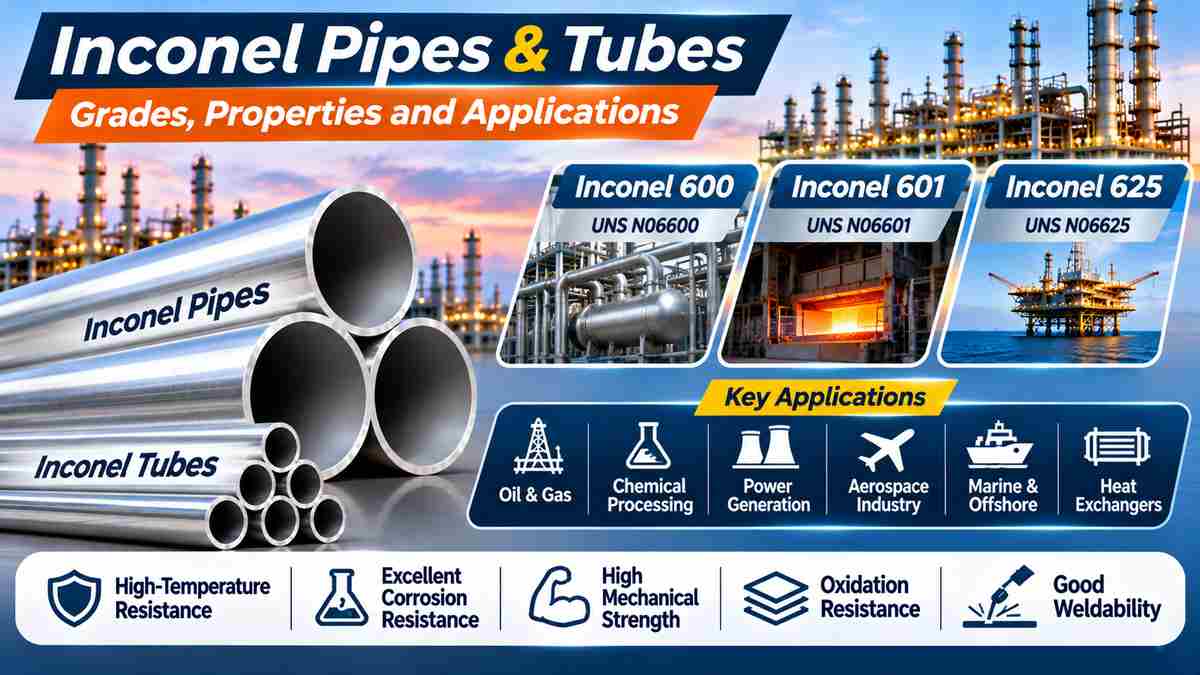
Different Inconel grades offer different combinations of mechanical strength, corrosion resistance and thermal stability. Grades such as Inconel 600, Inconel 601 and Inconel 625 are commonly considered for chemical processing, oil and gas, marine engineering, power generation, aerospace and heat exchanger applications.
Although pipes and tubes are often discussed together, they serve different engineering requirements. Understanding their grades, specifications, dimensions and applications helps buyers select the right product for their projects.
In this guide, we explain the key properties, common grades, manufacturing forms and industrial applications of Inconel pipes and tubes.
1. What Are Inconel Pipes and Tubes?
Inconel is a family of nickel-based alloys developed for applications requiring resistance to heat, oxidation and corrosion. These alloys contain nickel along with elements such as chromium, iron, molybdenum and niobium, depending on the grade.
Inconel pipes and tubes are used to transport fluids, transfer heat or form part of equipment operating under demanding industrial conditions.
Some important characteristics include:
- Resistance to oxidation at elevated temperatures
- Good mechanical strength
- Resistance to several corrosive environments
- Performance in demanding thermal conditions
- Resistance to chloride stress corrosion cracking in suitable grades and environments
- Availability in different seamless and welded product forms
The exact properties depend on the selected grade, manufacturing route, heat treatment and operating conditions.
2. Difference Between Inconel Pipes and Inconel Tubes
Inconel pipes and tubes are both hollow products, but they are generally specified and used differently.
| Comparison | Inconel Pipes | Inconel Tubes |
|---|---|---|
| Main purpose | Fluid transportation and process systems | Heat transfer, instrumentation and specialised equipment |
| Sizing | Commonly specified by nominal pipe size and schedule | Commonly specified by actual outside diameter and wall thickness |
| Dimensions | Governed by applicable pipe dimensional standards | Governed by applicable tube dimensional requirements |
| Applications | Process piping, industrial lines and pressure systems | Heat exchangers, condensers and instrumentation |
| Selection | Based on flow, pressure, temperature and design code | Based on heat transfer, pressure, dimensions and equipment design |
The distinction is based mainly on product specification and intended application. The actual dimensional and manufacturing requirements should always be confirmed before ordering.
3. Common Grades of Inconel Pipes and Tubes
Different Inconel grades are developed for specific industrial conditions. Three commonly used grades are Inconel 600, Inconel 601 and Inconel 625.
Inconel 600 Pipes and Tubes
Inconel 600 is a nickel-chromium alloy known for its resistance to oxidation and corrosion at elevated temperatures.
Material identification:
- UNS: N06600
- DIN: 2.4816
Key characteristics:
- Good resistance to oxidation
- Useful mechanical properties at elevated temperatures
- Resistance to chloride-ion stress corrosion cracking in suitable environments
- Good performance in selected chemical processing applications
Common applications:
- Heat treatment equipment
- Chemical processing systems
- Furnace components
- Heat exchangers
- Industrial heating equipment
Inconel 601 Pipes and Tubes
Inconel 601 is a nickel-chromium alloy containing aluminium. The aluminium addition helps improve oxidation resistance at elevated temperatures.
Material identification:
- UNS: N06601
- DIN: 2.4851
Key characteristics:
- Excellent resistance to high-temperature oxidation
- Good resistance to carburisation in suitable environments
- High-temperature mechanical performance
- Suitable for selected thermal processing equipment
Common applications:
- Industrial furnaces
- Heat treatment equipment
- Thermal processing systems
- Combustion equipment
- High-temperature heat exchangers
Inconel 625 Pipes and Tubes
Inconel 625 is a nickel-chromium-molybdenum-niobium alloy. It is known for its combination of mechanical strength and corrosion resistance.
Material identification:
- UNS: N06625
- DIN: 2.4856
Key characteristics:
- Excellent resistance to pitting and crevice corrosion in many environments
- High mechanical strength
- Resistance to several chloride-containing environments
- Good fatigue and thermal fatigue resistance
- Good weldability with suitable procedures
Common applications:
- Offshore oil and gas equipment
- Marine engineering systems
- Chemical processing equipment
- Heat exchangers
- Subsea components
- Corrosion-resistant process equipment
Explore Leoscor’s Inconel 625 tube product page for more product information.
4. Important Properties of Inconel Pipes and Tubes
Inconel alloys are selected for applications where a combination of mechanical and environmental resistance is required.
High-Temperature Resistance
Several Inconel grades maintain useful mechanical properties at elevated temperatures. Inconel 600 and 601, for example, are considered for thermal processing and furnace applications.
The maximum service temperature depends on the grade, atmosphere, loading conditions and equipment design.
Corrosion Resistance
Inconel alloys offer resistance to different corrosive environments. The performance varies by grade and depends on the type of chemical, concentration, temperature and exposure conditions.
Inconel 625 is particularly valued for its resistance to pitting and crevice corrosion in many chloride-containing environments.
Oxidation Resistance
Chromium contributes to the formation of a protective oxide layer. Inconel 601 also contains aluminium, which helps improve oxidation resistance in demanding high-temperature applications.
Mechanical Strength
Inconel grades provide useful tensile strength and resistance to mechanical loading. These properties make them suitable for selected pressure systems and industrial equipment.
Thermal and Fatigue Performance
Some Inconel alloys perform well under repeated thermal cycling and mechanical loading. This is important in equipment exposed to changing temperatures and operating conditions.
5. Industrial Applications of Inconel Pipes and Tubes
Inconel pipes and tubes are used across industries that require specialised materials for heat, corrosion and pressure-related challenges.
Oil and Gas Industry
Oil and gas facilities may expose equipment to high pressure, chlorides, corrosive production fluids and demanding offshore conditions.
Inconel pipes and tubes are considered for suitable applications such as:
- Offshore process equipment
- Subsea components
- Chemical injection systems
- Corrosion-resistant piping
- Heat exchanger tubing
- Specialised production equipment
The alloy grade must be selected according to the actual production fluid, temperature, pressure and applicable sour-service requirements.
Chemical Processing Industry
Chemical plants handle acids, solvents and other aggressive substances. Inconel grades are used in suitable process equipment where resistance to corrosion and elevated temperatures is required.
Applications include:
- Chemical processing equipment
- Heat exchangers
- Process piping
- Reactors and specialised equipment
- Corrosion-resistant fluid handling systems
Power Generation Industry
Power generation facilities use high-temperature equipment and heat transfer systems. Selected Inconel grades are used in thermal equipment, heat exchangers and specialised power generation components.
Aerospace Industry
The aerospace industry uses nickel-based alloys in applications requiring strength, temperature resistance and reliable performance.
Certain Inconel grades are used in engine-related components, exhaust systems and specialised aerospace equipment. The required product form and specification depend on the component design.
Marine and Offshore Engineering
Marine environments expose equipment to seawater and chloride-rich conditions. Inconel 625 is considered for selected marine and offshore components because of its corrosion resistance and mechanical properties.
Applications include:
- Seawater handling equipment
- Offshore installations
- Marine heat exchangers
- Subsea equipment
- Specialised corrosion-resistant components
Heat Exchanger Applications
Inconel tubes are used in selected heat exchangers where temperature, corrosion and pressure requirements demand a nickel-based alloy.
Grade selection depends on the process fluid, heat transfer conditions, operating pressure and design requirements.
6. Inconel Seamless Pipes vs Inconel Welded Pipes
Inconel pipes are available in seamless and welded forms, depending on the grade, dimensions and applicable product specification.
| Parameter | Seamless Inconel Pipes | Welded Inconel Pipes |
|---|---|---|
| Manufacturing | Produced without a longitudinal weld seam | Formed from strip or plate and joined by welding |
| Weld seam | No longitudinal weld seam | Contains a longitudinal weld seam |
| Production | Piercing, extrusion, rolling or drawing | Forming and welding |
| Inspection | Tested according to the applicable product specification | Weld quality and required weld examination are important |
| Applications | Selected pressure and specialised industrial services | Applications permitted by the relevant welded product specification |
Neither construction is automatically better for every application. Selection should be based on the project specification, design code, dimensions, inspection requirements and operating conditions.
7. Inconel Pipe and Tube Standards
Inconel pipes and tubes are supplied according to grade-specific product standards. The correct specification depends on the alloy, product form and intended service.
Some standards listed in Leoscor’s nickel alloy product range include:
| Standard | Product information |
|---|---|
| ASTM B163 | Nickel alloy seamless condenser and heat exchanger tubes |
| ASTM B167 | Nickel-chromium-iron alloy pipe and tube |
| ASTM B444 | Nickel-chromium-molybdenum-columbium alloy pipe and tube |
| ASTM B751 | Welded nickel and nickel alloy pipe |
| ASTM B704 | Welded nickel alloy pipe and tube |
| ASTM B705 | Welded nickel alloy pipe and tube |
Always confirm the exact grade coverage, product form and requirements in the current edition of the applicable ASTM specification before placing an order.
8. How to Select the Right Inconel Pipes and Tubes
Choosing the correct Inconel grade is important for equipment performance, safety and service life.
Consider the following factors:
1. Operating temperature: Check the normal and maximum service temperatures, including thermal cycling.
2. Operating pressure: Confirm the design pressure, wall thickness and applicable engineering code.
3. Corrosion environment: Identify the process fluid, chemical concentration, chloride content and potential corrosion mechanisms.
4. Material grade: Select the Inconel grade according to the required mechanical, thermal and corrosion performance.
5. Product form: Specify whether you require seamless or welded pipes or tubes.
6. Dimensions: Confirm outside diameter, wall thickness, schedule or tube dimensions, length and tolerances.
7. Inspection and certification: Confirm the required testing, material test certificate, heat-number traceability and inspection documentation.
A suitable material should be selected according to actual service conditions, not simply because it belongs to the Inconel family.
9. Why Choose Leoscor Alloy Pipes for Inconel Pipes and Tubes?
Leoscor Alloy Pipes supplies nickel alloy pipes and tubes in grades including Inconel 600, Inconel 601 and Inconel 625.
According to its product information, the company offers different sizes and manufacturing forms, including seamless and welded products. Its listed stock range includes pipe sizes from NPS 1/2 to 24 inches and tube outside diameters from 6 mm to 50 mm, subject to grade and availability.
The company also lists EN 10204 3.1 material test certificates as standard, with 3.2 certification available on request.
Customers can discuss requirements for:
- Inconel 600, 601 and 625 grades
- Seamless and welded product forms
- Pipe and tube dimensions
- Wall thickness and schedule requirements
- Standard and customised lengths
- Applicable ASTM specifications
- Inspection and material documentation
Explore the product categories:
- Inconel and Nickel Alloy Pipes – Leoscor Alloy Pipes
- Inconel and Nickel Alloy Tubes – Leoscor Alloy Pipes
Contact Leoscor Alloy Pipes with your required grade, dimensions, quantity and applicable specification to discuss availability and pricing.
Frequently Asked Questions
1. What are Inconel pipes and tubes used for?
Inconel pipes and tubes are used in oil and gas, chemical processing, marine engineering, aerospace, power generation and heat exchanger applications where corrosion resistance, strength and high-temperature performance are important.
2. What are the common grades of Inconel pipes and tubes?
Common grades include Inconel 600, Inconel 601 and Inconel 625. Each grade offers different properties and is selected according to the operating environment.
3. What is the difference between Inconel 600 and Inconel 625?
Inconel 600 is a nickel-chromium alloy commonly selected for oxidation resistance and elevated-temperature applications. Inconel 625 contains molybdenum and niobium and is valued for its combination of strength and corrosion resistance.
4. Are Inconel pipes suitable for high-temperature applications?
Yes. Several Inconel grades are designed for elevated-temperature service. The appropriate grade depends on the temperature, atmosphere, mechanical loading and design requirements.
5. Are Inconel tubes used in heat exchangers?
Yes. Inconel tubes are used in selected heat exchangers where corrosion resistance, thermal performance and mechanical strength are required.
6. What is the difference between Inconel seamless and welded pipes?
Seamless pipes are manufactured without a longitudinal weld seam. Welded pipes are formed from metal strip or plate and joined by welding. Both forms can be suitable when they meet the applicable product and design specifications.
7. What is the UNS number of Inconel 625?
The UNS designation of Inconel 625 is N06625. Its commonly used DIN material number is 2.4856.
8. Which ASTM standard is used for Inconel 625 tubes?
ASTM B444 is a specification for seamless nickel-chromium-molybdenum-columbium alloy pipe and tube, including Alloy 625. Confirm the exact product form and applicable edition before ordering.
Inconel pipes and tubes are important materials for industrial applications that require resistance to heat, oxidation, corrosion and mechanical stress. Grades such as Inconel 600, 601 and 625 offer different performance characteristics for chemical processing, oil and gas, marine engineering, power generation and heat exchanger systems.
The right selection depends on the alloy grade, operating temperature, pressure, corrosion environment, product dimensions and applicable standard.
For Inconel pipe and tube requirements, explore the product range at Leoscor Alloy Pipes and discuss your technical specifications with the team.