

Inconel 625 Tubes: Industrial Applications, Benefits and Uses Across Different Industries
Inconel 625 tubes are widely used in industries where materials must withstand high temperatures, pressure, corrosion and demanding operating conditions. Manufactured from a nickel-chromium-molybdenum alloy strengthened with niobium, these tubes offer a combination of mechanical strength, corrosion resistance and thermal stability.
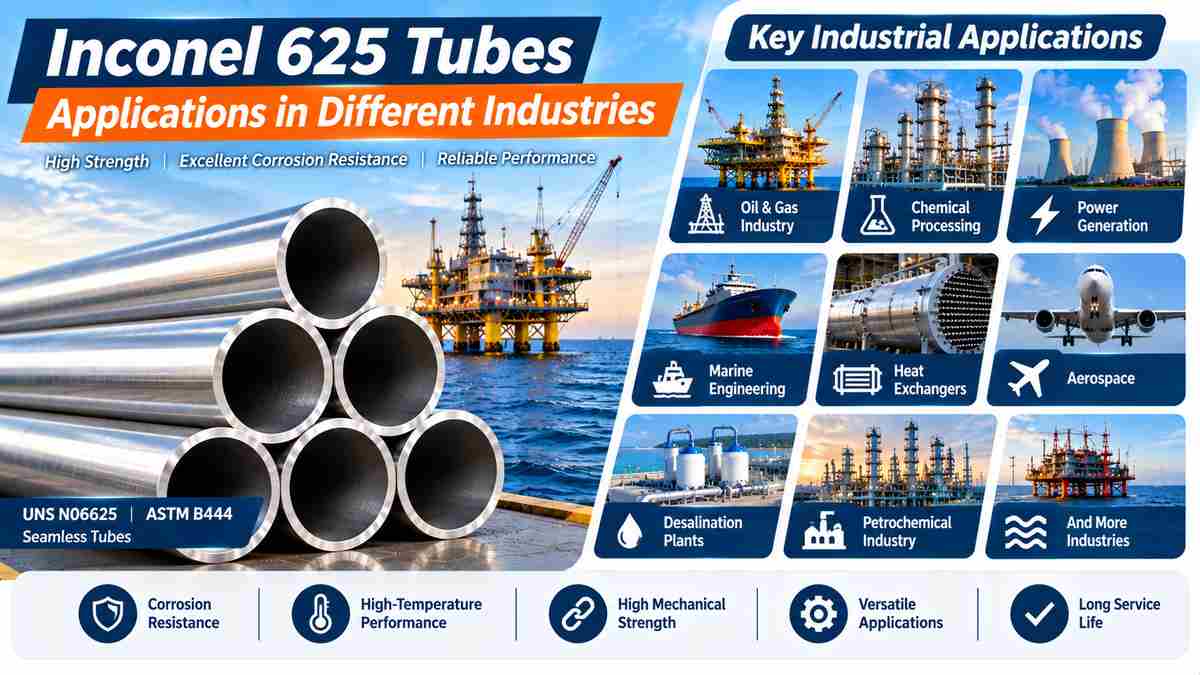
They are commonly considered for chemical processing equipment, offshore installations, marine systems, aerospace components, power generation facilities and oil and gas applications.
The main advantage of Inconel 625 is its ability to maintain reliable performance in environments where conventional stainless steel tubes may not provide the required service life. Its resistance to pitting, crevice corrosion, oxidation and chloride-related corrosion makes it a valuable material for specialised industrial equipment.
In this article, we explain the major applications of Inconel 625 tubes, their important properties and the factors to consider when selecting them for industrial projects.
1. What Are Inconel 625 Tubes?
Inconel 625 is a nickel-based alloy containing chromium, molybdenum and niobium as major alloying elements. It is internationally identified by the following designations:
- UNS: N06625
- DIN Material Number: 2.4856
- ASTM Specification: ASTM B444
- Alloy Name: Inconel 625
The combination of nickel, chromium and molybdenum provides resistance to different corrosive environments. Niobium contributes to strengthening the alloy, helping it maintain high mechanical strength under demanding conditions.
Inconel 625 tubes are used in applications that require:
- Excellent resistance to corrosion
- High tensile and fatigue strength
- Resistance to pitting and crevice corrosion
- Good resistance to oxidation
- Performance across a wide temperature range
- Good weldability and fabrication characteristics
For detailed product specifications, visit ASTM B444 Inconel 625 Tubes Supplier and Exporter – Leoscor Alloy Pipes.
2. Major Industrial Applications of Inconel 625 Tubes
Inconel 625 tubes are used across several industries because of their ability to perform in demanding service conditions. The following are some of their important applications.
2.1 Chemical Processing Industry
Chemical processing plants handle acids, solvents, corrosive chemicals and other aggressive fluids. Equipment used in these facilities must be manufactured from materials that can withstand the chemical environment.
Inconel 625 tubes are considered for selected chemical processing applications because of their resistance to pitting, crevice corrosion and various corrosive media.
Common applications include:
- Chemical processing equipment
- Heat exchanger tubing
- Process piping connections
- Chemical transfer systems
- Corrosion-resistant equipment components
The final material selection depends on the chemical concentration, temperature, pressure and exposure conditions.
2.2 Oil and Gas Industry
The oil and gas industry operates in challenging environments, including offshore platforms, refineries, subsea installations and production facilities.
Equipment may be exposed to seawater, chlorides, high pressure and corrosive production fluids. Inconel 625 is used in suitable applications where strength and corrosion resistance are important.
Common applications include:
- Offshore production equipment
- Subsea components
- Hydraulic and instrumentation tubing
- Chemical injection systems
- Corrosion-resistant process equipment
- Selected oil and gas heat exchangers
For sour-service applications, material suitability must be checked against the relevant requirements, including NACE MR0175 / ISO 15156 where applicable. Inconel 625 should not be assumed suitable for every sour environment without reviewing the actual service conditions and material requirements.
2.3 Marine and Offshore Applications
Marine equipment is regularly exposed to seawater, salt, moisture and chloride-rich environments. These conditions can accelerate corrosion in unsuitable materials.
Inconel 625 provides strong resistance to many marine corrosion mechanisms, making it suitable for selected marine and offshore components.
Its applications may include:
- Seawater handling equipment
- Offshore platform components
- Marine heat exchangers
- Subsea equipment
- Corrosion-resistant tubing systems
- Selected shipboard process equipment
The alloy’s resistance to pitting and crevice corrosion is particularly useful in applications where chloride exposure is a major concern.
2.4 Aerospace Industry
The aerospace industry requires materials that combine high mechanical strength, thermal stability and resistance to oxidation.
Inconel 625 is used in selected aerospace components because it retains useful mechanical properties under demanding temperature conditions.
Applications include:
- Aircraft engine components
- Exhaust systems
- Combustion-related equipment
- Heat-resistant structural components
- Aerospace tubing and specialised assemblies
The specific alloy form and manufacturing specification must match the design requirements of the component.
2.5 Power Generation Industry
Power generation facilities operate with high-temperature equipment, heat transfer systems and pressure-containing components.
Inconel 625 is considered for selected power generation applications where corrosion resistance, oxidation resistance and mechanical performance are required.
Typical applications include:
- Heat exchanger components
- Boiler-related equipment
- Gas turbine components
- High-temperature process equipment
- Corrosion-resistant tubing systems
The grade can be useful in specialised thermal applications, but the required design temperature, pressure and applicable code must be checked before selection.
2.6 Petrochemical and Refinery Industry
Petrochemical plants and refineries process hydrocarbons, chemicals and other fluids under demanding operating conditions.
Inconel 625 tubes may be used in selected equipment where resistance to corrosion and high mechanical strength are important.
Applications include:
- Process heat exchangers
- Refinery equipment
- Chemical transfer systems
- Corrosion-resistant process components
- Specialised tubing assemblies
The actual operating fluid and its impurities should be evaluated before selecting the alloy.
2.7 Fertilizer Industry
Fertilizer manufacturing involves chemical processing systems that may expose equipment to corrosive fluids and elevated temperatures.
Inconel 625 can be considered for selected equipment where the process environment requires a nickel-based corrosion-resistant alloy.
Potential applications include:
- Chemical processing equipment
- Heat exchanger components
- Specialised process tubing
- Corrosion-resistant equipment parts
Material selection should be based on the specific chemicals, concentration and process temperature.
2.8 Food Processing Industry
Food processing plants use heat exchangers, fluid transfer equipment and specialised processing systems. Material selection must consider corrosion resistance, hygiene requirements and cleaning procedures.
Inconel 625 may be specified for specialised equipment exposed to demanding process conditions. However, it is not automatically the preferred material for ordinary food-processing applications. Stainless steel grades are often used, depending on the process and hygiene requirements.
3. Why Are Inconel 625 Tubes Preferred for Industrial Applications?
The performance of Inconel 625 comes from its chemical composition and material properties.
Excellent Corrosion Resistance
The combination of nickel, chromium and molybdenum helps the alloy resist several forms of corrosion, including pitting and crevice corrosion. This makes it useful in selected chloride-containing and aggressive industrial environments.
High Mechanical Strength
Inconel 625 offers high tensile strength and good fatigue resistance. These properties are important for equipment exposed to mechanical loading, vibration and pressure.
High-Temperature Performance
The alloy maintains useful mechanical properties at elevated temperatures and offers resistance to oxidation. This makes it suitable for selected heat-resistant industrial components.
Good Weldability
Inconel 625 has good weldability compared with many other high-strength nickel-based alloys. Appropriate welding procedures and filler materials are still necessary to achieve the required joint performance.
Resistance to Oxidation
Its chromium content contributes to oxidation resistance, which is important for equipment operating in elevated-temperature environments.
4. Inconel 625 Tube Specifications and Standards
Inconel 625 tubes are supplied according to the required product specification, dimensions and manufacturing conditions.
ASTM B444 / ASME SB444 is an important specification for seamless nickel-chromium-molybdenum-columbium alloy pipe and tube.
Key requirements to confirm before ordering include:
| Specification | Details |
|---|---|
| Material grade | Inconel 625 |
| UNS designation | N06625 |
| DIN material number | 2.4856 |
| Product standard | ASTM B444 / ASME SB444 |
| Manufacturing form | Seamless, where specified under B444 |
| Dimensions | As per project requirements |
| Length | Required cut or standard length |
| Testing | As required by the applicable specification |
| Documentation | Material Test Certificate and traceability requirements |
Always confirm the applicable standard and product form with the supplier. ASTM B444 is a seamless product specification; welded tubes require the appropriate specification for the product form and application.
5. How to Select the Right Inconel 625 Tubes
Selecting the correct tube is important for equipment performance, safety and service life. Before placing an order, consider the following factors.
1. Operating temperature: Check the minimum and maximum service temperatures and the thermal cycling conditions.
2. Operating pressure: Confirm the design pressure and required wall thickness according to the applicable engineering code.
3. Corrosion environment: Identify the process fluid, chloride concentration, chemical composition and potential corrosion mechanisms.
4. Tube dimensions: Confirm outside diameter, wall thickness, length and dimensional tolerances.
5. Manufacturing method: Specify seamless or welded construction according to the applicable product standard and project requirement.
6. Inspection and certification: Confirm testing, inspection, material certification and traceability requirements before procurement.
A technically correct material selection should always be based on the actual operating environment rather than the alloy name alone.
6. Why Choose Leoscor Alloy Pipes for Inconel 625 Tubes?
Leoscor Alloy Pipes supplies ASTM B444 Inconel 625 tubes for industrial and project requirements. The product page identifies the material as UNS N06625 and DIN 2.4856.
The company lists different sizes, dimensions and customised options, along with seamless tube supply under ASTM B444.
Customers can discuss their requirements for:
- Inconel 625 tube dimensions
- Required wall thickness and length
- ASTM B444 / ASME SB444 specification
- Project-specific inspection requirements
- Material certification and documentation
- Availability and quotation
For product details and enquiries, visit the Inconel 625 Tubes product page.
Contact Leoscor Alloy Pipes with your required grade, dimensions, quantity and technical specification to request a quotation.
Frequently Asked Questions
1. What are Inconel 625 tubes used for?
Inconel 625 tubes are used in selected chemical processing, oil and gas, marine, offshore, aerospace, power generation and petrochemical applications. They are chosen for their corrosion resistance, mechanical strength and high-temperature performance.
2. What is the UNS number of Inconel 625?
The UNS designation for Inconel 625 is N06625. Its commonly used DIN material number is 2.4856.
3. Why is Inconel 625 suitable for marine applications?
Inconel 625 offers excellent resistance to pitting and crevice corrosion in many chloride-containing environments. This makes it useful for selected seawater and marine equipment applications.
4. Are Inconel 625 tubes suitable for high-temperature applications?
Yes. Inconel 625 maintains useful mechanical properties at elevated temperatures and provides resistance to oxidation. The maximum allowable service temperature depends on the application, design conditions and applicable engineering requirements.
5. What is ASTM B444 Inconel 625?
ASTM B444 is a specification covering seamless nickel-chromium-molybdenum-columbium alloy pipe and tube, including Alloy 625. It defines material and product requirements that must be checked against the applicable edition.
6. Are Inconel 625 tubes corrosion-resistant?
Yes. Their nickel, chromium and molybdenum content provides resistance to several corrosive environments, including pitting and crevice corrosion. Actual performance depends on the fluid, temperature and service conditions.
7. What is the difference between Inconel 625 and stainless steel tubes?
Inconel 625 is a nickel-based alloy, while stainless steel grades are primarily iron-based alloys. Inconel 625 is selected for specialised applications requiring a combination of corrosion resistance, strength and temperature performance that may exceed the requirements of conventional stainless steel.
Inconel 625 tubes play an important role in industries where corrosion resistance, mechanical strength and reliable performance under demanding conditions are essential. From chemical processing and offshore installations to marine engineering, aerospace and power generation, this nickel-based alloy supports a wide range of specialised applications.
Choosing the right tube requires careful consideration of operating temperature, pressure, corrosion conditions, dimensions and applicable standards.
For ASTM B444 Inconel 625 tube requirements, contact Leoscor Alloy Pipes to discuss your project specifications and material requirements.