

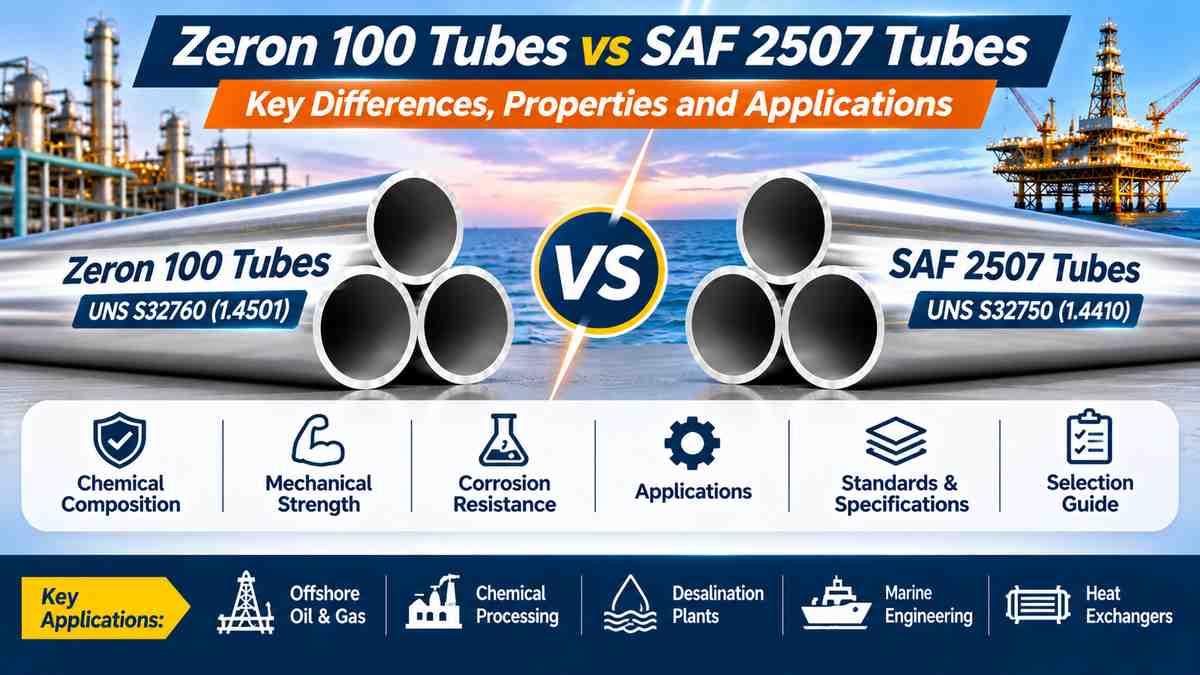
Zeron 100 Tubes vs SAF 2507 Tubes: Key Differences, Properties, Applications and Selection Guide
Super duplex stainless steel tubes are widely used in industries where high mechanical strength and excellent corrosion resistance are essential. Two commonly specified grades are Zeron 100 and SAF 2507. Both are designed to perform in demanding environments involving seawater, chlorides, chemicals, high pressure and elevated corrosion risks.
Although these grades share several characteristics, they are not identical. Differences in chemical composition, alloying additions and corrosion performance can influence which grade is more suitable for a particular application.
In this guide, we compare Zeron 100 tubes and SAF 2507 tubes to help engineers, procurement teams and industrial buyers make an informed material selection.
1. What Are Zeron 100 Tubes?
Zeron 100 tubes is a super duplex stainless steel grade developed for demanding applications requiring high strength and excellent resistance to corrosion. It is commonly identified as UNS S32760 and is also associated with the 1.4501 material designation.
Its alloy composition includes chromium, nickel, molybdenum and nitrogen, along with additional alloying elements such as copper and tungsten. These additions contribute to its performance in aggressive environments.
Zeron 100 tubes are commonly considered for:
- Offshore oil and gas installations
- Seawater handling systems
- Desalination plants
- Chemical processing equipment
- Marine engineering systems
- Heat exchangers and high-pressure applications
The grade offers high mechanical strength and resistance to pitting corrosion, crevice corrosion and chloride stress corrosion cracking.
Explore the product range: Super Duplex Steel Zeron 100 Tubes Supplier
2. What Are SAF 2507 Tubes?
SAF 2507 is a super duplex stainless steel grade commonly identified as UNS S32750. It combines a duplex microstructure with high chromium, molybdenum, nickel and nitrogen content.
This combination provides excellent resistance to pitting, crevice corrosion and chloride stress corrosion cracking. SAF 2507 also offers high tensile strength, making it suitable for equipment operating under demanding pressure and corrosion conditions.
SAF 2507 tubes are widely used in:
- Oil and gas production facilities
- Offshore platforms
- Marine and seawater systems
- Desalination plants
- Chemical processing units
- Heat exchangers
- Petrochemical industries
The grade is often selected where conventional stainless steel grades cannot provide the required combination of strength and corrosion resistance.
Explore the product range: Super Duplex Steel SAF 2507 Tubes Supplier
3. Zeron 100 Tubes vs SAF 2507 Tubes: Key Differences
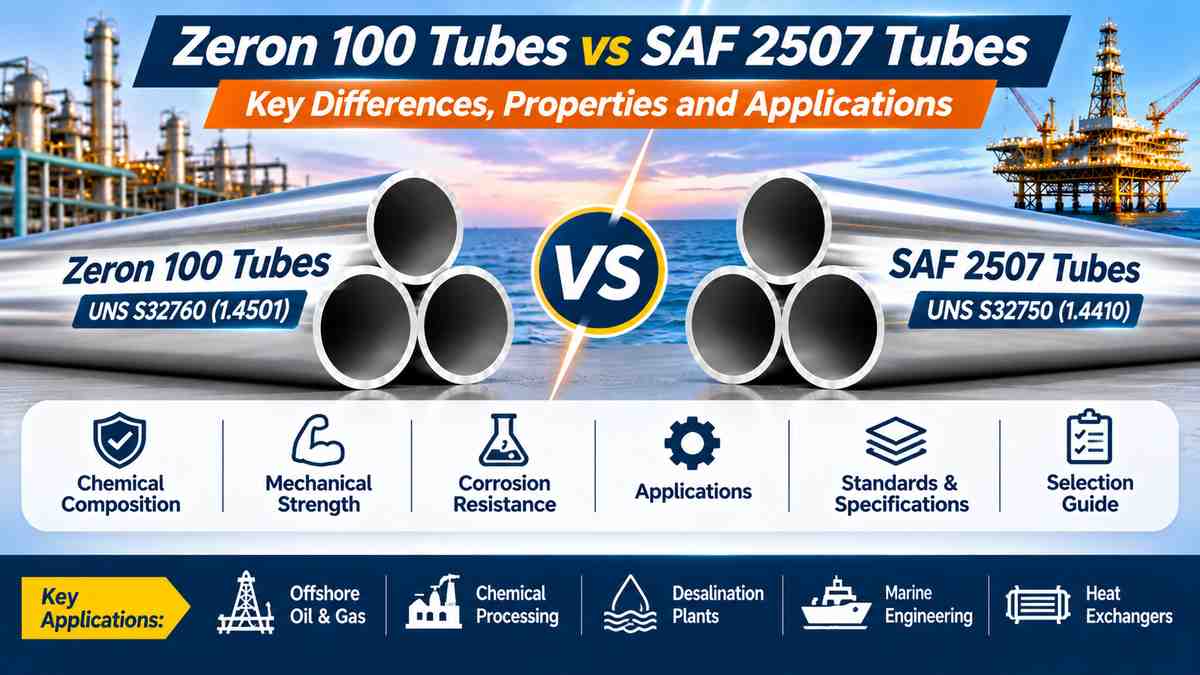
Both materials belong to the super duplex stainless steel family. However, their alloy designations and chemical compositions are different.
| Comparison | Zeron 100 | SAF 2507 |
|---|---|---|
| Material type | Super duplex stainless steel | Super duplex stainless steel |
| UNS designation | S32760 | S32750 |
| Common material number | 1.4501 | 1.4410 |
| Chromium | Approximately 24–26% | Approximately 24–26% |
| Nickel | Approximately 6–8% | Approximately 6–8% |
| Molybdenum | Approximately 3–4% | Approximately 3–5% |
| Nitrogen | Alloyed addition | Alloyed addition |
| Additional alloying | Copper and tungsten are characteristic additions | Different alloy balance |
| Corrosion resistance | Excellent resistance in aggressive chloride environments | Excellent resistance in aggressive chloride environments |
| Mechanical strength | High | High |
| Typical applications | Offshore, seawater and chemical processing | Offshore, oil and gas, marine and chemical processing |
Note: Composition ranges are indicative and may vary by applicable product specification and manufacturing standard. Always verify the material test certificate (MTC) for the supplied heat.
4. Chemical Composition: Zeron 100 vs SAF 2507
Chemical composition is one of the main factors that distinguishes these two super duplex grades.
Both grades contain high levels of chromium, molybdenum and nitrogen. These elements contribute to their corrosion resistance, particularly against pitting and crevice corrosion in chloride-containing environments.
Zeron 100 tubes is distinguished by its alloy design, which includes copper and tungsten additions. These additions help tailor its corrosion performance in demanding service conditions.
SAF 2507 uses a different alloy balance, with chromium, molybdenum, nickel and nitrogen providing its characteristic super duplex properties.
When comparing the two grades, buyers should not rely only on general composition tables. The exact chemical analysis should be checked against the applicable specification and the manufacturer’s test certificate.
5. Mechanical Properties of Zeron 100 and SAF 2507 Tubes
Both grades provide high mechanical strength compared with conventional austenitic stainless steel grades.
The product information published by Leoscor lists the following typical mechanical property values for both grades:
| Mechanical Property | Zeron 100 | SAF 2507 |
|---|---|---|
| Minimum yield strength (0.2% offset) | 550 MPa | 550 MPa |
| Minimum tensile strength | 800 MPa | 800 MPa |
| Elongation | 15% | 15% |
| Density | 7.8 g/cm³ | 7.8 g/cm³ |
Values shown are based on the product-page data and should be confirmed against the applicable standard, product form, dimensions and delivery condition before engineering use.
Their high strength can support pressure-system designs, but actual allowable pressure and wall thickness must be calculated according to the relevant design code.
6. Corrosion Resistance: Which Grade Is Better?
Corrosion resistance is an important consideration when selecting super duplex tubes for offshore, marine and chemical processing applications.
Zeron 100 corrosion resistance
Zeron 100 tubes is designed for aggressive environments where resistance to pitting, crevice corrosion and chloride stress corrosion cracking is important. Its alloying design makes it a strong candidate for demanding seawater and offshore applications.
SAF 2507 corrosion resistance
SAF 2507 also provides excellent resistance to chloride-related corrosion, including pitting and crevice corrosion. It is widely used in seawater systems, desalination facilities and oil and gas installations.
Which one should you choose?
There is no universal winner. The better grade depends on the actual service environment, including:
- Chloride concentration
- Operating temperature
- pH and chemical composition
- Flow velocity and erosion risk
- Pressure and mechanical loading
- Fabrication and welding requirements
For severe chloride conditions, compare the grades using their certified chemical composition and applicable pitting resistance criteria, such as PREN. A higher nominal PREN can indicate better pitting resistance, but it does not replace application-specific corrosion testing or engineering evaluation.
7. Industrial Applications of Zeron 100 and SAF 2507 Tubes
Both grades are used in industries that require reliable performance under demanding operating conditions.
Offshore oil and gas
Both grades can be considered for offshore equipment, seawater systems and process installations where chloride corrosion and mechanical strength are important.
Marine engineering
Marine systems are regularly exposed to seawater, making corrosion-resistant materials essential. Zeron 100 and SAF 2507 tubes are used in suitable marine and seawater-handling applications.
Desalination plants
Desalination equipment handles seawater and concentrated brine. Super duplex tubes can be specified for selected heat-transfer and process applications where chloride corrosion resistance is required.
Chemical processing
Chemical plants handle different corrosive fluids at varying temperatures and concentrations. Material selection should be based on the specific chemical environment and operating conditions.
Heat exchangers
Both grades may be considered for heat exchanger tubing in demanding industrial services. The final selection depends on the process fluid, temperature, pressure, design code and fabrication requirements.
8. Zeron 100 vs SAF 2507: Which Tube Grade Should You Select?
The right choice depends on the operating conditions and technical requirements of the project.
Choose Zeron 100 when:
- The project specification specifically requires UNS S32760.
- Copper and tungsten alloying additions are relevant to the material requirement.
- The application requires a super duplex grade for aggressive chloride environments.
- The equipment design and qualification documents specify Zeron 100.
Choose SAF 2507 when:
- The project specification requires UNS S32750.
- The application requires high strength and resistance to chloride-related corrosion.
- The material is specified for offshore, marine, desalination or chemical processing equipment.
- The design documents identify SAF 2507 or UNS S32750.
Do not substitute one grade for the other without approval from the project engineer or material specialist. Even when their properties appear similar, their chemical composition and material designations are different.
9. Standards and Specifications for Super Duplex Tubes
Super duplex stainless steel tubes are supplied according to relevant product standards and project requirements.
One commonly used specification is:
- ASTM A789 / ASME SA789: Specification for seamless and welded ferritic/austenitic stainless steel tubing for general service.
Depending on the application, additional requirements may apply to dimensions, heat treatment, testing, inspection, surface condition and material certification.
Before ordering, confirm:
- Required grade and UNS designation
- Seamless or welded manufacturing route
- Outside diameter and wall thickness
- Length and dimensional tolerances
- Heat treatment condition
- Testing and inspection requirements
- Material test certificate and traceability
- Any project-specific corrosion or sour-service requirements
10. Why Choose Leoscor Alloy Pipes for Zeron 100 and SAF 2507 Tubes?
Leoscor Alloy Pipes supplies super duplex stainless steel tubes for industrial applications. Its product range includes Zeron 100 and SAF 2507 tubes in different forms and specifications.
Customers can discuss their requirements for:
- Seamless and welded tubes
- Standard and customised dimensions
- Different lengths and end finishes
- Industrial and project-specific requirements
- Material documentation and inspection requirements
For product details, visit:
Contact Leoscor Alloy Pipes with your grade, dimensions, quantity and applicable specification to discuss availability and pricing.
Frequently Asked Questions
1. What is the main difference between Zeron 100 and SAF 2507 tubes?
The main difference is their material designation and alloy composition. Zeron 100 is UNS S32760, while SAF 2507 is UNS S32750. Zeron 100 also has characteristic copper and tungsten alloying additions.
2. Are Zeron 100 and SAF 2507 both super duplex stainless steels?
Yes. Both are super duplex stainless steel grades designed to provide high mechanical strength and excellent corrosion resistance.
3. Which grade offers better corrosion resistance?
Neither grade is automatically better in every environment. Performance depends on the fluid chemistry, chloride concentration, temperature, fabrication condition and other service parameters. Compare certified material data and application-specific corrosion requirements.
4. What is the UNS number of Zeron 100?
Zeron 100 is commonly identified by UNS S32760.
5. What is the UNS number of SAF 2507?
SAF 2507 is commonly identified by UNS S32750.
6. Are Zeron 100 and SAF 2507 tubes suitable for seawater applications?
Both grades are used in suitable seawater and marine applications because of their resistance to chloride-related corrosion. Final suitability depends on the operating conditions and engineering specification.
7. Which standard is used for super duplex stainless steel tubes?
ASTM A789 / ASME SA789 is a commonly used specification for seamless and welded ferritic/austenitic stainless steel tubing for general service. Confirm the required product form and project specification before ordering.
8. Can SAF 2507 replace Zeron 100?
Not automatically. Although both are super duplex grades, their compositions and designations differ. Any material substitution should be reviewed and approved by the responsible engineer or project authority.
Conclusion
Zeron 100 and SAF 2507 are two important super duplex stainless steel grades used in demanding industrial environments. Both offer high mechanical strength and excellent resistance to chloride-related corrosion, making them suitable for selected offshore, marine, desalination and chemical processing applications.
The correct choice depends on the required UNS grade, chemical composition, operating environment, design conditions and project specification. Always verify the material test certificate and applicable standards before placing an order.
For Zeron 100 tubes and SAF 2507 tube requirements, Contact Leoscor Alloy Pipes to discuss your technical specifications and material requirements.