

Hexagonal Tubes – Types, Materials, Sizes, Applications and Manufacturers in India
Hexagonal tubes are specialised hollow metal sections featuring a six-sided outer profile. They are used in selected engineering, fabrication, machinery, architectural and industrial applications where a specific geometric shape, dimensional accuracy and suitable material properties are required.
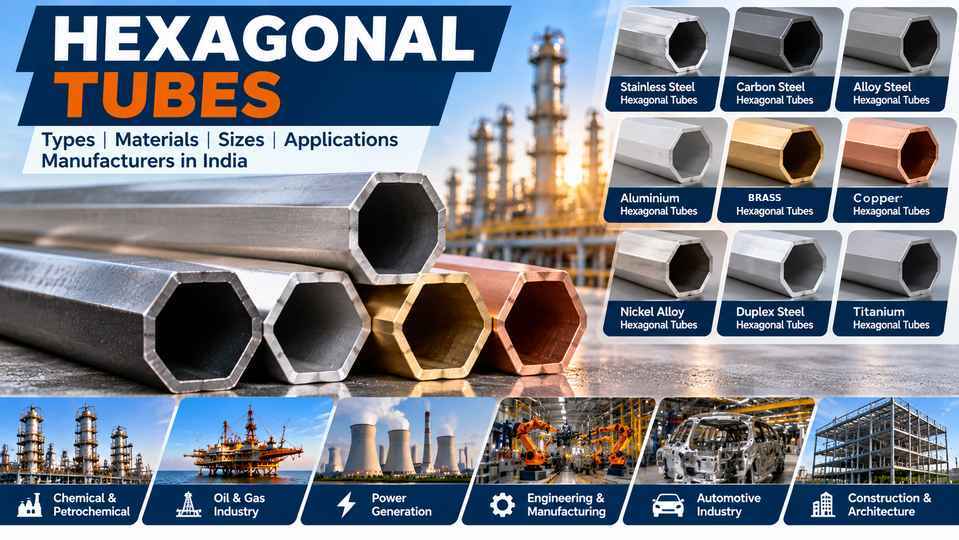
Depending on the application, hexagonal tubes can be made from stainless steel, carbon steel, alloy steel, aluminium, brass, copper and other specialised metals. The selection of the correct material depends on operating conditions, corrosion exposure, mechanical requirements, dimensions and manufacturing specifications.
For industrial buyers, choosing the right hexagonal tube involves more than selecting a metal. It is equally important to understand the manufacturing process, wall thickness, across-flats dimensions, material grade and quality requirements.
This guide explains the different types of hexagonal tubes, their materials, manufacturing methods, technical specifications, industrial applications and important factors to consider when selecting a manufacturer or supplier in India.
What Are Hexagonal Tubes?
Hexagonal tubes are hollow metal sections with six flat outer surfaces arranged in a hexagonal shape. Unlike conventional round, square or rectangular tubes, their six-sided profile provides a distinctive geometry for specialised fabrication and engineering requirements.
These tubes are manufactured from suitable metal materials and can be supplied in different dimensions, wall thicknesses, lengths and surface finishes, depending on the manufacturing process and supplier capabilities.
The internal profile may also vary according to the design. Therefore, buyers should clearly specify whether they require a hexagonal outer profile with a particular internal shape or another customised hollow configuration.
Key Characteristics of Hexagonal Metal Tubes
- Six-sided external profile.
- Hollow internal construction.
- Different wall thickness and dimensional options.
- Availability in selected metal grades and alloys.
- Custom lengths and fabrication requirements.
- Suitability for specialised engineering and industrial components.
Hexagonal Tubes vs Hexagonal Bars: What Is the Difference?
Hexagonal tubes and hexagonal bars have different cross-sectional structures and applications.
A hexagonal tube is hollow, which can reduce material usage and component weight when compared with a solid section of similar external dimensions. It may be used in specialised tubular fabrication, mechanical assemblies, housings and architectural components.
A hexagonal bar is solid throughout its cross-section. It is commonly used for machining, fasteners, nuts, bolts, spacers and other components that require solid material.
The distinction is important when preparing a purchase order. Buyers should specify hexagonal hollow tubes when they require a tubular product rather than a solid hexagonal bar.
Hexagonal Tubes vs Round and Square Tubes
Round tubes are commonly used in fluid transportation, machinery and general engineering. Square tubes are often selected for frames, supports and fabrication work.
Hexagonal tubes are considered when a six-sided profile is needed for design, assembly or fabrication purposes.
The correct shape depends on the component design, connection method, loading conditions, manufacturing requirements and intended application.
Types of Hexagonal Tubes Based on Metal Materials
The metal used in a hexagonal tube directly influences its mechanical properties, corrosion resistance, weight, fabrication characteristics and suitability for different environments.
Below are the major material categories industrial buyers may consider. Actual availability of hexagonal hollow profiles depends on the material grade, manufacturing capability, dimensions and supplier confirmation.
1. Stainless Steel Hexagonal Tubes
Stainless steel hexagonal tubes are considered for applications requiring corrosion resistance, durability and suitable mechanical properties.
Stainless steel contains chromium, which helps develop a protective passive layer on the material surface. Different grades provide different levels of corrosion resistance and performance depending on their chemical composition.
Common stainless steel grades that buyers may evaluate include:
- SS 304 Hexagonal Tubes: Considered for general engineering, fabrication and applications requiring good general corrosion resistance.
- SS 304L Hexagonal Tubes: A low-carbon grade used where welding and resistance to sensitisation are important considerations.
- SS 316 Hexagonal Tubes: Contains molybdenum and is commonly selected for improved resistance to certain chloride-containing environments.
- SS 316L Hexagonal Tubes: A low-carbon version of SS 316, often considered for welded components.
- SS 321 Hexagonal Tubes: A titanium-stabilised grade used in selected elevated-temperature applications.
- SS 310 Hexagonal Tubes: Considered for applications involving elevated temperatures and oxidation.
- SS 904L Hexagonal Tubes: A high-alloy austenitic grade designed for selected demanding corrosive environments.
The final grade should be selected according to the chemical environment, temperature, mechanical requirements and applicable material specification.
Explore the available Stainless Steel Pipes and Grades from Leoscor Alloy Pipes.
2. Carbon Steel Hexagonal Tubes
Carbon steel hexagonal tubes may be considered for industrial fabrication, machinery and engineering applications where mechanical strength and cost considerations are important.
Carbon steel properties vary according to carbon content, manufacturing process and material specification.
Common material categories include:
- Carbon Steel Hexagonal Tubes
- Mild Steel Hexagonal Tubes
- MS Hexagonal Tubes
- Low Carbon Steel Hexagonal Tubes
- Medium Carbon Steel Hexagonal Tubes
- High Carbon Steel Hexagonal Tubes
Low-carbon steel is generally easier to form and weld than higher-carbon grades. However, the appropriate material must be selected according to the required strength, fabrication process and service environment.
Carbon steel does not offer the same general corrosion resistance as stainless steel. Protective coatings, painting or other suitable corrosion-control measures may therefore be required.
View the Carbon Steel Pipes Product Range for related industrial material options.
3. Alloy Steel Hexagonal Tubes
Alloy steel contains additional elements such as chromium, molybdenum, nickel and other alloying elements to modify its mechanical and physical properties.
Alloy steel hexagonal sections may be considered for specialised engineering applications where higher strength, hardenability, wear resistance or elevated-temperature performance is required.
Common alloy steel categories include:
- Alloy Steel Hexagonal Tubes
- Chromium Molybdenum Steel Tubes
- Chrome Moly Hexagonal Tubes
- Low Alloy Steel Hollow Sections
- Special Alloy Steel Tubes
The required alloy grade should be selected according to the intended application and applicable product specification.
Explore Alloy Steel Pipes from Leoscor Alloy Pipes for related alloy steel product requirements.
4. Aluminium Hexagonal Tubes
Aluminium hexagonal tubes are valued for their lightweight construction, corrosion resistance and ease of fabrication.
Aluminium alloys are commonly used in applications where reducing component weight is important without compromising the required mechanical performance.
Some aluminium alloy categories buyers may evaluate include:
- 6061 Aluminium Hexagonal Tubes
- 6063 Aluminium Hexagonal Tubes
- Aluminium Alloy Hexagonal Tubes
- Aluminium Hexagonal Hollow Sections
Aluminium hexagonal tubing may be considered for selected architectural components, machinery, equipment frames and lightweight fabrication.
The correct alloy and temper should be confirmed based on the required strength, welding characteristics, surface finish and operating conditions.
5. Brass Hexagonal Tubes
Brass is a copper-zinc alloy known for its machinability, corrosion resistance and attractive surface appearance.
Brass hexagonal tubes may be considered for selected engineering, decorative, electrical and specialised mechanical components.
Common product-related search terms include:
- Brass Hexagonal Tubes
- Brass Hexagonal Hollow Tubes
- Brass Alloy Hexagonal Tubes
- Brass Hexagonal Sections
The suitability of brass depends on the alloy composition, mechanical requirements and surrounding environment. Buyers should confirm whether the required hollow hexagonal profile can be manufactured in the selected brass grade.
6. Copper Hexagonal Tubes
Copper and copper alloys offer useful electrical and thermal conductivity, along with properties that make them suitable for selected industrial applications.
Copper hexagonal tubes may be considered for specialised electrical, thermal, mechanical and fabrication requirements.
Related material categories include:
- Copper Hexagonal Tubes
- Copper Alloy Hexagonal Tubes
- Copper Hexagonal Hollow Sections
- Copper-Nickel Alloy Tubes
The exact copper alloy should be selected according to conductivity, corrosion exposure, mechanical strength and manufacturing requirements.
7. Nickel Alloy, Titanium and Other Special Metal Hexagonal Tubes
Some industrial applications require specialised materials to handle demanding temperatures, corrosive environments or mechanical conditions.
Depending on manufacturing capability, buyers may investigate the following materials:
- Nickel Alloy Hexagonal Tubes
- Monel Hexagonal Tubes
- Inconel Hexagonal Tubes
- Hastelloy Hexagonal Tubes
- Titanium Hexagonal Tubes
- Duplex Stainless Steel Hexagonal Tubes
- Super Duplex Hexagonal Tubes
- Bronze Hexagonal Tubes
- Phosphor Bronze Hexagonal Tubes
- Gunmetal Hexagonal Tubes
These materials are not interchangeable. For example, nickel-based alloys are selected for particular corrosion and temperature requirements, while titanium is considered for applications where its strength-to-weight ratio and corrosion resistance are useful.
Special alloy profiles may require customised manufacturing or sourcing. Buyers should confirm the exact grade, product form, dimensions and certification requirements before ordering.
Manufacturing Types of Hexagonal Tubes
The manufacturing method affects the dimensional accuracy, surface quality, wall thickness, mechanical properties and suitability of a hexagonal tube for its intended application.
The available process depends on the metal, grade, dimensions and production equipment.
1. Seamless Hexagonal Tubes
Seamless tubes are manufactured without a longitudinal welded joint. Their production generally starts with a solid billet that is pierced and processed into a hollow tubular form.
A hexagonal external profile may require an additional forming or shaping operation, depending on the product design and material.
Seamless hexagonal tubes may be considered when the project specification requires seamless construction. The final product must still meet the required dimensional, mechanical and inspection criteria.
2. Welded Hexagonal Tubes
Welded hexagonal tubes are produced by forming suitable metal strip or sheet material into the required profile and joining the edges through an appropriate welding process.
The manufacturing process must be selected according to material thickness, metal grade, dimensional requirements and service conditions.
Weld quality, seam integrity, dimensional consistency and the specified inspection requirements should be reviewed before procurement.
3. Cold Drawn Hexagonal Tubes
Cold drawing is a manufacturing process used to achieve controlled dimensions and surface characteristics.
In suitable tube manufacturing routes, the material is drawn through specialised tooling to produce the required profile and dimensions.
Cold drawing may be considered where precision, dimensional consistency and surface finish are important.
4. Hot Finished Hexagonal Tubes
Hot forming and hot finishing processes are used to shape metal at elevated temperatures.
The suitability of a hot-finished process depends on the selected alloy, manufacturing route, dimensional requirements and applicable product specifications.
Buyers should confirm the actual manufacturing process with the supplier rather than assume every hexagonal tube is available in seamless, welded, cold-drawn and hot-finished forms.
Hexagonal Tube Sizes, Dimensions and Technical Specifications
Hexagonal tube dimensions are important because they influence fitment, fabrication, component weight and mechanical performance.
Unlike round tubes, hexagonal tubes require specific measurements to describe their external geometry.
Before placing an order, buyers should confirm the following specifications.
| Specification | What it means |
|---|---|
| Across-Flats Dimension | Distance between two opposite parallel flat surfaces |
| Across-Corners Dimension | Distance between two opposite outer corners |
| Outer Profile | External hexagonal shape and dimensions |
| Inner Profile | Internal hollow geometry |
| Wall Thickness | Thickness of the tube material |
| Length | Required overall tube length |
| Material Grade | Specific metal or alloy designation |
| Manufacturing Type | Seamless, welded or other specified process |
| Surface Finish | Mill finish, polished or another specified finish |
| Dimensional Tolerance | Permitted variation in measurements |
Standard Hexagonal Tube Sizes
Hexagonal tubes may be required in different across-flats dimensions and wall thicknesses depending on the component design.
Unlike standard round pipes, the dimensions of a hexagonal hollow profile should not be assumed from conventional nominal pipe sizes.
A technical drawing is often the best way to communicate the required external profile, internal opening, corner radius and wall thickness.
Buyers should confirm whether the required dimensions are standard, available through existing production tooling or need customised manufacturing.
Hexagonal Tube Wall Thickness
Wall thickness is the distance between the outer and inner surfaces of the tube.
It is an important specification because it influences the material quantity, component weight, stiffness and load-bearing behaviour.
A thicker wall does not automatically make a product suitable for every application. Engineers should consider the complete component design, material properties, loading conditions and applicable design requirements.
Hexagonal Tube Weight Per Meter
The weight of a hexagonal tube depends on its material density, external dimensions, internal dimensions and wall thickness.
Unlike a simple circular tube calculation, a hexagonal hollow section requires its actual cross-sectional area to be considered.
A general calculation method is:
Weight per meter = Cross-sectional area × Material density
The cross-sectional area should be calculated from the actual hollow profile, taking the internal geometry and corner radii into account.
For accurate procurement and engineering calculations, use the supplier’s dimensional data and verified material density. Weight may vary with manufacturing tolerances and the final profile.
Material Grades and Applicable Standards
Material standards define important requirements such as chemical composition, mechanical properties, manufacturing processes, dimensional tolerances and testing.
Different metals and product forms may follow different ASTM, ASME, EN, DIN, JIS or other material specifications.
For example, stainless steel pressure pipes and stainless steel tubes may have different applicable product standards. A standard intended for round pipe should not automatically be applied to a customised hexagonal hollow section.
Always verify that the selected standard covers the actual material, product form, manufacturing process and intended application.
Industrial Applications of Hexagonal Tubes
Hexagonal tubes are used in selected applications where their six-sided profile offers a practical design or fabrication advantage.
Their suitability depends on the metal grade, dimensions, wall thickness, loading conditions and component requirements.
1. Engineering and Machinery
Hexagonal hollow sections may be considered for customised machine components, equipment housings, tubular supports and fabricated assemblies.
Their profile can help meet specific equipment design and connection requirements.
2. Automotive and Transportation
Specialised metal profiles may be used in selected vehicle components, lightweight assemblies, brackets and fabrication requirements.
The material should be selected according to the mechanical loads, vibration, temperature and environmental conditions involved.
3. Industrial Equipment and Fabrication
Manufacturers may use hexagonal sections in equipment frames, guards, support structures, housings and customised fabricated products.
The external shape can be useful when a component design calls for a six-sided profile rather than conventional round or square tubing.
4. Construction and Architectural Fabrication
Hexagonal metal profiles may be considered for architectural detailing, decorative structures, furniture components and specialised fabrication.
The design must account for structural loading, connection details, corrosion exposure and the suitability of the material.
5. Chemical and Petrochemical Industries
Material selection is particularly important in chemical and petrochemical environments because the metal may be exposed to corrosive fluids, gases and elevated temperatures.
Specialised alloy profiles may be considered for selected equipment and fabrication requirements. However, a hexagonal tube should not be assumed suitable for pressure-containing service unless its design, product specification, testing and code requirements have been properly established.
6. Electrical and General Manufacturing
Selected copper, brass, aluminium and stainless steel profiles may be considered for specialised electrical, mechanical and general manufacturing components.
The required conductivity, strength, dimensional accuracy and surface finish should guide material selection.
Key Factors to Consider When Buying Hexagonal Tubes
Selecting a suitable hexagonal tube requires reviewing both the material and the product dimensions. Industrial buyers should confirm the complete specification before requesting a quotation.
1. Select the Correct Metal and Grade
Identify whether the application requires stainless steel, carbon steel, alloy steel, aluminium, brass, copper or a specialised nickel alloy.
Within each metal category, the individual grade must be selected according to corrosion exposure, temperature, strength and fabrication requirements.
2. Confirm Dimensions and Wall Thickness
Specify the across-flats dimension, across-corners dimension where relevant, wall thickness, internal profile and overall length.
A technical drawing can help avoid measurement errors.
3. Check the Manufacturing Type
Confirm whether the project requires seamless, welded, cold-drawn or another manufacturing route.
The selection should match the required product specification and engineering conditions.
4. Review Mechanical and Chemical Properties
Check the material’s chemical composition, tensile strength, yield strength, hardness and other relevant mechanical properties.
For corrosive environments, evaluate the specific fluid, concentration, temperature and exposure duration.
5. Verify Quality Inspection and Material Test Certificates
Ask for the required material test certificate and confirm that the heat number, material grade and chemical composition match the purchase order.
Dimensional inspection, mechanical testing, non-destructive testing and third-party inspection may also be required depending on the project specification.
6. Consider Custom Sizes and Surface Finishing
Some hexagonal hollow profiles may require specialised tooling or customised manufacturing.
Confirm the availability of custom dimensions, tolerances, corner radii, surface finish and cut lengths before finalising the purchase.
7. Confirm Stock Availability and Delivery Schedule
For urgent industrial requirements, confirm current availability, quantity, production lead time, packaging and delivery schedule.
This helps procurement teams plan material supply without unnecessary project delays.
How to Choose the Right Hexagonal Tube Manufacturer or Supplier in India
Finding a suitable hexagonal tube manufacturer or supplier in India requires evaluating technical capability, material sourcing, quality documentation and delivery support.
The following factors can help buyers make a more informed decision.
Material range: Check whether the supplier can source the required metals, grades and alloy specifications.
Manufacturing capability: Confirm whether the supplier or its manufacturing partners can produce the required hollow hexagonal profile and dimensions.
Quality assurance: Review material test certificates, heat-number traceability, dimensional inspection and other required quality documents.
Customisation: Ask whether the supplier can meet non-standard dimensions, wall thicknesses, lengths and surface finishing requirements.
Technical support: A reliable supplier should be able to review the material specification and clarify product requirements before confirming an order.
Delivery and logistics: Confirm the expected delivery schedule, packaging requirements and shipping arrangements.
Why Consider Leoscor Alloy Pipes for Industrial Pipe and Tube Requirements?
Leoscor Alloy Pipes supplies industrial pipes and tubes in several material categories, including stainless steel, duplex steel, super duplex steel, carbon steel, alloy steel and nickel alloys.
Its stainless steel pipe product range lists different forms and profiles, including hexagonal and hollow sections. Buyers looking for a specific hexagonal hollow tube should share their drawing, material grade, dimensions and manufacturing requirements with the team to confirm the exact product availability and supply route.
Explore the relevant product categories:
- Stainless Steel Pipes
- Stainless Steel Tubes
- Carbon Steel Pipes
- Alloy Steel Pipes
- Duplex Steel Pipes
- Super Duplex Steel Tubes
- Nickel Alloy Tubes
For product enquiries, visit the Leoscor Alloy Pipes Contact Page and share your technical requirements.
Factors Affecting Hexagonal Tube Prices in India
The price of hexagonal tubes depends on several technical and commercial factors. There is no single price applicable to every metal, grade or dimension.
Important pricing factors include:
1. Material and grade: Stainless steel, carbon steel, aluminium, brass and specialised alloys have different raw material costs.
2. Dimensions and wall thickness: Larger dimensions and thicker walls generally require more material.
3. Manufacturing process: Seamless, welded, cold-drawn and customised profiles may involve different production costs.
4. Manufacturing quantity: Order quantity can influence production economics, sourcing and tooling costs.
5. Surface finish and tolerances: Special finishing, closer dimensional tolerances and additional inspection may affect the final price.
6. Quality documentation: Material test certificates, third-party inspection and project-specific testing can influence procurement costs.
7. Transportation and delivery: Packaging, logistics, delivery location and shipping requirements also affect the final quotation.
For an accurate price, buyers should provide the material grade, dimensions, wall thickness, quantity, required manufacturing type and delivery location.
Frequently Asked Questions About Hexagonal Tubes
1. What are hexagonal tubes used for?
Hexagonal tubes are hollow metal sections used in selected engineering, machinery, fabrication, architectural and industrial applications. Their six-sided external profile is useful when a specific shape is required for component design or assembly. Depending on the material and dimensions, they may be considered for equipment housings, tubular supports, guards and customised fabricated components. Their suitability should always be confirmed against the intended application.
2. Which metals are available for hexagonal tube manufacturing?
Hexagonal hollow profiles may be manufactured or sourced in selected materials such as stainless steel, carbon steel, alloy steel, aluminium, brass, copper and specialised nickel alloys. However, availability varies according to the metal grade, profile dimensions, manufacturing process and production capability. Buyers should provide their required material specification and technical drawing to confirm whether the exact hollow hexagonal section can be supplied.
3. What is the difference between hexagonal tubes and hexagonal bars?
Hexagonal tubes have a hollow internal structure, while hexagonal bars are solid metal products. Tubes may be selected where a hollow profile, reduced material usage or lower component weight is required. Solid hexagonal bars are commonly used for machining, fasteners, nuts, bolts and spacers. Buyers should clearly specify whether they need a hollow tube or a solid bar when requesting a quotation.
4. Are stainless steel hexagonal tubes available in SS 304 and SS 316 grades?
SS 304 and SS 316 are widely used austenitic stainless steel grades with different corrosion-resistance characteristics. They may be considered for hexagonal hollow profiles when suitable manufacturing or sourcing options are available. SS 316 generally offers improved resistance to certain chloride-containing environments compared with SS 304. Buyers should confirm the required grade, dimensions, wall thickness, manufacturing method and material certification.
5. Are seamless and welded hexagonal tubes available?
Seamless and welded are two different manufacturing categories. A seamless tube has no longitudinal welded joint, while a welded tube is produced by forming and joining suitable metal material. A hexagonal profile may require additional shaping or forming operations after the initial tube-making process. Availability depends on the material, dimensions, production route and supplier capability, so the required construction should be specified clearly.
6. How do I select the right hexagonal tube size and wall thickness?
Start by identifying the component’s design requirements and the loads or operating conditions it will experience. Specify the across-flats dimension, across-corners dimension where relevant, internal profile, wall thickness and overall length. Also confirm the metal grade, dimensional tolerance and manufacturing process. For critical components, have the design and wall thickness reviewed by a qualified engineer before procurement.
7. Are custom-size metal hexagonal tubes available?
Custom-size hexagonal tubes may be possible when suitable forming equipment, tooling and material are available. Requirements can include non-standard across-flats dimensions, special wall thicknesses, customised lengths, corner radii and surface finishes. The feasibility depends on the selected alloy, production process, order quantity and required tolerances. Providing a technical drawing is the most effective way to help a supplier assess a customised requirement.
8. How is the weight of a hexagonal tube calculated?
The weight of a hexagonal tube is calculated using its hollow cross-sectional area, material density and length. The cross-sectional area depends on the outer and inner profiles, their dimensions and corner radii. Unlike round pipes, a circular pipe formula should not be used directly for a hexagonal section. For accurate weight estimates, request dimensional data and a calculation based on the actual geometry.
9. What factors affect hexagonal tube prices in India?
Hexagonal tube prices depend on the metal grade, material density, dimensions, wall thickness, manufacturing method and order quantity. Custom tooling, special surface finishes, close dimensional tolerances, testing and certification may also affect the quotation. Raw material market conditions and transportation requirements influence the final cost. Buyers should submit a complete technical specification to receive an accurate and comparable price.
10. How can I choose a reliable hexagonal tube manufacturer or supplier in India?
Evaluate the supplier’s material range, sourcing network, manufacturing capability, quality inspection process and documentation. Confirm whether the supplier can provide the exact hollow profile, required grade, dimensions and applicable product specification. Ask for material test certificates, traceability details and delivery commitments where required. A technical drawing and complete enquiry specification help the supplier assess feasibility and provide a more accurate quotation.
Conclusion: Find the Right Hexagonal Tubes for Your Industrial Requirements
Hexagonal tubes are specialised hollow metal products designed for applications requiring a six-sided external profile. They may be considered in stainless steel, carbon steel, alloy steel, aluminium, brass, copper and selected high-performance alloys, depending on manufacturing and sourcing capabilities.
Choosing the correct hexagonal tube requires careful evaluation of material grade, external dimensions, internal profile, wall thickness, manufacturing method, mechanical properties and quality documentation.
For industrial buyers, working with an experienced supplier can simplify material selection, technical evaluation and procurement.
Leoscor Alloy Pipes offers a range of industrial pipes and tubes in different material categories. Contact the team with your required material grade, technical drawing, dimensions, quantity and application details to discuss suitable product options.
Explore industrial pipe and tube solutions from Leoscor Alloy Pipes:
https://www.leoscoralloypipes.com/