

304 Stainless Steel Seamless Pipe: Properties, Applications and Benefits
When selecting stainless steel pipes for an industrial project, material quality and manufacturing method both matter. A pipe must meet the requirements of the application, whether it is used in food processing, chemical handling, water systems or general industrial piping.
One of the most widely used options is the 304 stainless steel seamless pipe. It is known for its general corrosion resistance, good fabrication characteristics and versatility across different industries.
Grade 304 contains chromium and nickel, which help protect the surface against corrosion and support its mechanical properties. When manufactured as a seamless pipe, it has no longitudinal manufacturing weld seam. This makes it a suitable choice for many applications where the specified seamless product is required.
However, choosing the correct pipe involves more than selecting a familiar grade. Buyers must consider the fluid being transported, operating temperature, pressure, pipe dimensions and applicable material standards.
In this guide, we will explain what 304 stainless steel seamless pipe is, its chemical composition, key properties, industrial applications and the factors to check before purchasing it.
What Is a 304 Stainless Steel Seamless Pipe?
A 304 stainless steel seamless pipe is manufactured from Grade 304 austenitic stainless steel without a longitudinal weld seam.
The manufacturing process generally begins with a solid steel billet. The billet is heated and pierced to create a hollow section, which is then rolled or processed to achieve the required outside diameter and wall thickness.
Grade 304 belongs to the chromium-nickel family of stainless steels. It is commonly identified by the UNS designation S30400 and is also known as EN 1.4301 and JIS SUS 304, subject to confirmation of the applicable product specification.
The chromium content helps form a thin passive layer on the steel surface. This layer slows corrosion in many environments, while nickel contributes to the austenitic structure and fabrication characteristics.
The seamless manufacturing method and the material grade serve different purposes. Grade 304 describes the material, while seamless describes how the pipe is manufactured.
For industrial applications, the product must meet the correct material and dimensional specifications.
Chemical Composition of 304 Stainless Steel
The chemical composition of stainless steel plays an important role in its corrosion resistance, mechanical properties and fabrication performance.
Common ASTM product specifications for Grade 304 define the following composition limits.
| Element | Typical composition limit |
|---|---|
| Carbon (C) | 0.08% maximum |
| Chromium (Cr) | 18.0–20.0% |
| Nickel (Ni) | 8.0–10.5% |
| Manganese (Mn) | 2.0% maximum |
| Silicon (Si) | 0.75% maximum |
| Phosphorus (P) | 0.045% maximum |
| Sulfur (S) | 0.030% maximum |
| Nitrogen (N) | 0.10% maximum |
| Iron (Fe) | Balance |
These are common reference limits, not a substitute for the exact standard specified for the product.
Chromium contributes to the protective passive layer, while nickel helps maintain the austenitic structure. Together, these elements give Grade 304 its useful combination of corrosion resistance and formability.
Before purchasing a 304 stainless steel seamless pipe, confirm its chemical composition and material identification through the applicable material test certificate.
Key Properties of 304 Stainless Steel Seamless Pipe
1. General Corrosion Resistance
Grade 304 provides good resistance to corrosion in many atmospheric and industrial environments. It is commonly used where carbon steel may require additional corrosion protection.
However, stainless steel is not completely rust-proof. Chlorides, aggressive chemicals, deposits and unsuitable operating conditions can cause localised corrosion.
The material should therefore be selected according to the actual process environment.
2. Mechanical Properties
Grade 304 offers a useful combination of strength, toughness and ductility. Its mechanical properties depend on the product form, manufacturing process, heat treatment and applicable specification.
For pressure piping, the specified mechanical properties must be checked against the relevant product standard and design code.
The seamless manufacturing process does not automatically guarantee higher strength than every welded pipe. Suitability depends on the complete product specification and operating conditions.
3. Good Fabrication Characteristics
Grade 304 can be formed and fabricated using appropriate industrial methods. It is also widely welded using suitable procedures.
For applications involving welding, fabrication conditions and the finished surface should be considered alongside the original material properties.
Where lower carbon content is important for welding or service conditions, Grade 304L may be worth evaluating, subject to engineering approval.
4. Oxidation Resistance
Grade 304 provides useful oxidation resistance under suitable temperature and atmospheric conditions.
Its performance depends on the metal temperature, exposure duration and environment. For prolonged or more demanding high-temperature service, a specialised heat-resistant grade may be more appropriate.
5. Wide Industrial Availability
Grade 304 is widely used across different industries and is available in multiple product forms. Depending on the manufacturer’s range and required specification, pipes may be supplied in different sizes, schedules, lengths and end finishes.
For procurement, the exact pipe dimensions and manufacturing type should be stated clearly.
Applications of 304 Stainless Steel Seamless Pipe
304 stainless steel seamless pipe is used in a broad range of industrial applications where its material properties meet the operating requirements.
1. Food and Beverage Processing
Food processing facilities use stainless steel equipment and piping because the material can offer suitable corrosion resistance and cleanable surfaces.
Grade 304 may be used in tanks, processing equipment and selected piping systems where the product meets the required hygiene, cleaning and process specifications.
The final choice should also consider the chemicals used for cleaning and the nature of the product being handled.
2. Chemical Processing
Chemical plants use different grades of stainless steel depending on the chemicals involved, their concentrations and operating temperatures.
Grade 304 can be suitable for certain process fluids and utility systems. However, it should not be assumed compatible with every acid, chloride-containing solution or aggressive chemical.
Where corrosion exposure is more demanding, another grade may be necessary.
3. Water Handling Systems
304 stainless steel pipes can be used in selected water handling and utility applications.
The suitability of the material depends on water chemistry, chloride concentration, temperature and other service conditions. The design must account for the risk of pitting and other corrosion mechanisms.
4. Pharmaceutical and Healthcare Equipment
Stainless steel is used in pharmaceutical manufacturing equipment and other applications where surface finish and cleanability are important.
Grade 304 may be suitable for selected components and systems, provided it meets the applicable process and hygienic requirements.
More demanding pharmaceutical applications may require different materials, specialised finishes or additional documentation.
5. Industrial Manufacturing
General engineering, machinery and manufacturing facilities use stainless steel piping in applications involving compatible fluids, equipment connections and utility systems.
Grade 304 is often considered where general corrosion resistance and fabrication versatility are required.
6. Petrochemical and Process Industries
Certain petrochemical and process applications use Grade 304 pipes where the operating conditions are compatible with the material.
Engineers must evaluate fluid composition, temperature, pressure and corrosion risk before specifying the grade. More aggressive environments may require higher-alloy stainless steel or another corrosion-resistant material.
Benefits of Choosing Seamless 304 Stainless Steel Pipes
The main benefits of this product come from combining Grade 304’s material properties with seamless manufacturing.
No longitudinal manufacturing weld seam: Seamless pipes are formed without welding the edges of a strip or plate together along the pipe body.
Suitable for specified industrial service: Seamless Grade 304 pipes are used in applications where the product meets the relevant material, dimensional and design requirements.
Corrosion resistance: The chromium-nickel composition provides useful resistance to corrosion in many environments.
Fabrication versatility: Grade 304 can be formed and welded using suitable procedures.
Different dimensional options: Pipes can be specified according to nominal size, outside diameter, schedule or wall thickness and required length.
Broad application range: The grade is used in food processing, general engineering, water handling and other industrial sectors.
These benefits depend on selecting the right product and ensuring that it complies with the relevant specification.
304 Stainless Steel Seamless Pipe vs Welded Pipe
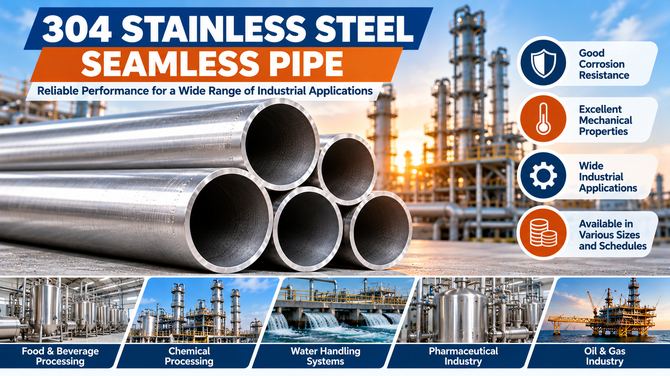
Grade 304 can be manufactured as both seamless and welded pipe. The main difference is the manufacturing process, not the base material grade.
| Comparison factor | Seamless Grade 304 pipe | Welded Grade 304 pipe |
|---|---|---|
| Manufacturing | Formed from a solid billet without a longitudinal weld seam | Formed from steel strip or plate and joined by welding |
| Longitudinal weld seam | Not present | Present in longitudinally welded types |
| Material | Grade 304 stainless steel | Grade 304 stainless steel |
| Typical selection | Applications where seamless construction is specified or preferred | Applications where welded construction meets the project requirements |
| Cost | Can be more expensive for comparable requirements | Can offer cost advantages for suitable sizes and specifications |
| Suitability | Depends on grade, dimensions, standard and design conditions | Depends on grade, weld quality, dimensions, standard and design conditions |
Neither product type is automatically superior for every application. The correct choice depends on the project specification, design conditions, required dimensions, inspection and cost.
For more demanding applications, the engineer should confirm whether the product must be seamless or whether an approved welded pipe is acceptable.
Common Standards for 304 Stainless Steel Seamless Pipe
Product standards specify requirements for material composition, mechanical properties, manufacturing, dimensions, testing and inspection.
One commonly used specification is ASTM A312/ASME SA312, which covers seamless, welded and heavily cold-worked welded austenitic stainless steel pipes intended for high-temperature and general corrosive service.
Grade TP304 is included within the applicable specification. The precise requirements depend on the selected edition, product form and purchase specification.
When ordering, buyers should confirm:
- Material grade and product specification
- Nominal pipe size and schedule
- Required wall thickness and length
- Seamless construction
- Chemical and mechanical test requirements
- Material test certificate and heat-number traceability
- Any additional project-specific inspection requirements
The standard should always match the product form and intended service. Never assume that specifying only “SS 304 pipe” provides enough information for a critical industrial purchase.
How to Select the Right 304 Stainless Steel Seamless Pipe
Before placing an order, consider the following factors.
1. Define the Application
Identify whether the pipe will be used in food processing, water handling, chemical processing, manufacturing or another industrial system.
2. Check the Operating Environment
Review the fluid composition, temperature, pressure and potential exposure to chlorides or aggressive chemicals.
3. Confirm the Pipe Dimensions
Specify the nominal size, outside diameter, schedule or wall thickness, length and required end finish.
4. Verify the Material Standard
State the required grade and applicable standard, such as ASTM A312 TP304 where appropriate.
5. Review Testing and Certification
Confirm the material test certificate, chemical composition, mechanical properties and any additional inspection requirements.
6. Evaluate Fabrication Requirements
Consider whether the pipe will require welding, forming, cutting or other fabrication. Make sure the selected grade and product condition are suitable for the intended work.
7. Confirm Supplier Availability
Check that the required grade, size, wall thickness, quantity and delivery schedule can be met. Actual availability should be confirmed before placing the order.
Following these steps helps reduce specification errors and makes it easier to compare supplier quotations accurately.
Why Source 304 Stainless Steel Seamless Pipes from Leoscor Alloy Pipes?
Leoscor Alloy Pipes supplies Grade 304 stainless steel pipes for industrial piping, process systems, fabrication, water handling, food processing, chemical processing and general engineering applications.
Its published product range includes seamless, welded, ERW and other configurations, with different sizes, schedules, wall thicknesses, lengths and end finishes according to project requirements.
For a seamless pipe enquiry, clearly specify Grade 304, the required standard, nominal size, schedule or wall thickness and quantity.
You can explore the 304 Stainless Steel Pipes product range from Leoscor Alloy Pipes for further specifications and product information.
Request a Quote for 304 Stainless Steel Seamless Pipes
Looking for SS 304 seamless pipes for an industrial project?
Contact Leoscor Alloy Pipes with your required grade, dimensions, quantity and applicable standard. Include your testing and certification requirements so the product can be evaluated against your technical specifications.
Contact Leoscor Alloy Pipes to submit your requirements and request a quotation.
Conclusion
304 stainless steel seamless pipe is a widely used option for industrial applications requiring general corrosion resistance, useful mechanical properties and fabrication versatility.
Its chromium-nickel composition makes it suitable for many food processing, water handling, manufacturing and selected chemical processing applications. Seamless construction may be preferred where the project specification requires a pipe without a longitudinal manufacturing weld seam.
However, Grade 304 is not the right material for every environment. Chloride exposure, aggressive chemicals, operating temperature, pressure and the applicable design code must all be considered before selecting a pipe.
For a successful purchase, verify the material grade, product standard, size, wall thickness, certification and delivery requirements.
For industrial piping requirements, contact Leoscor Alloy Pipes with your technical specifications to discuss suitable Grade 304 seamless pipe options.
Frequently Asked Questions
1. What is a 304 stainless steel seamless pipe?
It is a pipe made from Grade 304 austenitic stainless steel without a longitudinal manufacturing weld seam. It is used in industrial applications where its corrosion resistance and mechanical properties meet the service requirements.
2. What is the chemical composition of SS 304?
Grade 304 typically contains 18–20% chromium and 8–10.5% nickel, with a maximum carbon content of 0.08% under common specifications. The exact composition limits depend on the applicable product standard.
3. Is SS 304 suitable for industrial piping?
Yes. It is widely used in general industrial piping, food processing, water handling and manufacturing. The grade must still be evaluated against the fluid, temperature, pressure and corrosion conditions.
4. What is the standard for 304 stainless steel seamless pipes?
ASTM A312/ASME SA312 is a commonly used specification covering seamless and welded austenitic stainless steel pipes, including applicable TP304 products. Confirm the exact specification in the purchase order.
5. What is the difference between SS 304 seamless and welded pipes?
Seamless pipes are manufactured without a longitudinal weld seam. Welded pipes are formed from steel strip or plate and joined by welding. Their suitability depends on the required standard, design conditions, dimensions and inspection requirements.
6. Is 304 stainless steel corrosion-resistant?
Yes. Grade 304 offers good corrosion resistance in many environments. However, chloride-rich solutions, aggressive chemicals and certain high-temperature conditions can cause corrosion and may require a different grade.
7. Is 304 stainless steel suitable for high temperatures?
Grade 304 can be used in selected elevated-temperature applications, but suitability depends on the metal temperature, exposure duration, mechanical loading and applicable design requirements. More demanding high-temperature service may require a specialised grade.
8. How do I select the correct size of a 304 seamless pipe?
Specify the nominal pipe size, outside diameter, schedule or wall thickness, required length and applicable dimensional standard. The selection should be verified against the project specification.
9. Can SS 304 seamless pipes be welded?
Yes. Grade 304 can be welded using suitable qualified procedures. Fabrication requirements, cleaning and the final service environment should be considered.
10. Where can I source 304 stainless steel seamless pipes?
You can review the 304 Stainless Steel Pipes range from Leoscor Alloy Pipes and submit an enquiry with your required grade, dimensions, quantity and certification requirements.