

Understanding the Difference Between 316L and 317L Stainless Steel
Choosing the right stainless steel grade is important when a pipe or component must withstand corrosion, chemicals and demanding industrial conditions. Two grades that often come up during material selection are 316L and 317L stainless steel.
At first glance, these grades may appear similar. Both belong to the austenitic stainless steel family, contain chromium, nickel and molybdenum, and offer good corrosion resistance. Both also have a low carbon content that helps reduce the risk of sensitisation during welding.
However, there is a key difference in their chemical composition. 317L generally contains more chromium and molybdenum than 316L, which can provide better resistance to pitting and crevice corrosion in certain aggressive environments.
This difference can matter in chemical processing plants, refineries, pharmaceutical facilities and other industrial applications where material performance directly affects maintenance and service life.
Does this mean 317L is always the better choice? Not necessarily. The correct grade depends on the chemicals involved, operating temperature, chloride concentration, fabrication requirements and project budget.
In this guide, we will explain the difference between 316L and 317L stainless steel, compare their properties and applications, and help you understand when each grade may be suitable for your project.
What Is 316L Stainless Steel?
316L is a low-carbon austenitic stainless steel grade containing chromium, nickel and molybdenum. Its UNS designation is S31603.
The molybdenum content improves its resistance to pitting and crevice corrosion compared with conventional grades such as 304L in many environments.
The letter “L” stands for low carbon. Under common specifications, 316L has a maximum carbon content of 0.03%. This lower carbon limit helps reduce the risk of chromium carbide precipitation during welding, which can otherwise affect corrosion resistance near welded areas.
316L is widely used in industrial piping, chemical processing, food and beverage equipment, pharmaceutical systems and marine-related applications where its properties meet the service requirements.
Key Properties of 316L Stainless Steel
- Good corrosion resistance: Suitable for many industrial environments, including applications involving mild chloride exposure.
- Low carbon content: Helps reduce the risk of sensitisation during welding.
- Fabrication capability: Can be welded and formed using appropriate procedures.
- Industrial availability: Widely specified across different pipe, tube and component product forms.
- Versatility: Used in several industries where corrosion resistance and fabrication requirements must be balanced.
However, 316L is not immune to corrosion. Under certain combinations of chloride concentration, temperature and mechanical stress, it can develop pitting, crevice corrosion or stress corrosion cracking.
For product specifications, visit the 316L Stainless Steel Pipes page from Leoscor Alloy Pipes.
What Is 317L Stainless Steel?
317L is also a low-carbon austenitic stainless steel, identified by the UNS designation S31703.
Like 316L, it contains chromium, nickel and molybdenum. The main difference is that 317L generally contains higher levels of chromium and molybdenum.
These additional alloying elements can improve resistance to general corrosion and localised corrosion, particularly in certain chloride-containing and chemical environments.
Its low carbon content also helps reduce the risk of sensitisation during welding when suitable fabrication procedures are followed.
317L is often considered for chemical processing equipment, pulp and paper production, selected pharmaceutical applications and industrial systems where 316L may not provide sufficient corrosion resistance.
Key Properties of 317L Stainless Steel
- Improved pitting resistance: Its higher molybdenum content generally improves resistance to localised corrosion compared with 316L.
- Good chemical resistance: Can be suitable for certain acidic and chemical environments, subject to compatibility testing.
- Low carbon content: Helps reduce the risk of sensitisation during welding.
- Austenitic structure: Provides useful toughness and fabrication characteristics.
- More demanding applications: May be preferred when the service environment requires improved corrosion resistance.
The suitability of 317L still depends on the actual chemical composition of the process fluid, operating temperature, surface condition and design requirements.
Explore the 317L Stainless Steel Pipes range from Leoscor Alloy Pipes for product-related information.
Difference Between 316L and 317L Stainless Steel
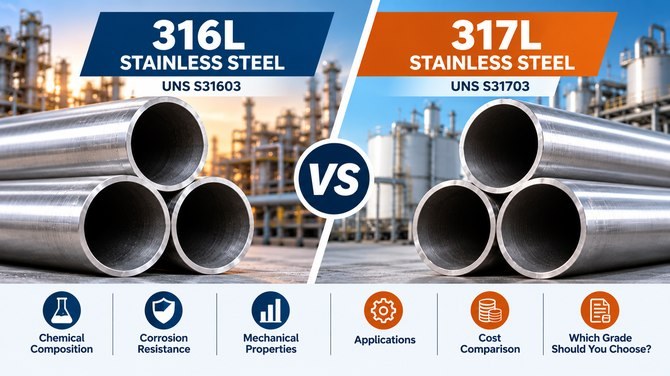
The main differences are related to chemical composition, corrosion resistance, common applications and material cost.
| Comparison factor | 316L Stainless Steel | 317L Stainless Steel |
|---|---|---|
| UNS designation | S31603 | S31703 |
| Material family | Austenitic stainless steel | Austenitic stainless steel |
| Carbon content | 0.03% maximum | 0.03% maximum |
| Chromium content | 16–18% | 18–20% |
| Nickel content | 10–14% | 11–15% |
| Molybdenum content | 2–3% | 3–4% |
| Corrosion resistance | Good in many industrial environments | Generally improved resistance to pitting and certain chemical corrosion |
| Weldability | Good with suitable procedures | Good with suitable procedures |
| Relative cost | Generally lower | Generally higher |
| Typical selection | General industrial and moderately corrosive service | Applications requiring greater resistance to localised corrosion |
Composition ranges shown are common ASTM A240/ASME SA-240 reference limits for wrought products. Always verify the relevant product standard and material test certificate.
1. Chemical Composition: 316L vs 317L
Chemical composition is one of the main reasons these grades perform differently.
Chromium supports the formation of a protective passive layer on stainless steel. Nickel helps maintain the austenitic structure, while molybdenum improves resistance to localised corrosion in suitable environments.
316L typically contains 16–18% chromium and 2–3% molybdenum. In comparison, 317L typically contains 18–20% chromium and 3–4% molybdenum.
This higher alloy content can give 317L an advantage in environments where pitting and crevice corrosion are concerns.
Both grades have a maximum carbon content of 0.03% under common specifications, making them useful choices for applications where welding-related sensitisation needs to be controlled.
The key point is that the additional alloy content in 317L can improve corrosion resistance, but it does not guarantee suitability for every chemical or operating environment.
2. Corrosion Resistance: Which Grade Performs Better?
Corrosion resistance is often the deciding factor when choosing between 316L and 317L.
316L Corrosion Resistance
316L performs well in many industrial environments and offers improved resistance to pitting and crevice corrosion compared with 304L.
It is commonly used in process piping, food and pharmaceutical equipment, and selected marine-related systems.
However, exposure to high chloride concentrations, deposits, stagnant liquid or elevated temperatures can increase the risk of localised corrosion.
317L Corrosion Resistance
317L generally provides better resistance to pitting and crevice corrosion because of its higher chromium and molybdenum content.
This can make it a suitable option for certain chemical processing systems and other applications where 316L has insufficient corrosion resistance.
However, 317L is not a universal solution for highly aggressive environments. Hot seawater, concentrated chlorides or particularly corrosive chemicals may require a higher-alloy stainless steel, duplex stainless steel or super duplex grade.
Which should you choose? If 316L meets the required corrosion criteria, it may be the more economical option. If the environment requires additional resistance to pitting or chemical attack, 317L may be worth evaluating.
The final decision should be based on the actual fluid chemistry and operating conditions.
3. Strength and Mechanical Properties
Both 316L and 317L are austenitic stainless steels with useful strength, toughness and fabrication characteristics.
Their mechanical properties depend on the product form, manufacturing route, heat treatment, dimensions and applicable material standard.
Although their chemistry differs, it is not correct to assume that 317L is automatically stronger than 316L in every application.
For pressure-containing pipes, the allowable stress and required wall thickness must be determined using the relevant engineering code and design conditions. These include pressure, temperature, outside diameter, corrosion allowance and mechanical loading.
For industrial procurement, always check the specified tensile strength, yield strength and other mechanical properties in the applicable product specification.
4. Welding and Fabrication
Both 316L and 317L can be welded using suitable procedures.
Their low carbon content helps reduce the risk of sensitisation associated with chromium carbide precipitation during welding. However, it does not remove the need for correct fabrication practices.
For industrial applications, consider the following:
- Use a qualified welding procedure appropriate for the grade and product thickness.
- Select compatible filler material where required.
- Control heat input and interpass temperature as specified by the welding procedure.
- Prevent contamination from carbon steel and other materials.
- Carry out the required cleaning, pickling or passivation after fabrication.
- Verify weld quality and material documentation before commissioning.
The selection of 316L or 317L should account for the corrosion conditions around welds as well as the parent material.
For corrosive service, correct fabrication and surface treatment can be just as important as selecting the appropriate grade.
5. Cost Difference Between 316L and 317L
317L generally costs more than 316L because it contains higher levels of chromium, nickel and molybdenum.
However, the exact price difference depends on raw material prices, pipe dimensions, wall thickness, manufacturing method, quantity, testing requirements and supplier availability.
For many general industrial applications, 316L provides an effective balance of performance and cost.
Where additional corrosion resistance is required, 317L may help reduce the risk of premature corrosion and associated maintenance costs.
When evaluating the two grades, consider the total cost of ownership rather than only the purchase price. This includes material costs, fabrication, inspection, maintenance, replacement and potential production downtime.
6. Common Applications of 316L and 317L Stainless Steel
Applications of 316L
316L is commonly used in:
- Food and beverage processing equipment
- Pharmaceutical equipment and process piping
- Chemical processing systems
- Industrial water and utility lines
- Selected marine and coastal applications
- Heat exchangers and condensers
- General corrosion-resistant industrial piping
Its popularity is partly due to its broad availability and useful corrosion resistance across many applications.
Applications of 317L
317L may be considered for:
- Chemical processing equipment
- Pulp and paper plants
- Industrial equipment exposed to certain acids
- Selected pharmaceutical and food processing applications
- Process systems requiring greater resistance to pitting
- Corrosive environments where 316L does not meet the design requirement
The appropriate grade depends on the chemical medium, temperature, concentration and exposure conditions. A material compatibility assessment may be necessary before final selection.
How to Choose Between 316L and 317L Stainless Steel
Before ordering stainless steel pipes, review these factors carefully.
1. Identify the process fluid. Record the chemicals involved, their concentrations and any cleaning agents used in the system.
2. Evaluate corrosion risk. Consider chloride exposure, operating temperature, deposits, stagnant conditions and the possibility of pitting or crevice corrosion.
3. Confirm operating pressure and temperature. Make sure the selected grade and pipe dimensions meet the required design conditions.
4. Select the required material standard. Specify the grade and product standard, such as the applicable ASTM or ASME specification for the required pipe or tube product.
5. Review fabrication requirements. Consider welding procedures, heat input, filler material, cleaning and post-weld requirements.
6. Verify documentation. Check the material test certificate, chemical composition, mechanical properties and traceability requirements.
7. Compare lifecycle cost. Evaluate the initial purchase price alongside expected maintenance, replacement and downtime.
For critical chemical or pressure applications, consult a qualified materials or piping engineer before making the final selection.
Why Source Stainless Steel Pipes from Leoscor Alloy Pipes?
Leoscor Alloy Pipes supplies stainless steel piping products in different grades and product configurations for industrial applications.
Its published product range includes both 316L and 317L stainless steel pipes, allowing buyers to review the relevant grades for their project requirements.
When requesting a quotation, prepare the following details:
- Required stainless steel grade
- Applicable material specification
- Pipe size and wall thickness or schedule
- Required length and quantity
- Seamless or welded construction, where specified
- Inspection and material certification requirements
- Delivery location and expected schedule
You can explore the 316L Stainless Steel Pipes product page and the 317L Stainless Steel Pipes product page for additional product information.
Request a Quote for 316L or 317L Stainless Steel Pipes
Looking for stainless steel pipes for a chemical processing plant, refinery, pharmaceutical facility or another industrial project?
Contact Leoscor Alloy Pipes with your material grade, dimensions, quantity and operating requirements. This information will help the team review your enquiry and discuss suitable supply options.
Contact Leoscor Alloy Pipes to submit your requirements and request a quotation.
Conclusion
The main difference between 316L and 317L stainless steel is their alloy composition. Both are low-carbon austenitic stainless steels, but 317L generally contains more chromium and molybdenum.
This gives 317L improved resistance to pitting and crevice corrosion in certain aggressive environments. However, 316L remains a widely used option for many industrial applications where its corrosion resistance is sufficient.
Neither grade is automatically the right choice for every project. Selection should be based on the process fluid, operating temperature, pressure, fabrication requirements, applicable specification and total cost of ownership.
By evaluating these factors before procurement, engineers and buyers can select a material that meets the project’s performance requirements without unnecessary material expense.
For industrial stainless steel pipe requirements, contact Leoscor Alloy Pipes with your technical specifications to discuss the available options.
Frequently Asked Questions
1. What is the main difference between 316L and 317L stainless steel?
317L generally contains higher amounts of chromium and molybdenum than 316L. This provides improved resistance to pitting and certain forms of chemical corrosion under suitable conditions.
2. Is 317L more corrosion-resistant than 316L?
Generally, yes. The higher chromium and molybdenum content of 317L improves resistance to localised corrosion in many chloride-containing environments. Actual performance depends on the specific service conditions.
3. What is the UNS designation for 316L and 317L?
The UNS designation for 316L stainless steel is S31603. The UNS designation for 317L stainless steel is S31703.
4. Is 317L stronger than 316L?
Not necessarily in every product form or condition. Mechanical properties depend on the specification, manufacturing process and material condition. Compare certified mechanical properties for the exact products before making a decision.
5. Why is 317L generally more expensive than 316L?
317L generally costs more because of its higher alloy content, especially chromium and molybdenum. The final price also depends on dimensions, manufacturing, testing, quantity and market conditions.
6. Can 316L stainless steel be used in chemical processing?
Yes. 316L is widely used in chemical processing where its corrosion resistance is suitable for the particular chemicals, concentrations and temperatures involved.
7. When should I choose 317L instead of 316L?
Consider 317L when the operating environment requires greater resistance to pitting, crevice corrosion or certain chemical attacks than 316L can provide. The choice should be supported by a material compatibility assessment.
8. Are 316L and 317L stainless steel suitable for welding?
Both grades can be welded using suitable qualified procedures. Their low carbon content helps reduce the risk of sensitisation, but appropriate welding, cleaning and inspection practices remain essential.
9. Is 317L suitable for seawater applications?
317L offers better localised corrosion resistance than 316L in many chloride environments, but it is not immune to seawater corrosion. More aggressive seawater applications may require duplex, super duplex or another higher-alloy material.
10. Where can I source 316L and 317L stainless steel pipes?
You can explore the 316L and 317L product ranges from Leoscor Alloy Pipes and submit your requirements through the company’s official contact page.