

Inconel Tube vs Monel Tube: Differences, Properties, Applications and Selection Guide
When selecting nickel alloy tubes for industrial applications, two material families often come into consideration: Inconel and Monel. Both are known for their corrosion resistance, durability and ability to perform in demanding operating conditions. However, they have different chemical compositions and are designed to handle different industrial challenges.
Inconel tubes are commonly selected for applications involving high temperatures, oxidation and demanding mechanical conditions. Monel tubes, on the other hand, are widely used in marine environments, chemical processing and applications where resistance to seawater and certain reducing chemicals is important.
But which material is better for your project?
The answer depends on the operating temperature, process fluid, corrosion exposure, pressure and mechanical requirements. In this guide, we will compare Inconel and Monel tubes, explain the differences between their popular grades and help you understand which material is suitable for different industrial applications.
What Is an Inconel Tube?
Inconel is a family of nickel-based alloys developed for applications that require resistance to heat, corrosion and mechanical stress. These alloys generally contain nickel and chromium, while some grades also include molybdenum, niobium, aluminium and iron.
The exact composition and performance depend on the selected grade.
Some commonly used Inconel grades include:
- Inconel 600 (UNS N06600): A nickel-chromium-iron alloy known for oxidation resistance and performance in high-temperature environments.
- Inconel 601 (UNS N06601): Contains additional chromium and aluminium, providing improved resistance to high-temperature oxidation.
- Inconel 625 (UNS N06625): A nickel-chromium-molybdenum-niobium alloy known for high strength and excellent resistance to many corrosive environments.
Inconel tubes are used in heat exchangers, chemical processing equipment, furnace systems, power plants, aerospace equipment and offshore applications.
Depending on the application, buyers can consider seamless and welded Inconel tube options.
Explore the available products from Leoscor Alloy Pipes:
What Is a Monel Tube?
Monel is another family of nickel-based alloys, but its chemical composition is different from Inconel. It primarily consists of nickel and copper, with smaller quantities of iron, manganese and other elements.
One of the most widely used grades is Monel 400, also known as UNS N04400.
Monel 400 is valued for its resistance to seawater, marine environments, hydrofluoric acid and several reducing chemical conditions. It also offers good mechanical properties and can perform in a range of temperatures.
Because of these characteristics, Monel tubes are commonly used in marine engineering, chemical processing, heat exchangers, offshore equipment, saltwater systems and industrial fluid-handling applications.
For Monel tube requirements, explore:
Inconel Tube vs Monel Tube: Key Differences
The main difference between Inconel and Monel is their chemical composition and the environments in which they perform best.
Inconel grades generally contain chromium, which contributes to oxidation and corrosion resistance. Certain grades, such as Inconel 625, also contain molybdenum and niobium for improved strength and resistance to localized corrosion.
Monel 400 contains a high percentage of nickel and a significant amount of copper. This composition gives it useful resistance to seawater and several reducing chemical environments.
Here is a quick comparison:
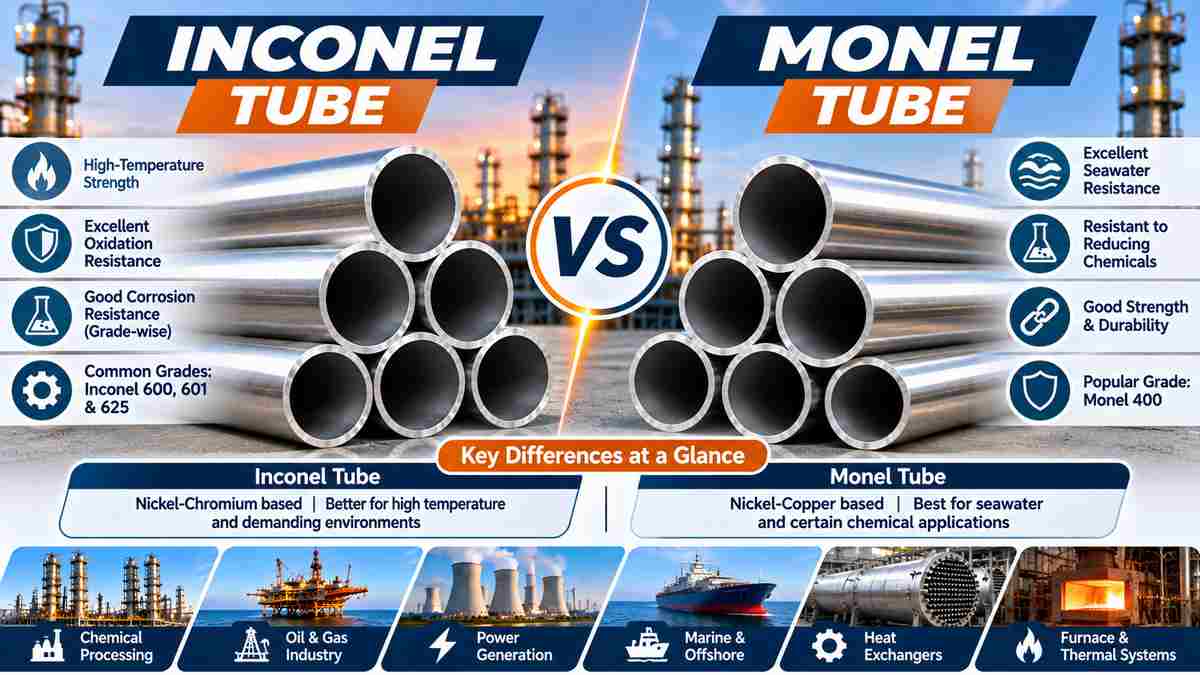
| Comparison Parameter | Inconel Tubes | Monel 400 Tubes |
|---|---|---|
| Main Alloy System | Nickel-Chromium based | Nickel-Copper based |
| Popular Grades | 600, 601, 625 | 400 |
| UNS Numbers | N06600, N06601, N06625 | N04400 |
| Main Alloying Elements | Nickel, chromium, iron; molybdenum and niobium in selected grades | Nickel and copper |
| High-Temperature Oxidation | Good to excellent, depending on grade | More limited than many Inconel grades |
| Seawater Resistance | Excellent in selected grades, especially 625 | Very good in many seawater conditions |
| Pitting and Crevice Resistance | Particularly strong in Inconel 625 | More limited than Inconel 625 |
| Common Applications | Furnaces, heat exchangers, chemical plants and power generation | Marine systems, seawater equipment and chemical processing |
Note: Inconel is a family of alloys. Its properties vary significantly between grades, so a grade-specific comparison is necessary for final material selection.
1. Chemical Composition: Inconel vs Monel
Chemical composition plays a major role in determining the performance of nickel alloy tubes.
Inconel 600 mainly contains nickel, chromium and iron. Its high nickel content and chromium addition help it resist oxidation and corrosion in suitable industrial environments.
Inconel 601 contains more chromium than Inconel 600, along with aluminium. This combination improves its resistance to oxidation at elevated temperatures.
Inconel 625 contains nickel, chromium, molybdenum and niobium. Molybdenum and niobium contribute to its strength and resistance to pitting and crevice corrosion.
Monel 400 has a different composition. It contains a high percentage of nickel and approximately 28–34% copper. This combination makes it particularly useful in seawater and several reducing chemical environments.
Typical Chemical Composition Comparison
| Element | Inconel 600 | Inconel 601 | Inconel 625 | Monel 400 |
|---|---|---|---|---|
| Nickel | 72% min | 58–63% | 58% min | 63% min |
| Chromium | 14–17% | 21–25% | 20–23% | Not intentionally added |
| Copper | Max 0.5% | Max 1% | Not a major addition | 28–34% |
| Iron | 6–10% | Balance | Max 5% | Max 2.5% |
| Molybdenum | Not a major addition | Not a major addition | 8–10% | Not a major addition |
| Niobium + Tantalum | Not a major addition | Not a major addition | 3.15–4.15% | Not a major addition |
| Aluminium | Small residual amount | 1–1.7% | Max 0.4% | Not a major addition |
Values are typical specification limits or ranges, not guaranteed heat analyses. Refer to the applicable ASTM specification and material test certificate for exact requirements.
2. Corrosion Resistance
Corrosion resistance is one of the most important factors when selecting industrial tubes.
However, Inconel and Monel do not offer the same type of corrosion protection.
Inconel corrosion resistance
Inconel grades are used in environments where oxidation, chemical attack and high-temperature corrosion are concerns.
Inconel 600 provides good resistance to oxidation and several corrosive environments. Inconel 601 offers improved high-temperature oxidation resistance due to its chromium and aluminium content.
Inconel 625 is particularly useful in demanding chloride-containing environments because its molybdenum and niobium content improves resistance to pitting and crevice corrosion.
Monel corrosion resistance
Monel 400 is known for its resistance to seawater, brine and several reducing chemical environments. It is also used in certain hydrofluoric acid applications where the process conditions are suitable.
This makes Monel 400 a popular material for marine equipment, seawater handling systems and chemical processing installations.
For applications involving aggressive chloride exposure, Inconel 625 may provide better resistance to localized corrosion than Monel 400. However, the final choice should always be based on the actual fluid composition, temperature, concentration and operating conditions.
3. High-Temperature Performance
Temperature is another major difference between Inconel and Monel tubes.
Inconel alloys are widely used in high-temperature industrial applications. Different grades are developed for different thermal conditions.
- Inconel 600: Suitable for applications requiring oxidation resistance and thermal stability.
- Inconel 601: Particularly useful where high-temperature oxidation resistance is a major requirement.
- Inconel 625: Offers a combination of high mechanical strength and corrosion resistance at elevated temperatures.
Monel 400 can also be used at elevated temperatures, but it is generally not the first choice when severe high-temperature oxidation resistance is the main requirement.
For furnace equipment, thermal processing systems and high-temperature components, Inconel 600 or 601 may be more suitable depending on the operating conditions.
For applications requiring both corrosion resistance and mechanical strength, Inconel 625 may be considered.
4. Mechanical Strength and Durability
Both Inconel and Monel tubes offer useful mechanical properties, but their performance depends on the selected grade, manufacturing process and material condition.
Inconel 625 is known for its high tensile strength and excellent mechanical performance. It is used in applications where the material must withstand mechanical loads, pressure and corrosive exposure.
Inconel 600 and 601 provide good mechanical properties for many heat-resistant industrial applications.
Monel 400 offers good strength, toughness and ductility. It can also be fabricated and machined using suitable industrial methods.
When selecting a tube for pressure-related applications, buyers should check the minimum tensile strength, yield strength, wall thickness, design temperature and applicable design code. Material names alone are not enough to confirm pressure suitability.
5. Industrial Applications of Inconel Tubes
Inconel tubes are used across industries where high temperature, corrosion resistance and mechanical strength are important.
Some common applications include:
Chemical Processing Plants: Inconel tubes are used in selected process equipment exposed to corrosive chemicals and elevated temperatures.
Oil and Gas Industry: Inconel 625 is used in demanding offshore and oilfield applications where corrosion resistance and strength are required.
Power Generation: Inconel 600 and 601 are used in selected heating, thermal processing and power generation equipment.
Heat Exchangers: Nickel alloy tubes are used in heat transfer systems where the operating temperature and process fluid require specialised materials.
Furnace Equipment: Inconel 601 is particularly useful in furnace components exposed to high-temperature oxidation.
Aerospace Industry: Selected Inconel grades are used in components that require high strength and heat resistance.
Leoscor Alloy Pipes offers product options including Inconel 600 welded tubes, Inconel 601 welded tubes and Inconel 625 welded tubes.
6. Industrial Applications of Monel Tubes
Monel 400 tubes are commonly selected for applications where seawater resistance and performance in suitable reducing chemical environments are important.
Typical applications include:
Marine Engineering: Used in selected seawater piping systems, marine equipment and offshore installations.
Chemical Processing: Suitable for equipment exposed to hydrofluoric acid and certain other reducing chemical environments.
Heat Exchangers: Used in selected marine and industrial heat exchanger applications.
Oil and Gas Industry: Applied in selected fluid-handling and process equipment where Monel 400 meets the corrosion requirements.
Saltwater Handling Systems: Used in suitable brine and seawater applications.
Industrial Equipment: Used in pumps, valves, shafts and other components requiring its combination of strength and corrosion resistance.
For project requirements, buyers can consider both Monel 400 seamless tubes and Monel 400 welded tubes.
7. Which Is Better: Inconel Tube or Monel Tube?
There is no universal winner between Inconel and Monel. The correct selection depends on the working environment and the properties required from the material.
Choose Inconel tubes when:
- The application involves high operating temperatures.
- Resistance to oxidation is important.
- The equipment is exposed to demanding corrosive conditions.
- High mechanical strength is required.
- The system operates in selected chloride-containing environments where Inconel 625 offers an advantage.
- The application involves furnaces, heat treatment or chemical processing equipment.
Choose Monel 400 tubes when:
- The application involves seawater or brine.
- Resistance to several reducing chemical environments is required.
- The equipment operates in suitable hydrofluoric acid conditions.
- Good mechanical strength and ductility are required.
- Marine engineering or seawater handling is the main application.
For a more accurate selection, engineers should compare the exact Inconel grade with Monel 400 rather than comparing the two alloy families as a whole.
8. ASTM Standards for Inconel and Monel Tubes
ASTM specifications define the requirements for chemical composition, mechanical properties, testing and product dimensions.
Some relevant specifications include:
| ASTM Standard | Product / Material |
|---|---|
| ASTM B167 | Seamless Inconel 600 and 601 pipe and tube |
| ASTM B444 | Inconel 625 seamless pipe and tube |
| ASTM B516 | Certain welded nickel-chromium-aluminium and nickel-chromium-iron alloy tubes |
| ASTM B165 | Monel 400 seamless pipe and tube |
| ASTM B730 | Welded nickel alloy pipe and tube, including UNS N04400 |
| ASTM B517 | Certain welded nickel-chromium-iron alloy pipes, including UNS N06600 |
Buyers should also check the relevant general requirements, inspection provisions and purchase-order requirements. A general requirements standard should not be treated as a replacement for the applicable product specification.
Before ordering, confirm the ASTM standard, UNS number, manufacturing method, dimensions, heat treatment and testing requirements against the material test certificate.
9. Factors to Consider Before Buying Inconel or Monel Tubes
Before purchasing nickel alloy tubes, it is important to review the technical requirements of your project.
1. Material Grade: Confirm whether the application requires Inconel 600, 601, 625 or Monel 400.
2. Operating Temperature: Check the normal and maximum operating temperatures, including temperature fluctuations.
3. Corrosion Environment: Identify the process fluid, chemical concentration, chloride content and exposure conditions.
4. Tube Dimensions: Confirm outside diameter, wall thickness, length and dimensional tolerances.
5. Manufacturing Type: Decide whether the project requires seamless or welded tubes.
6. Testing and Certification: Confirm the required chemical analysis, mechanical tests, hydrostatic or nondestructive testing and material test certificate.
7. Project Standards: Make sure the material meets the specified ASTM or ASME requirements and applicable engineering codes.
A proper material review helps avoid incorrect purchases and supports reliable performance throughout the equipment’s service life.
Frequently Asked Questions
1. What is the main difference between Inconel and Monel tubes?
The main difference is their chemical composition and corrosion behaviour. Inconel alloys are generally nickel-chromium based and are widely used for high-temperature oxidation resistance and demanding industrial conditions. Monel 400 is a nickel-copper alloy known for its performance in seawater and several reducing chemical environments. The correct choice depends on the actual service conditions.
2. Is Inconel better than Monel?
Inconel is generally a better option for applications requiring high-temperature oxidation resistance, mechanical strength or improved resistance to localized corrosion, depending on the grade. Monel 400 is often preferred for suitable marine and seawater applications. Neither material is better in every situation. Engineers should compare the exact alloy grades and process conditions before selecting a tube.
3. What is the most commonly used Monel tube grade?
Monel 400, identified by UNS N04400, is one of the most widely used Monel grades. It contains a high percentage of nickel and approximately 28–34% copper. The alloy is known for its seawater resistance, good mechanical properties and suitability for several chemical processing applications.
4. Which Inconel grade is best for high-temperature applications?
Inconel 600 and Inconel 601 are commonly considered for high-temperature applications. Inconel 601 offers improved oxidation resistance because of its higher chromium and aluminium content. The final grade should be selected according to operating temperature, atmosphere, mechanical loading and service life requirements.
5. Is Monel 400 suitable for seawater applications?
Yes. Monel 400 offers very good resistance to seawater and is used in selected marine equipment, heat exchangers and seawater handling systems. However, actual performance depends on factors such as flow velocity, temperature, aeration, deposits and crevice conditions. Engineering review is recommended for critical seawater installations.
6. What is the difference between Inconel 600, 601 and 625?
Inconel 600 is mainly a nickel-chromium-iron alloy used for oxidation resistance and high-temperature applications. Inconel 601 contains additional chromium and aluminium for improved high-temperature oxidation resistance. Inconel 625 contains molybdenum and niobium, offering high strength and excellent resistance to many corrosive environments, including pitting and crevice corrosion.
7. What is ASTM B165 used for?
ASTM B165 covers seamless nickel-copper alloy pipe and tube, including Monel 400 (UNS N04400). It specifies requirements related to material composition, mechanical properties and testing. Buyers should confirm the required product dimensions, condition and inspection requirements when placing an order.
8. What is ASTM B167 used for?
ASTM B167 covers seamless pipe and tube made from specified nickel-chromium-iron alloys, including Inconel 600 (UNS N06600) and Inconel 601 (UNS N06601). It is used for general corrosion-resistant and heat-resistant applications. The applicable edition and product requirements should be confirmed in the purchase specification.
Inconel and Monel tubes both play an important role in industrial applications, but their performance characteristics are different.
Inconel grades such as 600, 601 and 625 are commonly selected for applications involving high temperatures, oxidation resistance, mechanical strength and demanding corrosion conditions.
Monel 400 is a strong option for suitable marine, seawater and chemical processing applications where nickel-copper alloy properties are required.
The right material should always be selected after reviewing the operating temperature, process fluid, corrosion exposure, pressure, dimensions and applicable ASTM specification.
At Leoscor Alloy Pipes, buyers can explore different Inconel and Monel tube options for industrial requirements. Our product range includes seamless and welded tube options across selected nickel alloy grades.
Looking for Inconel Tubes or Monel 400 Tubes?
Connect with Leoscor Alloy Pipes to discuss your material grade, dimensions, manufacturing requirements and project specifications.
Explore our product range:
Contact Leoscor Alloy Pipes today for product enquiries and technical assistance.