

Inconel 625 Pipe vs Inconel 600 Tube: Key Differences, Properties and Applications
Nickel alloy pipes and tubes are widely used in industries where ordinary stainless steel may not provide the required performance. Chemical processing, oil and gas, power generation, marine engineering and high-temperature operations often require materials that can handle demanding service conditions.
Two commonly used nickel-based alloys in these applications are Inconel 625 and Inconel 600. Both offer good corrosion resistance and high-temperature performance, but their chemical compositions and engineering properties are different.
So, when should you choose an Inconel 625 pipe, and when is an Inconel 600 tube a better option?
The answer depends on the operating environment, temperature, pressure, corrosive media and mechanical requirements of the system. In this guide, we will compare both materials and explain their key differences to help engineers, procurement teams and industrial buyers make an informed decision.
What Is Inconel 625 Pipe?
Inconel 625 is a nickel-chromium-molybdenum alloy strengthened with niobium. It is known for its high strength, excellent resistance to corrosion and ability to perform in demanding industrial environments.
Its chemical composition includes a high percentage of nickel, chromium, molybdenum and niobium. The combination of these elements helps the alloy resist pitting, crevice corrosion and several forms of chemical attack.
Inconel 625 is commonly supplied in seamless pipe and tube forms for applications where both mechanical strength and corrosion resistance are important.
It is widely used in offshore installations, chemical processing equipment, marine systems, pollution control equipment and other industrial applications exposed to aggressive operating conditions.
For project requirements involving seamless Inconel 625 piping, explore ASTM B444 Inconel 625 Seamless Pipe from Leoscor Alloy Pipes.
What Is Inconel 600 Tube?
Inconel 600, also known as Alloy 600 or UNS N06600, is a nickel-chromium-iron alloy developed for applications that require good resistance to heat and corrosion.
Its high nickel content provides resistance to many corrosive environments, while chromium improves its resistance to oxidation at elevated temperatures. The alloy also offers good resistance to several alkaline and caustic environments.
Inconel 600 is commonly used in furnace equipment, heat treatment systems, chemical processing plants, heat exchangers and industrial heating applications.
It is particularly useful where oxidation resistance and thermal stability are important operating requirements.
For product details and availability, visit Inconel 600 Tube from Leoscor Alloy Pipes.
Inconel 625 Pipe vs Inconel 600 Tube: Key Differences
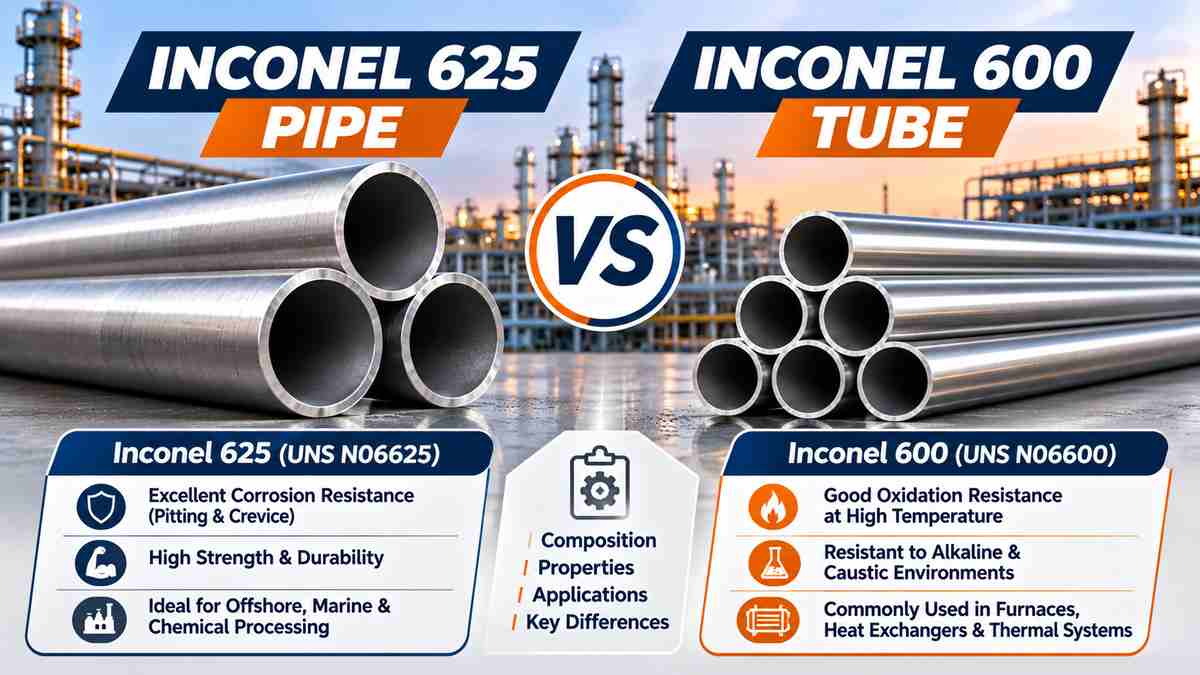
Although both materials belong to the nickel alloy family, their performance varies because of their different chemical compositions.
The following comparison highlights the main differences.
| Comparison Parameter | Inconel 625 | Inconel 600 |
|---|---|---|
| UNS Number | N06625 | N06600 |
| Alloy Type | Nickel-Chromium-Molybdenum-Niobium | Nickel-Chromium-Iron |
| Nickel Content | 58% minimum | 72% minimum |
| Chromium Content | 20–23% | 14–17% |
| Molybdenum Content | 8–10% | Not intentionally added |
| Niobium + Tantalum | 3.15–4.15% | Not intentionally added |
| Main Strength | High strength and corrosion resistance | Heat and oxidation resistance |
| Pitting Resistance | Excellent in many chloride environments | More limited in comparison |
| Typical Applications | Offshore, marine and chemical processing | Furnaces, heat exchangers and thermal processing |
Note: These are typical composition ranges and alloy characteristics. Always verify the applicable product specification and material test certificate for the supplied material.
1. Chemical Composition
Chemical composition is one of the main reasons why Inconel 625 and Inconel 600 behave differently under industrial operating conditions.
Inconel 625 contains nickel, chromium, molybdenum and niobium. Molybdenum and niobium play an important role in improving its strength and resistance to localized corrosion.
Inconel 600 contains a higher nickel percentage, along with chromium and iron. Its composition makes it suitable for applications involving elevated temperatures, oxidation and certain chemical environments.
The biggest difference is the presence of molybdenum and niobium in Inconel 625. These elements provide additional corrosion resistance and strength that make it suitable for more aggressive service conditions.
2. Corrosion Resistance
Corrosion resistance is an important factor when selecting materials for industrial piping systems.
Inconel 625 provides excellent resistance to several corrosive environments, including chloride-containing solutions, seawater and many chemical processing conditions. Its molybdenum and niobium content helps improve resistance to pitting and crevice corrosion.
This makes Inconel 625 a suitable option for offshore platforms, marine equipment, chemical plants and systems exposed to aggressive fluids.
Inconel 600 also offers good corrosion resistance in many environments. Its high nickel content helps it perform well in several alkaline and caustic conditions, while chromium improves oxidation resistance.
However, when the application involves severe chloride exposure or a high risk of localized corrosion, Inconel 625 is generally the stronger candidate.
The final selection should always consider the exact chemical concentration, temperature, flow conditions and exposure duration.
3. High-Temperature Performance
Both Inconel 625 and Inconel 600 are used in high-temperature industrial applications. However, their suitability depends on the type of service.
Inconel 600 is widely recognised for its resistance to oxidation at elevated temperatures. It is commonly used in furnace components, heating equipment, heat treatment systems and thermal processing applications.
Inconel 625 also performs well at elevated temperatures and offers high mechanical strength. Its different heat-treated conditions are important when selecting it for high-temperature service.
Under ASTM B444, Inconel 625 is supplied in Grade 1 annealed and Grade 2 solution-annealed conditions. The standard identifies Grade 1 for service up to 1100°F (593°C), while Grade 2 is intended for higher-temperature service where creep and rupture resistance are required.
Therefore, buyers should not select an alloy based only on its maximum temperature rating. The required strength, oxidation resistance, creep performance and actual operating conditions must also be considered.
4. Mechanical Strength
Inconel 625 is known for its high tensile strength and excellent mechanical performance. Its molybdenum and niobium additions provide solid-solution strengthening, allowing it to handle demanding mechanical conditions.
This makes it suitable for applications where pipes and tubes are exposed to pressure, mechanical loads and corrosive environments.
Inconel 600 also offers good mechanical strength and stability. It is suitable for many industrial heating and chemical processing applications, but it does not generally provide the same strength and localized corrosion resistance combination as Inconel 625.
For high-pressure or mechanically demanding applications, engineers should compare the specified minimum yield strength, tensile strength, wall thickness and design code requirements of the actual product.
5. Industrial Applications of Inconel 625 Pipe
Inconel 625 is selected for applications where corrosion resistance and mechanical strength are major requirements.
Common applications include:
- Oil and Gas Industry: Used in offshore piping, process equipment and components exposed to corrosive fluids.
- Marine Engineering: Suitable for selected seawater-handling systems and marine equipment.
- Chemical Processing: Used in equipment exposed to aggressive chemicals and demanding process conditions.
- Power Generation: Applied in selected high-temperature and corrosion-resistant components.
- Pollution Control Equipment: Used in systems exposed to corrosive gases and chemical environments.
- Aerospace Industry: Used in selected components requiring high strength and heat resistance.
The exact grade, product form and specification should be selected according to the operating conditions and engineering requirements.
6. Industrial Applications of Inconel 600 Tube
Inconel 600 is widely used in industries that require resistance to heat, oxidation and certain corrosive environments.
Its common applications include:
- Heat Exchangers: Used in selected heat exchanger and thermal processing equipment.
- Furnace Equipment: Suitable for furnace components and heating system applications.
- Chemical Processing: Used in equipment exposed to several alkaline and chemical environments.
- Power Plants: Applied in selected thermal and power generation components.
- Nuclear Industry: Used in certain components where its material properties meet the design requirements.
- Heat Treatment Equipment: Suitable for components exposed to repeated heating and cooling conditions.
Inconel 600 is a practical choice when the application requires good thermal stability and oxidation resistance without the additional alloying features of Inconel 625.
7. Which Is Better: Inconel 625 Pipe or Inconel 600 Tube?
There is no single answer because both alloys are designed for different engineering requirements.
Choose Inconel 625 when:
- The system is exposed to seawater or chloride-containing environments.
- Pitting and crevice corrosion are major concerns.
- Higher mechanical strength is required.
- The application involves aggressive chemical environments.
- Offshore and marine operating conditions demand additional corrosion resistance.
Choose Inconel 600 when:
- Oxidation resistance at elevated temperatures is important.
- The equipment operates in furnace or heat treatment environments.
- The application involves suitable alkaline or caustic conditions.
- Thermal stability is a key requirement.
- The specified mechanical and corrosion properties can be met by Alloy 600.
Before finalising the material, engineers should review the process fluid, temperature range, pressure, design life, fabrication requirements and applicable standards.
8. Important ASTM Specifications for Inconel 625 and Inconel 600
Material specifications are important because they define the requirements for chemical composition, mechanical properties, testing and product form.
For seamless Inconel 625 pipe and tube, ASTM B444 is an important specification. It covers nickel-chromium-molybdenum-niobium alloys, including UNS N06625, in cold-worked seamless pipe and tube forms.
For Inconel 600, ASTM B167 is commonly associated with seamless nickel alloy pipe and tube, while ASTM B163 covers certain seamless tubes used in condenser and heat exchanger applications.
One important specification detail should be checked before ordering: ASTM B166 covers nickel alloy rod, bar and wire, not seamless tube. Therefore, buyers should confirm the correct product-form specification against the material test certificate and purchase order rather than relying only on a product page heading.
For reference, you can check the official ASTM B444 specification and ASTM B166 specification.
9. Factors to Consider Before Buying Nickel Alloy Pipes and Tubes
Choosing the right nickel alloy involves more than comparing the material names. The product must meet the technical requirements of the actual application.
Consider these points before placing an order:
1. Material Grade: Confirm the correct alloy designation and UNS number. Inconel 625 is UNS N06625, while Inconel 600 is UNS N06600.
2. Product Form: Confirm whether your project requires seamless pipe, seamless tube or welded material. Pipe and tube dimensions and specifications may differ.
3. Dimensions: Check the outside diameter, wall thickness, length and dimensional tolerances.
4. Operating Conditions: Review the working temperature, pressure, process fluid and corrosion exposure.
5. Testing and Certification: Check the required inspection, testing and material test certificate requirements.
6. Project Standards: Confirm that the supplied material meets the applicable ASTM specification, design code and project documentation.
These checks help avoid material mismatches, procurement delays and problems during installation or operation.
Frequently Asked Questions
1. What is the main difference between Inconel 625 and Inconel 600?
The main difference is their chemical composition and performance. Inconel 625 contains molybdenum and niobium, which improve its strength and resistance to localized corrosion. Inconel 600 contains a higher nickel percentage and is widely used for oxidation resistance and high-temperature applications. The right choice depends on the operating environment and engineering requirements.
2. Is Inconel 625 better than Inconel 600?
Inconel 625 is generally better for applications involving aggressive chloride environments, pitting corrosion and higher mechanical strength requirements. Inconel 600 is a strong option for furnace equipment, heat treatment systems and suitable high-temperature applications. Neither alloy is universally better. Engineers should select the material based on process conditions, temperature, pressure and required service life.
3. What is the UNS number of Inconel 625?
The UNS designation of Inconel 625 is N06625. It is a nickel-chromium-molybdenum-niobium alloy. This designation helps identify the material during procurement, inspection and quality verification. Buyers should confirm the UNS number and chemical composition on the material test certificate before accepting the supplied pipe or tube.
4. What is the UNS number of Inconel 600?
Inconel 600 is identified by UNS N06600. It is a nickel-chromium-iron alloy known for its oxidation resistance and performance in several high-temperature environments. When purchasing Inconel 600 tubes, buyers should verify the alloy designation, product form, dimensions and applicable ASTM specification.
5. Which alloy is suitable for seawater applications?
Inconel 625 is generally the more suitable candidate when resistance to seawater-related pitting and crevice corrosion is important. Its molybdenum and niobium content provides better resistance to localized corrosion than Inconel 600 in many chloride environments. However, final suitability depends on seawater conditions, temperature, flow velocity and the design requirements of the system.
6. Which ASTM standard is used for Inconel 625 seamless pipe?
ASTM B444 is an important specification for Inconel 625 seamless pipe and tube. It covers UNS N06625 in cold-worked seamless product forms and includes requirements for chemical composition and mechanical testing. Buyers should confirm the required grade, dimensions, heat treatment and inspection requirements in their purchase specification.
7. Where are Inconel 600 tubes commonly used?
Inconel 600 tubes are commonly used in heat exchangers, furnace equipment, heat treatment systems, chemical processing equipment and selected power generation applications. The alloy is valued for its high nickel content, oxidation resistance and performance at elevated temperatures. The actual suitability depends on the operating environment and specified material condition.
Conclusion
Inconel 625 pipe and Inconel 600 tube both offer useful properties for demanding industrial applications, but they serve different engineering needs.
Inconel 625 is generally preferred where high strength and resistance to aggressive corrosion, particularly pitting and crevice corrosion, are important. Inconel 600 is widely selected for applications requiring oxidation resistance, thermal stability and performance in suitable high-temperature environments.
Before selecting either material, review the process conditions, dimensions, product form, applicable ASTM specification and certification requirements.
Leoscor Alloy Pipes supplies nickel alloy products for industrial requirements. Whether your project needs Inconel 625 seamless pipe or Inconel 600 tube, selecting the correct material and specification is an important step towards reliable piping performance.
Looking for Inconel 625 Pipe or Inconel 600 Tube?
Connect with Leoscor Alloy Pipes to discuss your material requirements, product dimensions and project specifications.
Explore our products:
Contact Leoscor Alloy Pipes today for product enquiries and technical assistance.