

Inconel 600 Tube vs Incoloy 800 Tube: Differences, Properties, Applications and Selection Guide
Selecting the right nickel alloy tube is important for industrial applications involving high temperatures, oxidation, corrosion and demanding operating conditions. Two commonly considered materials for such environments are Inconel 600 and Incoloy 800.
Although both alloys contain nickel and chromium, they have different chemical compositions, mechanical characteristics and application requirements. Understanding the difference between Inconel 600 tube and Incoloy 800 tube helps engineers, procurement professionals and industrial buyers select the right material for their projects.
Inconel 600 is a nickel-chromium-iron alloy known for its oxidation resistance and performance in various corrosive environments. Incoloy 800 is a nickel-iron-chromium alloy developed for applications requiring resistance to oxidation, carburisation and high-temperature exposure.
In this guide, we will compare Inconel 600 vs Incoloy 800 tubes based on chemical composition, mechanical properties, corrosion resistance, temperature performance, industrial applications and material specifications.
What Is Inconel 600 Tube?
Inconel 600 is a nickel-chromium-iron alloy identified by UNS designation N06600 and material number 2.4816.
It is designed to provide good corrosion resistance, oxidation resistance and mechanical performance across a range of temperatures.
The high nickel content contributes to resistance against chloride-ion stress corrosion cracking and certain reducing environments, while chromium improves resistance to oxidation.
Inconel 600 tubes are considered for industrial applications where corrosion resistance and reliable performance under elevated-temperature conditions are important.
Key Properties of Inconel 600 Tubes
- High nickel content.
- Good oxidation resistance at elevated temperatures.
- Resistance to chloride-ion stress corrosion cracking.
- Good resistance to selected caustic and reducing environments.
- Good mechanical properties and fabrication characteristics.
- Suitable for selected chemical processing and thermal applications.
Chemical Composition of Inconel 600
The typical specified chemical composition of Inconel 600 includes:
| Element | Composition (%) |
|---|---|
| Nickel + Cobalt | 72.00 minimum |
| Chromium | 14.00–17.00 |
| Iron | 6.00–10.00 |
| Manganese | 1.00 maximum |
| Silicon | 0.50 maximum |
| Copper | 0.50 maximum |
| Carbon | 0.15 maximum |
| Sulphur | 0.015 maximum |
The exact composition must be checked against the applicable material specification and material test certificate.
Industrial Applications of Inconel 600 Tubes
Inconel 600 tubes are used in selected industrial applications, including:
- Chemical processing equipment.
- Industrial furnace components.
- Heat-treatment equipment.
- Nuclear engineering applications.
- Heat exchangers and associated equipment.
- Food processing equipment.
- Thermal processing systems.
- Selected high-temperature process applications.
For product specifications and availability, explore ASTM B166 Inconel 600 Tubes from Leoscor Alloy Pipes.
What Is Incoloy 800 Tube?
Incoloy 800 is a nickel-iron-chromium alloy identified by UNS designation N08800 and material number 1.4876.
It is designed for applications requiring good strength, resistance to oxidation and carburisation, and stability during elevated-temperature exposure.
Unlike Inconel 600, Incoloy 800 contains a higher proportion of iron and a lower nickel content. Its chromium, aluminium and titanium content contributes to its high-temperature performance.
Incoloy 800 is commonly considered for process piping, heat exchangers, furnace equipment and other industrial systems operating under demanding thermal conditions.
Key Properties of Incoloy 800 Tubes
- Good resistance to oxidation at elevated temperatures.
- Good resistance to carburisation and sulfidation in suitable environments.
- High-temperature structural stability.
- Good resistance to corrosion in many aqueous environments.
- Good fabrication and welding characteristics.
- Suitable for selected heat exchangers and process equipment.
Chemical Composition of Incoloy 800
The typical specified chemical composition of Incoloy 800 includes:
| Element | Composition (%) |
|---|---|
| Nickel | 30.00–35.00 |
| Chromium | 19.00–23.00 |
| Iron | 39.50 minimum |
| Aluminium | 0.15–0.60 |
| Titanium | 0.15–0.60 |
| Carbon | 0.10 maximum |
| Manganese | 1.50 maximum |
| Silicon | 1.00 maximum |
| Copper | 0.75 maximum |
The balance is primarily iron. Actual composition must be verified against the relevant product specification.
Industrial Applications of Incoloy 800 Tubes
Incoloy 800 tubes are used in various high-temperature industrial applications, such as:
- Heat exchanger equipment.
- Industrial furnace components.
- Petrochemical processing equipment.
- Process piping systems.
- Carburising equipment.
- Heating element sheathing.
- Chemical processing plants.
- Selected power generation applications.
Explore ASTM B163 Incoloy 800 Tubes from Leoscor Alloy Pipes for product information and enquiry details.
Inconel 600 Tube vs Incoloy 800 Tube: Key Differences
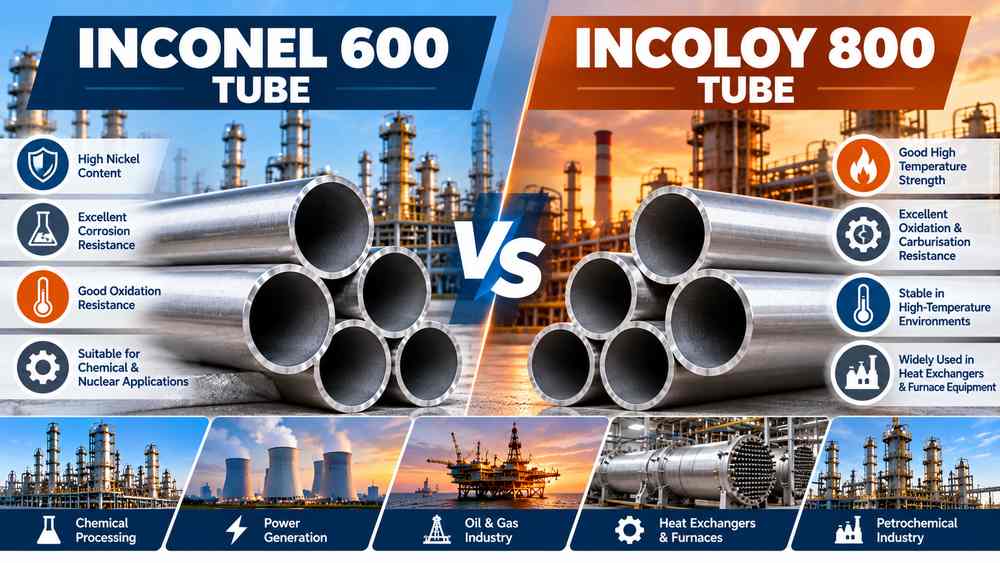
Both alloys are used in demanding industrial environments, but their chemical composition, corrosion behaviour and high-temperature characteristics differ.
The following comparison highlights the major differences.
| Comparison Factor | Inconel 600 | Incoloy 800 |
|---|---|---|
| Alloy family | Nickel-Chromium-Iron | Nickel-Iron-Chromium |
| UNS designation | N06600 | N08800 |
| Material number | 2.4816 | 1.4876 |
| Nickel content | 72% minimum | 30–35% |
| Chromium content | 14–17% | 19–23% |
| Iron content | 6–10% | 39.5% minimum |
| Aluminium | Not a principal specified addition | 0.15–0.60% |
| Titanium | Not a principal specified addition | 0.15–0.60% |
| Main characteristics | Corrosion and oxidation resistance | Oxidation, carburisation and high-temperature stability |
| Common applications | Chemical processing, furnace components and nuclear engineering | Heat exchangers, process piping and furnace equipment |
The comparison demonstrates that Inconel 600 has a substantially higher nickel content, while Incoloy 800 contains more iron and chromium.
The best choice depends on the actual operating environment and engineering requirements.
1. Chemical Composition: Inconel 600 vs Incoloy 800
Chemical composition is one of the most important differences between these two alloys.
Inconel 600 contains at least 72% nickel, along with chromium and iron. Its high nickel content contributes to resistance against chloride-ion stress corrosion cracking and selected reducing environments.
Incoloy 800 contains approximately 30–35% nickel and 19–23% chromium, with iron as the major remaining element. Aluminium and titanium are also controlled within specified ranges.
The higher chromium content and stabilising additions in Incoloy 800 support its resistance to oxidation and carburisation at elevated temperatures.
Therefore, the selection should be based on the specific chemical environment, temperature and required material performance rather than nickel content alone.
2. High-Temperature Performance
Both alloys are considered for high-temperature industrial applications, but their suitability depends on the operating conditions.
Inconel 600 offers good oxidation resistance and maintains useful mechanical properties under various elevated-temperature conditions. It is used in furnace components, thermal processing equipment and selected chemical applications.
Incoloy 800 is designed for high-temperature service where resistance to oxidation, carburisation and structural instability is important.
It is commonly considered for heat exchangers, process piping and industrial heating equipment.
For applications involving sustained high-temperature loading and creep-rupture requirements, engineers should also evaluate Incoloy 800H and 800HT. These are separate grades with additional composition and grain-size requirements.
3. Corrosion and Oxidation Resistance
Corrosion resistance is another important consideration when comparing Inconel 600 and Incoloy 800.
Inconel 600 offers good resistance to selected corrosive environments, including caustic conditions and chloride-ion stress corrosion cracking. Its chromium content also contributes to oxidation resistance.
Incoloy 800 offers resistance to oxidation, carburisation and sulfidation under suitable high-temperature conditions. It also provides good corrosion resistance in many aqueous environments.
Neither alloy is universally resistant to every chemical environment. Buyers should evaluate the chemical composition of the process fluid, temperature, concentration and exposure duration before selecting a material.
4. Mechanical Properties and Fabrication
Inconel 600 and Incoloy 800 both offer useful mechanical properties and can be fabricated using suitable industrial procedures.
Inconel 600 is strengthened primarily through solid-solution strengthening and can also be strengthened through cold working.
Incoloy 800 provides good strength and stability in elevated-temperature applications. Its suitability for long-term loading should be assessed against the relevant design requirements.
Both alloys can be welded and fabricated using appropriate procedures. The selection of welding consumables, joint preparation and inspection methods should follow the applicable engineering specifications.
5. Industrial Applications: Which Alloy Is Used Where?
Although there is some overlap in their applications, each alloy has characteristics that make it suitable for different industrial requirements.
Inconel 600 applications:
- Chemical processing equipment.
- Furnace components and fixtures.
- Nuclear engineering equipment.
- Thermal processing systems.
- Selected high-temperature components.
Incoloy 800 applications:
- Heat exchangers.
- Petrochemical process equipment.
- Industrial furnace components.
- Carburising equipment.
- Heating element sheathing.
- Process piping systems.
The actual material selection must be confirmed through engineering evaluation and the relevant design code.
Inconel 600 vs Incoloy 800: Which Tube Should You Choose?
There is no single answer for every industrial application. The correct alloy depends on the operating environment and the required performance.
Choose Inconel 600 When:
- High nickel content is required.
- Resistance to chloride-ion stress corrosion cracking is important.
- The application involves selected caustic or reducing environments.
- Good oxidation resistance is required at elevated temperatures.
- The equipment operates in suitable chemical or thermal processing conditions.
Choose Incoloy 800 When:
- Resistance to oxidation and carburisation is important.
- The application involves high-temperature process equipment.
- Heat exchanger or furnace-related requirements are involved.
- A nickel-iron-chromium alloy is suitable for the service environment.
- Long-term thermal stability is an important design consideration.
For applications involving prolonged high-temperature stress, evaluate Incoloy 800H or 800HT separately rather than assuming standard Incoloy 800 offers identical creep-rupture performance.
ASTM Standards and Specifications for Inconel 600 and Incoloy 800 Tubes
Material standards are important when purchasing nickel alloy tubes because they define product requirements, manufacturing methods, chemical composition, mechanical properties and testing procedures.
Commonly referenced specifications include:
| Material | Common tube/pipe specifications |
|---|---|
| Inconel 600 | ASTM B163, ASTM B167 and other applicable product specifications |
| Incoloy 800 | ASTM B163, ASTM B407 and other applicable product specifications |
The correct standard depends on the product form, manufacturing process and intended service.
For example, ASTM B163 covers seamless nickel and nickel-alloy condenser and heat-exchanger tubes, while ASTM B407 covers certain nickel-iron-chromium alloy seamless pipes and tubes.
Do not select a specification based only on the alloy name. Always verify the purchase specification, applicable ASTM standard and material test certificate for the actual product.
Important Factors to Consider When Buying Nickel Alloy Tubes
Before purchasing Inconel 600 or Incoloy 800 tubes, industrial buyers should evaluate the following factors.
1. Material Grade and UNS Number
Confirm the exact alloy designation and UNS number. Inconel 600 is UNS N06600, while Incoloy 800 is UNS N08800.
2. Tube Dimensions
Specify the outside diameter, inside diameter where required, wall thickness, schedule and tube length.
3. Manufacturing Process
Confirm whether the project requires seamless or welded tubes and ensure that the selected product meets the applicable standard.
4. Operating Temperature and Pressure
Evaluate the operating temperature, pressure, mechanical loading and expected service life.
5. Chemical Environment
Identify the process fluids, gases, chloride concentration, oxidising or reducing conditions and other potential corrosion factors.
6. Quality Documentation
Request the material test certificate and verify chemical composition, mechanical properties, heat number and traceability.
7. Inspection and Testing
Confirm the required dimensional inspection, mechanical testing, non-destructive testing and third-party inspection requirements.
Inconel 600 and Incoloy 800 Tube Supplier in India
Selecting the right nickel alloy tube supplier is important for industrial procurement, especially when the project requires specific material grades, dimensions and quality documentation.
Buyers should evaluate the supplier’s product range, technical knowledge, material sourcing capabilities, inspection documentation and delivery commitments.
Leoscor Alloy Pipes offers specialised nickel alloy tube options for industrial applications.
If your project requires Inconel 600 tubes, explore the ASTM B166 Inconel 600 Tube product page.
For Incoloy 800 tube requirements, visit the ASTM B163 Incoloy 800 Tube product page.
When requesting a quotation, provide the alloy grade, UNS designation, required dimensions, wall thickness, manufacturing type, quantity and applicable material specification.
This information helps the supplier understand the application and evaluate suitable product options.
Frequently Asked Questions
1. What is the main difference between Inconel 600 and Incoloy 800?
The main difference is their chemical composition and intended service characteristics. Inconel 600 (UNS N06600) is a nickel-chromium-iron alloy containing at least 72% nickel. Incoloy 800 (UNS N08800) is a nickel-iron-chromium alloy containing approximately 30–35% nickel and 19–23% chromium. Both provide high-temperature performance, but their suitability depends on the operating environment.
2. Is Incoloy 800 the same as Inconel 800?
No. Incoloy 800 and Inconel 600 are different alloy designations. Incoloy 800 is a nickel-iron-chromium alloy identified by UNS N08800, whereas Inconel 600 is a nickel-chromium-iron alloy identified by UNS N06600. The terms should not be used interchangeably when specifying materials, preparing purchase orders or reviewing material test certificates.
3. Which is better for high-temperature applications, Inconel 600 or Incoloy 800?
Both alloys are suitable for selected high-temperature applications. Inconel 600 offers good oxidation resistance, while Incoloy 800 is particularly considered for oxidation and carburisation resistance in high-temperature process equipment. The better option depends on temperature, atmosphere, mechanical loading and service duration. For creep-rupture requirements, Incoloy 800H or 800HT may also need evaluation.
4. What is the UNS number of Inconel 600 and Incoloy 800?
The UNS designation for Inconel 600 is N06600, and its material number is 2.4816. Incoloy 800 has the UNS designation N08800 and material number 1.4876. These identifiers help buyers and engineers confirm the correct material grade during procurement, inspection and quality documentation.
5. What are the common applications of Inconel 600 tubes?
Inconel 600 tubes are used in selected chemical processing, thermal processing, nuclear engineering and industrial furnace applications. They may also be considered for equipment exposed to oxidation, caustic conditions and certain corrosive environments. The exact suitability depends on temperature, pressure, chemical exposure and the relevant engineering specification.
6. Where are Incoloy 800 tubes commonly used?
Incoloy 800 tubes are commonly considered for heat exchangers, process piping, industrial furnaces, carburising equipment and heating element sheathing. Its nickel-iron-chromium composition provides resistance to oxidation and carburisation under suitable high-temperature conditions. The required grade should be selected according to the design temperature, loading conditions and applicable material specification.
7. What is the chemical composition of Inconel 600?
Inconel 600 generally contains at least 72% nickel, 14–17% chromium and 6–10% iron. It also contains controlled amounts of carbon, manganese, silicon, copper and sulphur. Its high nickel content contributes to corrosion resistance in selected environments, while chromium helps improve oxidation resistance. The exact limits should be checked against the governing material specification.
8. What is the difference between Incoloy 800, 800H and 800HT?
Incoloy 800, 800H and 800HT share a similar nickel-iron-chromium base composition, but they have different controlled carbon, aluminium and titanium requirements and grain-size conditions. Incoloy 800H and 800HT are designed to provide improved creep-rupture performance for demanding high-temperature service. The correct grade depends on the design temperature, stress and applicable code requirements.
9. Which ASTM standard is used for Inconel 600 and Incoloy 800 tubes?
The applicable ASTM standard depends on the alloy and product form. ASTM B163 covers seamless nickel-alloy condenser and heat-exchanger tubes, while ASTM B407 covers certain nickel-iron-chromium alloy seamless pipes and tubes. Other specifications may apply to different product forms. Buyers should verify the exact standard against the purchase order and material test certificate.
10. How do I select the right Inconel or Incoloy tube supplier in India?
Evaluate the supplier’s alloy range, material traceability, product specifications, inspection documents and delivery capabilities. Confirm that the supplier can meet the required UNS designation, tube dimensions, manufacturing method and applicable ASTM standard. Provide the operating conditions and technical drawing when requesting a quotation. This helps the supplier assess the requirement and identify suitable material options.
Inconel 600 and Incoloy 800 are two important nickel-based alloys used in demanding industrial environments. Although both offer useful high-temperature and corrosion-resistance properties, their chemical composition and performance characteristics are different.
Inconel 600 is known for its high nickel content, oxidation resistance and resistance to chloride-ion stress corrosion cracking. Incoloy 800 is widely considered for applications requiring resistance to oxidation, carburisation and high-temperature exposure.
The correct selection depends on operating temperature, chemical environment, mechanical loading, material specification and project requirements.
For industrial tube requirements, explore the Inconel 600 and Incoloy 800 product ranges from Leoscor Alloy Pipes and contact the team with your technical specifications to discuss suitable options.