

SUS 304 Pipe vs SUS 316 Pipe: Key Differences, Properties and Applications
Choosing the right stainless steel pipe is important for industrial applications where corrosion resistance, durability and long-term performance matter. SUS 304 and SUS 316 are two widely used austenitic stainless steel grades. Although they look similar and share several properties, their chemical composition makes them suitable for different operating environments.
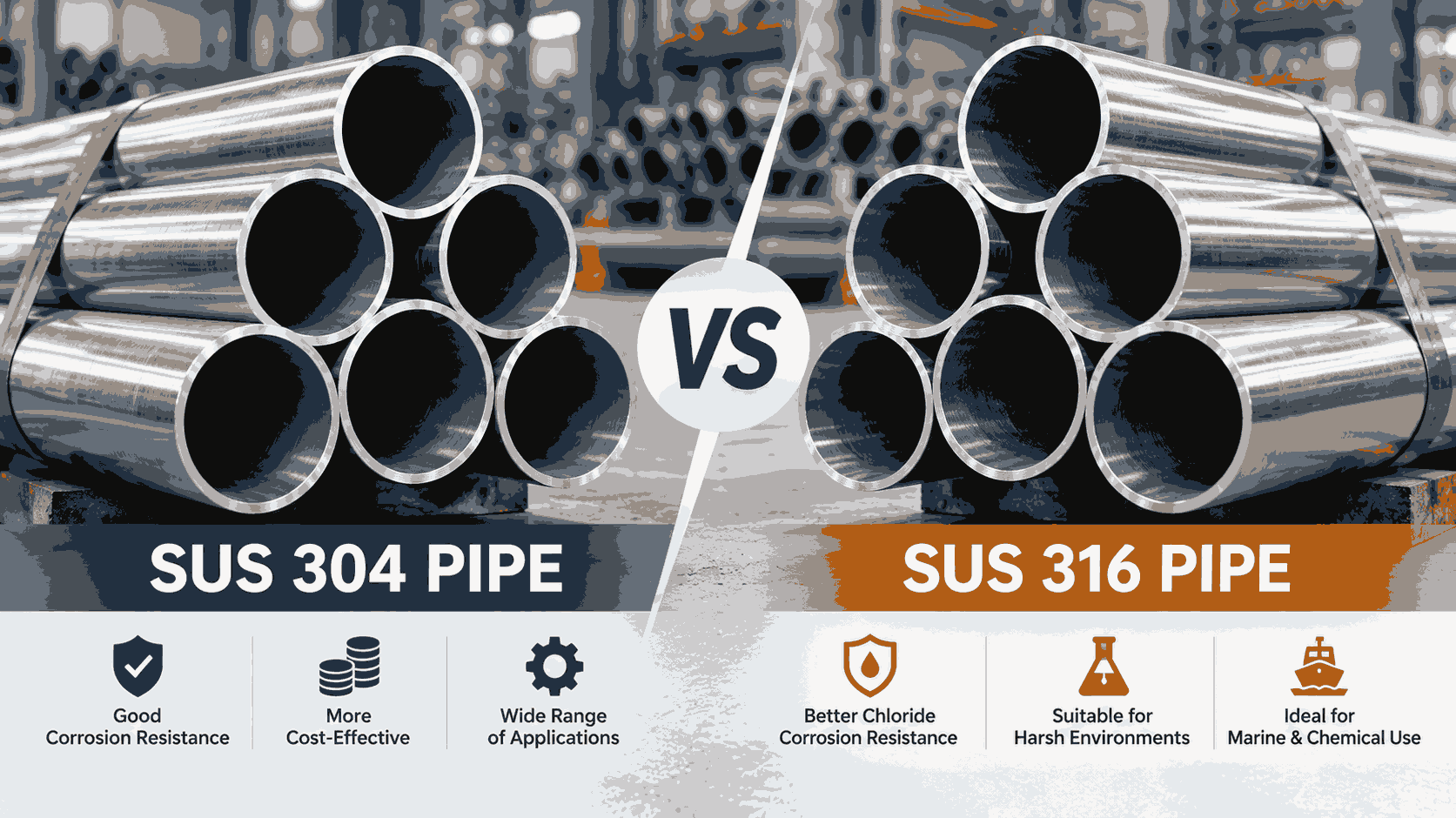
The main difference between SUS 304 pipe and SUS 316 pipe is the addition of molybdenum in SUS 316. This alloying element improves resistance to pitting and crevice corrosion, particularly in environments containing chlorides, such as saltwater and certain chemical solutions.
SUS 304 is commonly used in food processing equipment, general industrial piping and applications where standard corrosion resistance is sufficient. SUS 316 is often preferred for marine installations, chemical processing and other environments where greater resistance to localized corrosion is required.
In this guide, we compare SUS 304 pipe vs SUS 316 pipe, covering their composition, properties, applications, cost considerations and key selection factors to help engineers, contractors and procurement professionals make an informed decision.
What Is SUS 304 Stainless Steel Pipe?
SUS 304 is a widely used austenitic stainless steel grade designated under Japanese Industrial Standards (JIS). It is commonly associated with Type 304 stainless steel and the UNS designation S30400.
SUS 304 contains chromium and nickel, which help form a passive surface layer that protects the metal from corrosion in many everyday and industrial environments.
Its combination of formability, weldability and general corrosion resistance makes it suitable for a wide range of applications.
Key Properties of SUS 304 Pipe
- Corrosion resistance: Suitable for many general-purpose applications involving water, atmospheric exposure and various process environments.
- Formability: Can be formed into different shapes using appropriate fabrication methods.
- Weldability: Generally offers good weldability when suitable procedures and filler materials are used.
- Surface finish: Available in different finishes depending on manufacturing and application requirements.
- Cost considerations: Often provides a more economical option than SUS 316 when its corrosion resistance is sufficient.
Common Applications of SUS 304 Pipe
SUS 304 stainless steel pipes and tubes are commonly used in:
- Food processing and beverage equipment
- Kitchen and catering equipment
- General industrial piping
- Water distribution and utility systems
- Architectural and fabrication applications
- Pharmaceutical equipment, where the grade meets the required hygiene and process specifications
For product-related information, explore Leoscor Alloy Pipes’ SUS 304 stainless steel tubes.
What Is SUS 316 Stainless Steel Pipe?
SUS 316 is another austenitic stainless steel grade. It is commonly associated with Type 316 stainless steel and the UNS designation S31600.
Like SUS 304, SUS 316 contains chromium and nickel. Its defining characteristic is the addition of approximately 2–3% molybdenum, which improves its resistance to pitting and crevice corrosion in chloride-containing environments.
This makes SUS 316 a useful material choice for applications where SUS 304 may experience localized corrosion.
Key Properties of SUS 316 Pipe
- Improved chloride resistance: Generally provides better resistance to chloride-induced pitting and crevice corrosion than SUS 304.
- Industrial versatility: Used in selected marine, chemical and process applications.
- Fabrication capability: Can be welded and fabricated using suitable procedures.
- Chemical resistance: Offers improved resistance in certain chemical environments, although suitability depends on the specific chemical, concentration and temperature.
- Cost considerations: Usually costs more than SUS 304 because of its alloying composition.
Common Applications of SUS 316 Pipe
SUS 316 stainless steel pipes are commonly considered for:
- Marine equipment and selected coastal installations
- Chemical processing systems
- Pharmaceutical and biotechnology equipment
- Food and beverage processing involving more aggressive cleaning conditions
- Brine and chloride-containing process systems
- Industrial piping exposed to corrosive environments
The correct grade must always be selected after reviewing the operating environment and applicable material specifications. SUS 316 is not immune to corrosion and may not be suitable for every seawater or chemical application.
SUS 304 Pipe vs SUS 316 Pipe: Key Differences
The following table highlights the main differences between the two stainless steel grades.
| Comparison factor | SUS 304 Pipe | SUS 316 Pipe |
|---|---|---|
| Material type | Austenitic stainless steel | Austenitic stainless steel |
| UNS designation | S30400 | S31600 |
| Chromium content | Typically 18–20% | Typically 16–18% |
| Nickel content | Typically 8–10.5% | Typically 10–14% |
| Molybdenum | Generally not intentionally added | Typically 2–3% |
| General corrosion resistance | Good in many environments | Good, with improved resistance in certain aggressive environments |
| Chloride resistance | Lower than SUS 316 | Generally better than SUS 304 |
| Fabrication | Good with suitable procedures | Good with suitable procedures |
| Relative material cost | Usually lower | Usually higher |
| Typical selection | General-purpose industrial applications | Applications requiring greater resistance to localized corrosion |
Note: These composition ranges are general reference values for common grades. Exact limits depend on the applicable material standard and grade specification.
1. Chemical Composition: SUS 304 vs SUS 316
Chemical composition is one of the most important differences between SUS 304 and SUS 316 stainless steel pipes.
Both grades use chromium to form a protective passive layer and nickel to support their austenitic structure and corrosion performance. SUS 316 also contains molybdenum, which improves its resistance to localized corrosion in chloride-containing environments.
For many buyers, this additional molybdenum is the main reason to consider SUS 316 over SUS 304.
However, chemical composition should not be the only selection factor. The intended service, operating temperature, fabrication requirements and relevant material standard must also be considered.
2. Corrosion Resistance: Which Pipe Performs Better?
Corrosion resistance is often the deciding factor when comparing SUS 304 pipe vs SUS 316 pipe.
SUS 304 Corrosion Resistance
SUS 304 performs well in many general industrial and atmospheric environments. It is widely used in food processing, equipment manufacturing and applications involving relatively mild operating conditions.
However, exposure to chlorides can cause pitting or crevice corrosion under certain conditions. Risk depends on chloride concentration, temperature, surface condition, deposits and exposure duration.
SUS 316 Corrosion Resistance
SUS 316 generally provides better resistance to chloride-related pitting and crevice corrosion because of its molybdenum content.
It may therefore be a better choice for brine systems, selected marine applications and industrial processes where localized corrosion is a concern.
However, severe chloride exposure can still cause corrosion in SUS 316. More demanding applications may require a higher-alloy stainless steel or another corrosion-resistant material.
Which is better? SUS 316 is generally preferred when chloride resistance is a key requirement. SUS 304 remains suitable for many applications where its corrosion performance meets the design requirements.
3. Strength and Mechanical Properties
Both SUS 304 and SUS 316 belong to the austenitic stainless steel family. Their mechanical properties can be similar, and neither grade should be assumed to be universally stronger than the other.
Actual tensile strength, yield strength, hardness and elongation depend on the product form, manufacturing route, heat treatment and applicable standard.
For piping applications, pressure capacity is also influenced by the outside diameter, wall thickness, design temperature, allowable stress and relevant piping code.
Before selecting a pipe for pressure service, verify the specified mechanical properties and dimensional requirements rather than relying on the grade name alone.
4. Temperature Performance
SUS 304 and SUS 316 are used in a range of industrial temperature conditions, but the suitable operating limits depend on the application and governing specification.
Temperature can influence material strength, oxidation behaviour and corrosion mechanisms. In chloride-containing environments, increasing temperature can also increase the risk of localized corrosion.
For high-temperature service, low-temperature service or critical pressure applications, consult the applicable material data and engineering design requirements before choosing either grade.
5. SUS 304 Pipe vs SUS 316 Pipe: Cost Difference
SUS 304 is generally more economical than SUS 316 because SUS 316 contains molybdenum and typically has a different nickel content.
However, the actual price difference varies with raw material prices, pipe dimensions, wall thickness, manufacturing method, finish, testing requirements, quantity and supplier availability.
SUS 304 may be a cost-effective choice for applications where its corrosion resistance is sufficient. SUS 316 may offer better long-term value when the environment requires greater resistance to localized corrosion.
When comparing quotations, consider the total cost of ownership, including inspection, maintenance, replacement and downtime—not just the initial purchase price.
6. SUS 304 vs SUS 316: Applications by Industry
Food and Beverage Industry
SUS 304 is commonly used for food processing equipment, storage systems and general-purpose piping where the process conditions are suitable.
SUS 316 may be preferred when equipment is exposed to more aggressive cleaning chemicals or chloride-containing solutions. The final choice must meet the required hygienic and process standards.
Chemical Processing Industry
Chemical compatibility is essential when selecting a pipe for chemical processing.
SUS 304 can be suitable for certain process fluids, while SUS 316 may perform better in some chloride-containing or aggressive environments. Neither grade is universally resistant to all chemicals.
Marine and Coastal Applications
SUS 316 generally offers better resistance to chloride-related pitting than SUS 304. It may therefore be preferred for selected coastal and marine applications.
For continuous seawater exposure or severe marine service, engineers should assess whether a higher-alloy stainless steel or another material is necessary.
Pharmaceutical and Biotechnology Industry
Both grades may be used in equipment and piping systems, depending on process requirements. Material selection should consider cleanability, surface finish, chemical exposure, weld quality and applicable industry standards.
General Manufacturing
SUS 304 is often used in fabricated equipment, machinery and general industrial piping. SUS 316 is considered when additional corrosion resistance justifies the higher material cost.
How to Choose Between SUS 304 Pipe and SUS 316 Pipe
Before placing an order, review these factors:
- Operating environment: Identify the fluid, chloride concentration, chemical exposure and surrounding conditions.
- Temperature and pressure: Confirm the design conditions and required pipe dimensions.
- Material specification: Verify the correct JIS, ASTM, ASME or other applicable standard.
- Fabrication requirements: Consider welding, forming, surface finish and post-weld treatment.
- Corrosion risk: Assess pitting, crevice corrosion and other potential failure mechanisms.
- Budget and lifecycle cost: Compare the purchase price with expected maintenance and replacement requirements.
- Documentation: Confirm material test certificates, traceability and required inspection reports.
For welded piping in corrosive service, the low-carbon grades SUS 304L or SUS 316L may be appropriate, depending on the material specification and welding requirements.
Why Source Stainless Steel Pipes from Leoscor Alloy Pipes?
Leoscor Alloy Pipes supplies stainless steel and other industrial pipe and tube products for a range of engineering and industrial applications.
When sourcing SUS 304 or SUS 316 materials, buyers should confirm the required grade, product form, dimensions, applicable standard and documentation before finalising an order.
To help evaluate your requirement, prepare the following information:
- SUS 304 or SUS 316 grade
- Pipe or tube specification
- Outside diameter and wall thickness
- Required length and quantity
- Testing and certification requirements
- Delivery location and expected schedule
Visit the SUS 304 stainless steel tubes page for related product information, or contact Leoscor Alloy Pipes to discuss your stainless steel pipe requirements.
Conclusion
The choice between SUS 304 pipe and SUS 316 pipe depends mainly on corrosion resistance, operating conditions, applicable standards and overall project cost.
SUS 304 is widely used in general-purpose industrial applications because it combines useful corrosion resistance with fabrication versatility and a comparatively economical material cost.
SUS 316 contains molybdenum, which generally improves resistance to chloride-induced pitting and crevice corrosion. This makes it a strong candidate for selected marine, chemical and other more demanding environments.
Neither grade is automatically the best option for every application. Engineers and procurement teams should evaluate the service environment, design conditions and required material specification before making a final decision.
For help sourcing stainless steel pipes, contact Leoscor Alloy Pipes with your grade, dimensions, quantity and project requirements.
Frequently Asked Questions
1. What is the main difference between SUS 304 pipe and SUS 316 pipe?
The main difference is that SUS 316 contains approximately 2–3% molybdenum, which generally improves its resistance to chloride-induced pitting and crevice corrosion compared with SUS 304.
2. Is SUS 316 better than SUS 304?
SUS 316 is generally better for applications requiring improved resistance to chloride-related corrosion. SUS 304 is often sufficient for general-purpose applications and usually costs less. The right choice depends on the operating environment.
3. Which is more expensive, SUS 304 or SUS 316 pipe?
SUS 316 is generally more expensive because of its alloying composition. Actual prices depend on dimensions, product form, manufacturing requirements, market conditions and order quantity.
4. Can SUS 304 pipe be used in marine environments?
SUS 304 can be used in some marine-related applications where exposure conditions are controlled, but it is more susceptible to chloride-induced pitting than SUS 316. The material should be selected after assessing the actual exposure conditions.
5. Is SUS 316 pipe suitable for seawater?
SUS 316 offers improved chloride resistance compared with SUS 304, but it can still suffer localized corrosion in seawater. Continuous seawater service may require a more corrosion-resistant alloy, depending on temperature, flow, design and exposure conditions.
6. Are SUS 304 and SUS 316 pipes equally strong?
Their mechanical properties can be similar, but actual values depend on the product form, condition and applicable specification. Pressure capacity must be calculated using the relevant design requirements.
7. What is the difference between SUS 304 and SUS 304L?
SUS 304L is a low-carbon variant of SUS 304. Its lower carbon content helps reduce the risk of sensitization during welding, making it useful for certain welded applications.
8. What is the difference between SUS 316 and SUS 316L?
SUS 316L is the low-carbon variant of SUS 316. It is commonly considered for welded components where reducing the risk of sensitization is important.
9. How do I select the correct stainless steel pipe grade?
Consider the fluid composition, chloride exposure, operating temperature, pressure, pipe dimensions, fabrication requirements and applicable material standards. For critical service, consult a qualified materials or piping engineer.
10. Where can I source SUS 304 and SUS 316 stainless steel pipes?
Contact Leoscor Alloy Pipes with your required grade, dimensions, quantity and applicable specification to discuss product availability and quotation requirements.